
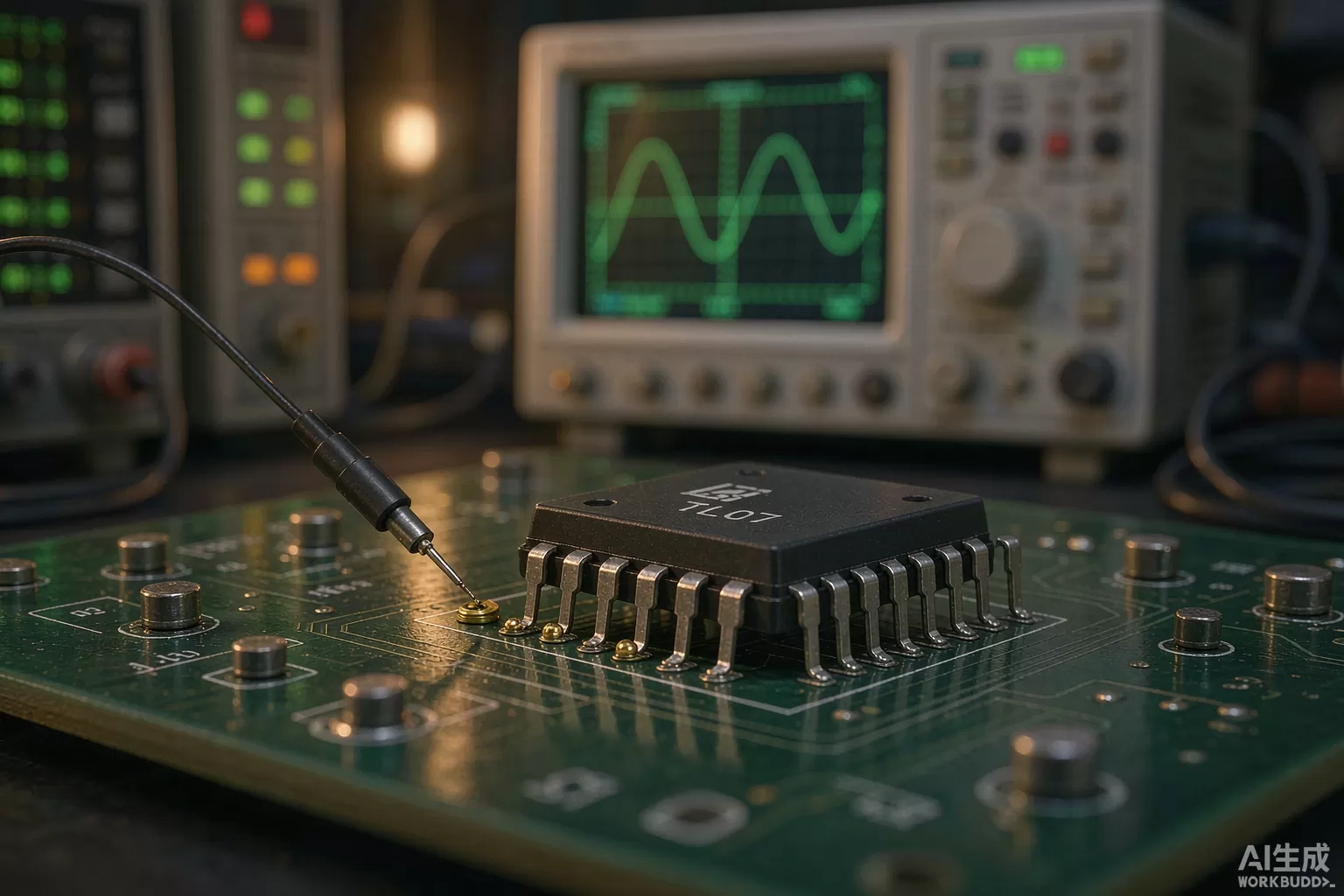
As an independent distributor we stock a wide range of COSINE precision amplifiers and other precision analog devices, and the question we hear most from design engineers is simple: how do you keep an op-amp's offset from wrecking a sensor reading taken months apart? The answer for the hardest cases is a zero-drift operational amplifier.
Why offset and drift matter
A conventional precision op-amp may spec an input offset voltage of 50–500 µV and a drift of a few µV/°C. Across a 50°C swing and a year of aging, that becomes a measurement error no calibration at the factory can fully remove. Zero-drift architectures attack exactly this: they measure the amplifier's own offset continuously and subtract it, holding effective Vos to single-digit µV and drift near zero.
Two ways to cancel offset
Auto-zero periodically connects the input to a nulled internal capacitor, samples the residual offset, and subtracts it on the next phase. It is simple and adds no clock-related output ripple, but produces a small correction glitch at each sampling instant. Chopper stabilization modulates the signal to a high frequency, amplifies, then demodulates — the offset is shifted out of band and filtered away. It gives the lowest drift but can leave a small ripple at the chop frequency that must be filtered.
Where to use them
Zero-drift op-amps are the right choice whenever the signal of interest is tiny and slow: strain-gauge and load-cell bridges, thermocouple and RTD conditioning, current-shunt monitoring, and pH or optical sensors. Their very low 1/f noise also helps low-frequency measurements. For higher-frequency or wideband paths, a low-noise or high-speed part is usually a better fit.
Among the COSINE amplifier portfolio we carry, parts such as COS8551, COS4333, COS2388 and COS2180 are built on zero-drift architectures spanning supply voltages from 5 V to 36 V — covering portable instruments through industrial loops.
Alternative & Cross-Reference Parts (for reference)
The devices below are commonly used industry parts in the same functional class. They are listed for identification and compatibility-engineering reference only. A cross-reference is not a guarantee of pin-to-pin or 100% functional equivalence — package, pinout, electrical parameters and temperature drift can differ between devices. Always verify against the original manufacturer's datasheet before substituting any part.
| Manufacturer | Typical part(s) | Class / note |
|---|---|---|
| Analog Devices | ADA4528 / ADA4522 | Precision zero-drift, ~5.5 MHz, low noise |
| Analog Devices | AD8551 / AD8552 / AD8554 | Chopper-stabilized, single/dual/quad |
| Texas Instruments | OPA333 / OPA335 | Sub-µA zero-drift, RRIO |
| Texas Instruments | LMP2021 / LMP2011 | Zero-drift, EMI-hardened |
| Maxim Integrated | MAX4238 / MAX4239 | Auto-zero, ultra-low offset |
| Microchip | MCP6V01 / MCP6V11 | Auto-zero, low power |
Mentioned brands (Analog Devices®, Texas Instruments®, Maxim Integrated®, Microchip®, STMicroelectronics®) are trademarks of their respective owners. Jingteng Electronics is an independent distributor and is not affiliated with, authorized by, or an agent of any semiconductor manufacturer.
Related COSINE Precision Amplifiers In Stock
| Part number | |
|---|---|
| COS8551 zero-drift | Check stock & quote |
| COS4333 zero-drift | Check stock & quote |
| COS2388 zero-drift | Check stock & quote |
| COS2180 36V zero-drift | Check stock & quote |
Frequently Asked Questions
What does 'zero-drift' actually mean?
It means the amplifier continuously measures and cancels its own input offset voltage and its temperature drift, so the effective Vos stays in the low-microvolt range and drift approaches zero over temperature and time.
Auto-zero or chopper — which is better?
Neither is universally better. Chopper parts have the lowest drift and no sampling artifacts but can introduce ripple at the clock frequency; auto-zero parts avoid that ripple but add small input glitches at the correction instant. Choose by which artifact your signal chain tolerates better.
Are these drop-in replacements for standard op-amps?
Functionally yes for many positions, but verify bandwidth, noise, supply range and package. A cross-reference is not a pin-to-pin guarantee — always confirm against the original datasheet before substitution.
Recommended next steps
If you are sourcing any of the parts mentioned in this guide, we can help you confirm stock, pricing, and lead times quickly.
- Upload your BOM — send your full parts list and receive a consolidated quote within 2 business hours.
- Browse related in-stock lines: Amplifiers / Data Conversion · Power Management ICs.
- Contact our team for hard-to-find or end-of-life components.
Trademark & Cross-Reference Notice
COSINE (科山芯创) is a registered trademark of its respective owner. References on this page to COSINE part numbers, and any comparison to devices from other manufacturers, are provided for identification and compatibility-engineering purposes only, indicating the function, package and parametric class a given part belongs to. Jingteng Electronics (Shenzhen) is an independent distributor, not an authorized agent or affiliate of COSINE or any other semiconductor manufacturer. A cross-reference does not imply pin-to-pin or 100% functional equivalence; before substituting any device, verify the package, pinout, electrical parameters and the original datasheet. Product availability, pricing and date code are confirmed at quotation.
About Jingteng Electronics
Jingteng Electronics (Shenzhen Jingteng Electronics Technology Co., Ltd.) is an independent distributor of electronic components, focused on hard-to-find and obsolete ICs, analog and mixed-signal devices. We source through long-verified, traceable channels and support BOM matching, small-lot sampling and volume inquiries. Contact us for a quote, or upload your BOM for a consolidated quote.
