
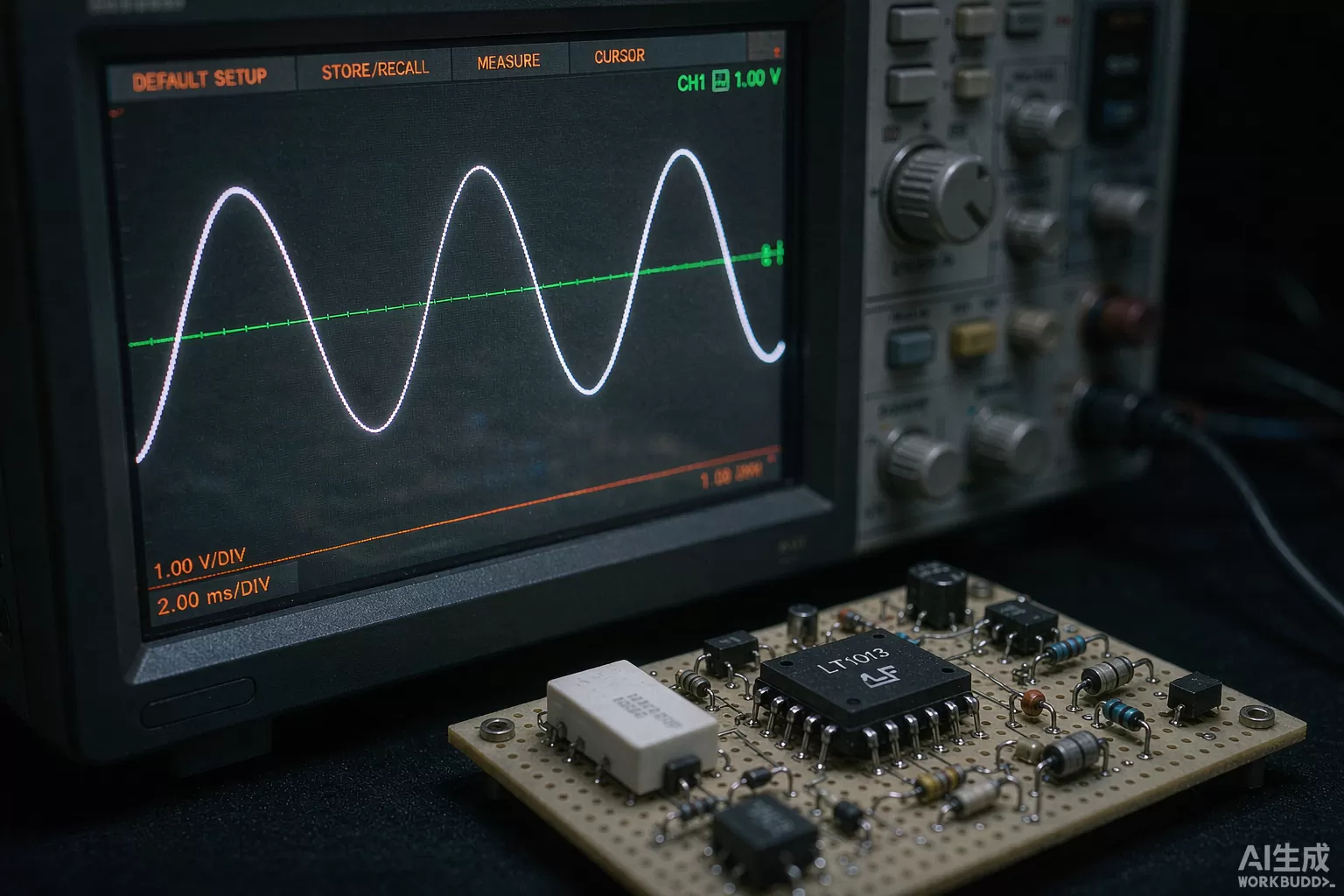
A low-noise operational amplifier is only as good as your understanding of where its noise comes from. Vendors quote a single headline number — often around 4–10 nV/√Hz — but the real behavior lives in the noise spectral density curve.
The two regions of the curve
Every op-amp noise plot has a white-noise floor (flat, given in nV/√Hz) and a 1/f region that climbs toward DC, meeting the floor at the corner frequency. For audio and AC designs the white floor dominates; for DC and low-frequency sensor conditioning the 1/f region is usually the bigger problem.
From density to total noise
Total RMS noise is the square root of the noise density integrated over your bandwidth (plus the current-noise contribution multiplied by source resistance, added in quadrature). Doubling bandwidth raises wideband noise by √2; halving it cuts noise by the same factor — so bandwidth limiting is the cheapest noise reduction available.
Picking the part
Match the part to the signal band and source impedance: low source resistance and AC content favor a low white-noise floor; high source resistance or DC content favor a low 1/f corner and low current noise. Within the COSINE amplifier portfolio we stock, COS724, COS722, COS721 and COS2374 are low-noise options spanning general-purpose through high-precision signal conditioning.
Remember that resistor noise (Johnson noise, 4kTR) scales with resistance — a 100 kΩ feedback resistor can easily dwarf a good op-amp's input noise, so keep impedances low or use a low-noise topology before blaming the amplifier.
Alternative & Cross-Reference Parts (for reference)
The devices below are commonly used industry parts in the same functional class. They are listed for identification and compatibility-engineering reference only. A cross-reference is not a guarantee of pin-to-pin or 100% functional equivalence — package, pinout, electrical parameters and temperature drift can differ between devices. Always verify against the original manufacturer's datasheet before substituting any part.
| Manufacturer | Typical part(s) | Class / note |
|---|---|---|
| Texas Instruments | OPA211 / OPA2211 | 1.1 nV/√Hz, precision/audio |
| Texas Instruments | OPA827 | Low-noise FET-input |
| Analog Devices | ADA4898 / AD797 | Ultra-low-noise |
| Analog Devices | OP27 / OP37 | Classic low-noise |
| Texas Instruments | LME49720 / NE5532 | Low-noise audio |
| Analog Devices | ADA4075 | Low-noise, high speed |
Mentioned brands (Analog Devices®, Texas Instruments®, Maxim Integrated®, Microchip®, STMicroelectronics®) are trademarks of their respective owners. Jingteng Electronics is an independent distributor and is not affiliated with, authorized by, or an agent of any semiconductor manufacturer.
Related COSINE Precision Amplifiers In Stock
| Part number | |
|---|---|
| COS724 low-noise | Check stock & quote |
| COS722 low-noise | Check stock & quote |
| COS721 low-noise | Check stock & quote |
| COS2374 low-noise | Check stock & quote |
Frequently Asked Questions
What is 1/f noise and why does it matter?
1/f (pink) noise rises at low frequency and dominates below the corner frequency, often around 10–100 Hz. For DC and low-frequency sensor measurements it is usually the dominant error source, which is why low-frequency designs need parts with a low 1/f corner.
How do I combine voltage and current noise?
They are independent and add in quadrature (RMS). Current noise becomes important when source resistance is high, because it multiplies by that resistance — a part with great voltage noise but poor current noise can still fail with a megohm-scale source.
Is a lower nV/√Hz number always better?
Only for the bandwidth and source impedance of your design. A part with 4 nV/√Hz and a high 1/f corner can underperform a 8 nV/√Hz part with a low corner in a DC measurement. Match the spec to the actual signal band.
Recommended next steps
If you are sourcing any of the parts mentioned in this guide, we can help you confirm stock, pricing, and lead times quickly.
- Upload your BOM — send your full parts list and receive a consolidated quote within 2 business hours.
- Browse related in-stock lines: Amplifiers / Data Conversion · Power Management ICs · Sensors / Optoelectronic Devices.
- Contact our team for hard-to-find or end-of-life components.
Trademark & Cross-Reference Notice
COSINE (科山芯创) is a registered trademark of its respective owner. References on this page to COSINE part numbers, and any comparison to devices from other manufacturers, are provided for identification and compatibility-engineering purposes only, indicating the function, package and parametric class a given part belongs to. Jingteng Electronics (Shenzhen) is an independent distributor, not an authorized agent or affiliate of COSINE or any other semiconductor manufacturer. A cross-reference does not imply pin-to-pin or 100% functional equivalence; before substituting any device, verify the package, pinout, electrical parameters and the original datasheet. Product availability, pricing and date code are confirmed at quotation.
About Jingteng Electronics
Jingteng Electronics (Shenzhen Jingteng Electronics Technology Co., Ltd.) is an independent distributor of electronic components, focused on hard-to-find and obsolete ICs, analog and mixed-signal devices. We source through long-verified, traceable channels and support BOM matching, small-lot sampling and volume inquiries. Contact us for a quote, or upload your BOM for a consolidated quote.
