
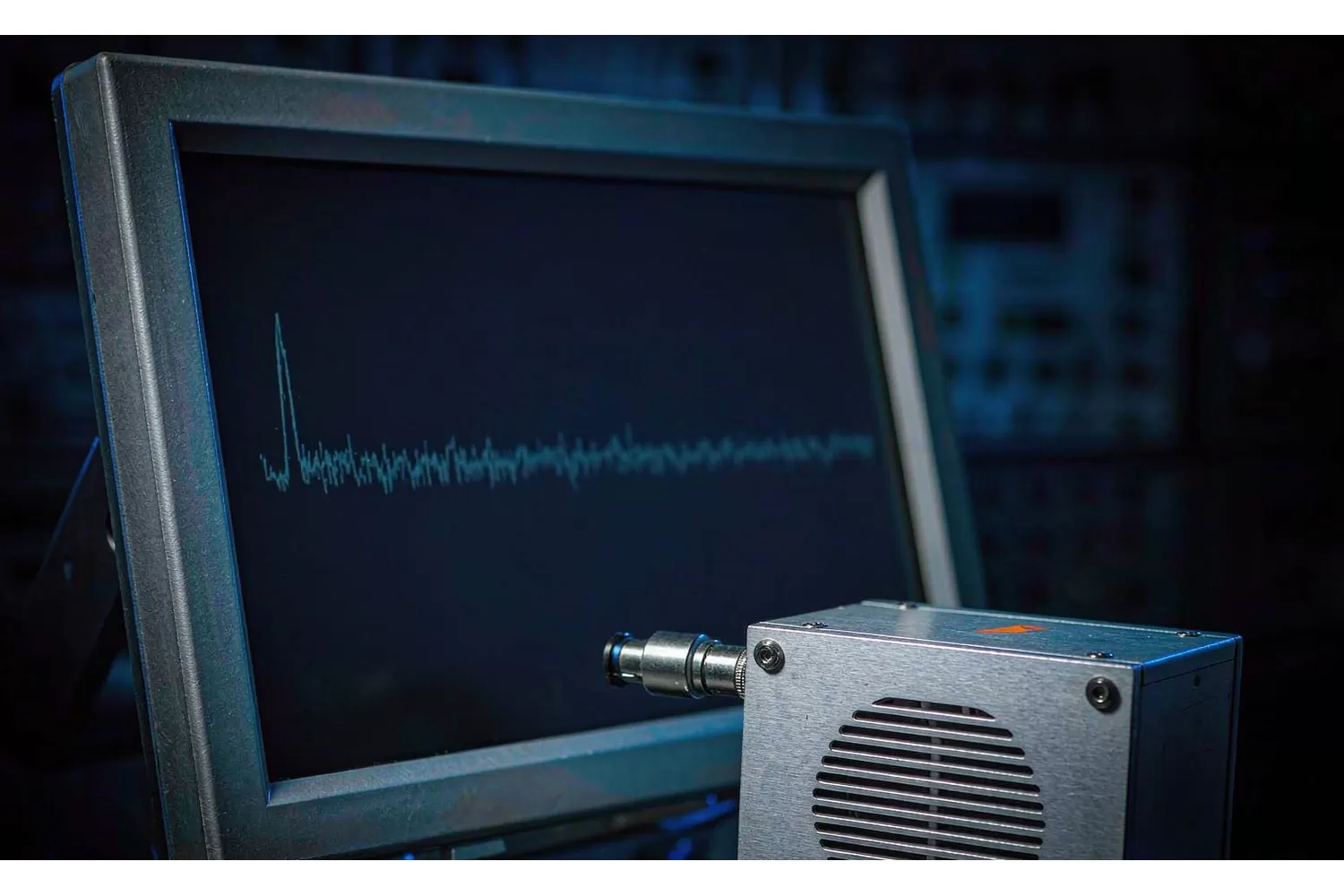
Noise is the specification people compare most casually and get wrong most often. Datasheet vendors highlight voltage noise spectral density, because it is a single impressive number. But the noise your circuit actually sees depends on three terms that add in quadrature, and which of them dominates is decided by your source impedance and your bandwidth — neither of which is a property of the amplifier.

The three contributors
- Amplifier voltage noise en, in nV/√Hz. It appears in series with the input and is amplified with the signal. Dominant when the source impedance is low.
- Amplifier current noise in, in fA/√Hz. It flows through the impedance seen at each input and generates a voltage. It scales with source impedance, so it dominates in high-impedance circuits.
- Thermal noise of the source, 4kTR, which sets a floor you cannot design below no matter which amplifier you choose.
Total input-referred noise density is approximately the root sum of squares:
etotal = √( en2 + (in × Rsource)2 + 4kTRsource )
Source impedance decides the winner
| Source impedance | Dominant term | What to prioritise |
|---|---|---|
| Under 100 Ω (shunts, low-value bridges) | Amplifier voltage noise | Low en, low offset drift |
| Around 1 kΩ | Voltage noise and thermal noise comparable | Balance both; do not ignore thermal |
| 10 kΩ to 1 MΩ (photodiode, high-value bridge) | Current noise through Rsource | Low in: CMOS or JFET input stage |
| Above 1 MΩ | Current noise and thermal noise | Electrometer-class input, guard layout |
Bandwidth: the multiplier nobody calculates
Density is not total noise. To get the RMS noise you multiply by the square root of the effective noise bandwidth, which for a single-pole response is about 1.57 times the −3 dB bandwidth. Then you multiply by the noise gain of the stage and compare the result with the signal you must resolve.
This is where substitutions go wrong. A replacement with 20% lower voltage noise but 30% more bandwidth is not quieter at all; it is noisier, because the bandwidth term grows faster than the density term falls. And a part with a worse 1/f corner will be worse in a slow, high-resolution measurement even if its broadband number looks better on the front page.
Putting a cost on it
The substitution question is not "is the noise figure lower?" but "does the change stay inside the resolution the product promises?" Three practical rules:
- Compute both candidates at your real source impedance. A single amplifier can be excellent in one circuit and poor in another; the datasheet does not decide this, your source impedance does.
- Work backwards from one LSB. If the change moves total noise by less than a third of an LSB at the resolution that matters, it is not worth a re-design. If it eats half your headroom above the signal, it is not a substitution at all.
- Watch the low-frequency band. In weighing, temperature measurement and other DC-adjacent applications, the 0.1–10 Hz band is the specification to compare, and the 1/f corner is what sets it.
| Model | Noise position | Suited to | Link |
|---|---|---|---|
| COS721SR | Low noise, single | Low-impedance precision front ends | COS721SR |
| COS722SR | Low noise, dual | Two-channel audio and instrumentation chains | COS722SR |
| COS724SR | Low noise, quad | Multi-channel acquisition with shared reference | COS724SR |
| COS2374SR | Low noise, low bias current | Higher-impedance sensor conditioning | COS2374SR |
Browse the range in amplifiers and data conversion, or send us the source impedance, the bandwidth and the smallest signal you need to resolve. We will tell you which noise term actually dominates before anyone quotes a replacement.
我们作为独立分销商保证所供元器件为原装正品,并提供日期码与检验选项,助您在量大量前完成验证。
价格随采购数量与行情流动,所示价格仅供参考。欢迎询价获取实时报价,量大从优。
About us & trademarks: JTDZ Tech (Shenzhen Jinteng Electronics Technology Co., Ltd.) is an independent distributor of electronic components. We are not an authorised distributor or representative of the manufacturers named in this article. Manufacturer and part names are used for indicative purposes only, to help identify the components discussed and the parts they are commonly compared with; all trademarks remain the property of their respective owners. Always verify specifications against the manufacturer's datasheet before design-in or purchase.
