
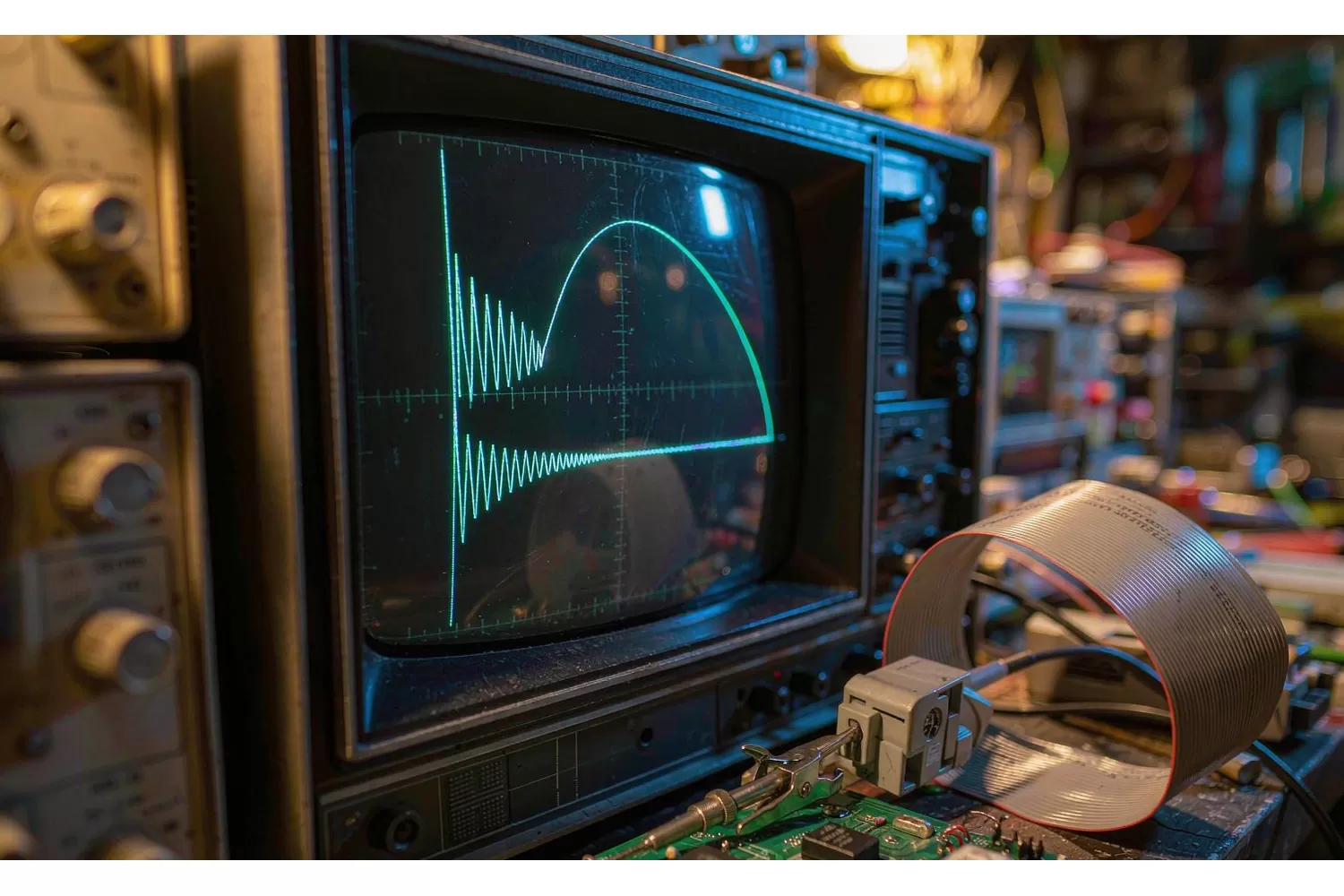
An amplifier that oscillates is the most expensive kind of substitution failure, because it passes bench testing and fails in the field. It is also the least mysterious once you think in terms of loop phase rather than part numbers. This article covers the underlying mechanism — phase margin, noise gain and the capacitive load pole — and why a swap that looks electrically identical can turn a stable design into a marginal one.

Stability is a loop property, not a part property
An op-amp is stable on its own. What oscillates is the feedback loop you build around it. Loop stability depends on how much phase shift accumulates before the loop gain crosses unity, and the margin left over is the phase margin. Below roughly 45° of margin you see overshoot and ringing; at zero you get a sustained oscillation.
The critical detail is that the loop is not evaluated at the signal gain. It is evaluated at the noise gain, the gain seen by a signal injected at the amplifier's own input:
noise gain = 1 + Zf / Zg
A follower has unity noise gain and is actually the hardest common configuration to stabilise, because the full input capacitance of the amplifier and any source capacitance sits directly at the summing node with no attenuation. An inverting stage with signal gain of 1 has a noise gain of 2 and is more forgiving.
The capacitive load pole
Every amplifier has a non-zero output impedance. Put a cable, a filter capacitor or an ADC sampling network on the output, and that impedance and capacitance form an RC low-pass. In a follower the output drives the load directly and the feedback is taken after that network, so the extra pole lands inside the loop and eats phase margin.
| Symptom | Likely cause | First fix to try |
|---|---|---|
| Bursts of oscillation at a few hundred kHz | Capacitive load, low phase margin | Series isolation resistor, 10–50 Ω |
| Peaking in the frequency response | Insufficient phase margin at the noise gain | Reduce feedback capacitor, adjust gain |
| Instability only with a long cable attached | Cable capacitance raising the load pole | Isolation resistor plus back-termination |
| Oscillation that appears only when cold or hot | Marginal margin, parameter drift | Stop substituting; re-check margin at temperature |
| Rectangular oscillation at the slew limit | Slew-rate limited loop recovery | Check GBW and compensation, not just the part |
Why a substitute can oscillate in a stable board
Three parameters decide whether the same circuit stays stable with a different amplifier, and none of them appear in a pin-compatible cross-reference:
- Open-loop output impedance. A higher output impedance shifts the load pole down in frequency and reduces margin.
- Gain bandwidth product and the internal compensation. A faster part moves the crossover frequency up into a region where your layout parasitics matter.
- Input capacitance. At high source impedance this adds a pole at the inverting node, an effect that is invisible until it is not.
This is why we advise treating any substitution in a stage that drives a cable, a filter or an ADC input as a stability re-qualification, not a drop-in. It is a two-hour bench job with a scope and a step input, and it is far cheaper than discovering the problem in a customer's cabinet.
What the fix costs
A series isolation resistor is a fraction of a cent and costs a little DC accuracy at the load. A feedback capacitor costs bandwidth. A snubber costs two components and some board area. Compare that with the cost of a field return, or of a redesign two weeks before a production ramp, and the arithmetic is not close: when stability margin is thin, the correct engineering decision is usually to keep the part the circuit was validated with and take the cost saving somewhere it is genuinely free.
| Model | Positioning | Note for loop stability | Link |
|---|---|---|---|
| COS8092MR | 5 V high-speed, dual | Higher bandwidth — check crossover with layout parasitics | COS8092MR |
| COS2177SR | 36 V precision, dual | Higher voltage, moderate speed — generous margin | COS2177SR |
| COS8054SOP | 5 V high-speed, quad | Multi-channel, shared supply decoupling matters | COS8054SOP |
| COS6004SR | Micro-power, quad | Lower bandwidth — usually the more forgiving substitute | COS6004SR |
Browse the range in amplifiers and data conversion. If you are substituting into a stage that drives anything capacitive, tell us the load and the cable length and we will flag which candidates need a compensation change before you commit.
我们作为独立分销商保证所供元器件为原装正品,并提供日期码与检验选项,助您在量大量前完成验证。
价格随采购数量与行情流动,所示价格仅供参考。欢迎询价获取实时报价,量大从优。
About us & trademarks: JTDZ Tech (Shenzhen Jinteng Electronics Technology Co., Ltd.) is an independent distributor of electronic components. We are not an authorised distributor or representative of the manufacturers named in this article. Manufacturer and part names are used for indicative purposes only, to help identify the components discussed and the parts they are commonly compared with; all trademarks remain the property of their respective owners. Always verify specifications against the manufacturer's datasheet before design-in or purchase.
