
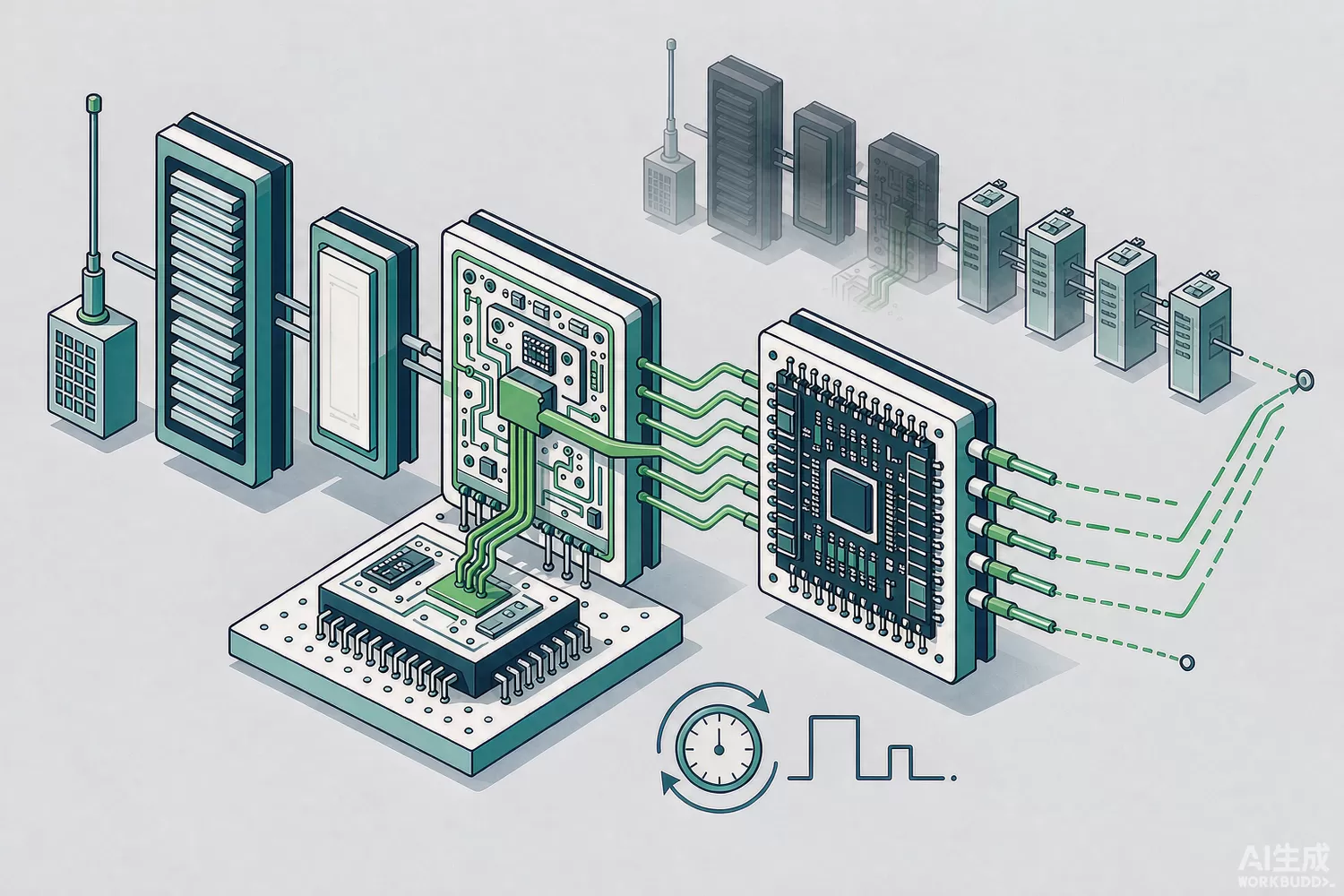
For decades the rule was that you cannot digitise what you have not already down-converted. RF-sampling converters broke that rule: with several gigasamples per second and gigahertz of analogue input bandwidth, they let the antenna signal, or a wide slice of the spectrum, be digitised directly. Since then the architecture of high-performance radios has been quietly rearranging itself around the converter rather than around the mixer.

Application logic: what changes when the converter moves forward
In a conventional superheterodyne or low-IF receiver, each band needs its own analogue mixing stage, its own local oscillator and its own filters, and the analogue chain consumes most of the board. With direct RF sampling, the analog front end shrinks to a low-noise amplifier, a band filter and possibly a balun, because the converter's own input bandwidth covers the band of interest. After that everything is digital: down-conversion, channel filtering, decimation and correction are performed in programmable logic, so a product can change band or channel count with a firmware image.
Three consequences follow. First, spurious performance becomes an architectural issue: with several gigahertz of instantaneous bandwidth, harmonics and interleaving spurs that would previously have been filtered now fall in band, so the converter's spectral purity and its interleaving correction decide the usable bandwidth. Second, clocking becomes the hardest part of the design. Converter signal-to-noise ratio is only as good as the clock's jitter, which is why RF-sampling systems almost always pair the converter with a jitter-cleaning clock device, and why the clock distribution is treated as an RF circuit. Third, the digital interface stops being a detail: a JESD204B/C link at 10 to 30 gigabits per second per lane dictates board stack-up, routing and the choice of host device, and its synchronisation determines whether several converters can be aligned, which is exactly what phased arrays and multi-channel instruments need.
Where this pays off is where analogue complexity used to be brutal: multi-band base stations, wideband radar and electronic-warfare receivers, satellite gateways, and instrument front ends. Instrument signal chains adopted direct sampling early for the same reason that makes it attractive in production: fewer analogue adjustments and better repeatability. Even the humble analog front ends around microcontrollers use the same vocabulary of reference, settling and effective resolution — see our notes on high-precision ADC front ends on MCUs and on when a lower-resolution converter is still the right choice, which are the same trade-offs at a much smaller scale.
New technology in data conversion for RF
- Direct RF sampling at ever higher input bandwidth, allowing signals in the L, S and C bands to be digitised without a first analogue conversion.
- Interleaving with on-chip calibration, which suppresses the spurs that multi-core time-interleaved architectures would otherwise produce.
- Integrated digital down- and up-conversion, so the host receives decimated baseband and the digital interface carries only useful data.
- JESD204B and JESD204C interfaces with deterministic latency and multi-device synchronisation, the enabler for coherent multi-channel systems.
- Converter-plus-logic integration, where a programmable-logic tile sits next to the converter so that channelisation happens on the same package.
- On-die temperature and voltage monitoring with digital correction, which keeps performance stable across the equipment's temperature range.
Domestic alternatives: what to analyse before switching
- Compare effective number of bits and signal-to-noise ratio at the input frequency you will use, not at the frequency used for the headline figure.
- Ask specifically for spurious-free dynamic range in the presence of a strong adjacent signal, which is the real receiver test.
- Check the analogue input bandwidth against the band you intend to sample directly.
- Verify the lane rate, subclass and synchronisation support of the serial interface against your host device.
- Confirm the clock input requirements and whether the device provides on-chip jitter cleaning or expects a cleaned clock.
- Plan the evaluation around a vendor reference board. At this performance level, board layout and clocking dominate the measured result, and a good reference design removes most of the risk.
Indicative cost comparison: imported originals vs domestic candidates
Price figures below are indicative public-market reference ranges for moderate volumes, compiled from publicly observable listings. They fluctuate with the spot market, package option, grade (industrial, automotive, screened) and order quantity, and must not be read as a quotation. Ask us for a firm price on your exact part numbers and quantities.
| Device class | Common imported reference | Indicative imported unit price | Commonly referenced domestic candidate | Indicative domestic unit price |
|---|---|---|---|---|
| Dual 14-bit 3 GSPS ADC with JESD204B, direct RF sampling | ADI AD9208 class | USD 250–900 | SC1249 (Shanghai Xinchip) / GX9208 (Guoxin Shidai) class, dual 14-bit 3 GSPS | USD 120–480 |
| 12-bit multi-GSPS RF direct-sampling ADC | ADI AD9213-class high-speed ADC | USD 300–1,200 | Chengdu Huawei HWD12B16GA4-class direct-RF-sampling ADC | USD 180–700 |
| Dual 16-bit 12 GSPS DAC with JESD204B | ADI AD9172 class | USD 180–600 | Domestic high-speed DAC families (device-level public information is limited; ask for current status) | USD 90–320 |
| RF-sampling transceiver with integrated DDC/DUC | ADI AD9081 / AD9082 class | USD 400–1,500 | Domestic converter-plus-logic platforms (programme level) | USD 200–800 |
Two cost notes. First, the converter is one of the most expensive parts in a wideband radio, and the domestic price advantage is real at the device level — but the switching cost sits in the digital interface and the reference design, so budget engineering time, not just unit cost. Second, grade and screening matter: at this performance level a cheaper commercial-grade part may not hold specification over industrial temperature, and the qualification cost of discovering that late exceeds the saving. A third practical point: because these designs are clock-limited rather than converter-limited, it is often worth spending the saved converter budget on a better clock device.
Commonly referenced alternative models
| Imported original (reference) | Domestic candidate (public sources) | Why it is referenced |
|---|---|---|
| ADI AD9208 — dual 14-bit 3 GSPS ADC, JESD204B | Shanghai Xinchip SC1249 (dual 14-bit 3 GSPS, 196-ball BGA) and Guoxin Shidai GX9208 (dual 14-bit 3 GSPS, 196-ball BGA) | Both are publicly documented as dual 14-bit 3 GSPS converters with on-chip buffers, fast over-range detection and a JESD204B serial output, aimed at the same direct-sampling role. Validate linearity and spurious performance with your own signal conditions. |
| ADI AD9213-class — multi-GSPS direct RF sampling ADC | Chengdu Huawei HWD12B16GA4-class direct-RF-sampling ADC | Publicly announced as a domestic RF direct-sampling converter aimed at high-speed acquisition. Confirm sample rate, input bandwidth and interface configuration for your application. |
| ADI AD9172-class — dual 16-bit high-speed DAC | Domestic high-speed DAC families (public device-level information is limited) | Cross-referenced for transmit chains that need direct synthesis at RF. Availability and support maturity should be checked device by device before a programme depends on it. |
| ADI AD9081-class — RF-sampling transceiver | Domestic converter-plus-logic platforms and RF-SoC programmes | Same architectural idea: wideband converters with digital processing alongside. Toolchain and IP availability are the deciding factors. |
| Imported wideband ADC plus separate FPGA | Domestic multi-GSPS ADC plus a domestic or imported FPGA | A pragmatic middle path: pair a domestic converter with a proven logic device, which reduces the number of new variables in the programme. |
We source data converters and their supporting analogue, clocking and interface parts. For lower-speed signal chains we also stock parts such as the ADS1256IDB 24-bit ADC, ADS1115IDGSR 16-bit ADC and ADC0832CCN 8-bit ADC, drawn from the amplifier, data-conversion and power collection and the RF and interface chip collection. Give us your sample rate, resolution and interface and we will quote the chain around the converter.
Frequently asked questions
Frequently asked questions
What does RF sampling mean in practice?
Instead of down-converting a signal to a low intermediate frequency and then digitising it, an RF-sampling converter digitises the radio signal directly in its band — often at 3 to 16 gigasamples per second with several gigahertz of analogue input bandwidth. Everything after the converter is digital, so the filters, mixers and channelisers become software.
What is the real benefit of moving the conversion earlier?
Radio architecture gets simpler and more flexible: one wideband front end can serve several bands, channel count and bandwidth are set in firmware, and the analogue chain shrinks to an amplifier, a filter and the interface. The price is a more demanding clock, a much faster digital interface and a careful look at spurious and noise performance.
Which interface do these converters use?
Almost all of them use a JESD204B or JESD204C serial interface, with one or more high-speed lanes per converter channel, plus a synchronisation signal for multi-device alignment. That interface, and the clocking for it, is usually where a first design goes wrong, not the converter itself.
Are domestic RF-sampling converters available?
Yes, and this is one of the areas where domestic progress has been most visible. Domestic dual 14-bit 3 GSPS converters and a domestically announced direct-RF-sampling ADC are published; availability, grade and support maturity vary by device, so treat the table below as a starting point for your own technical evaluation.
About us & trademarks: JTDZ Tech (Shenzhen Jingteng Electronics Technology Co., Ltd.) is an independent distributor of electronic components. We are not an authorised distributor or representative of the imported manufacturers named in this article. Manufacturer, brand and part names are used for identification purposes only; all trademarks remain the property of their respective owners. Cross-reference information in this article is based on publicly available sources, is subject to change, and is not a substitute for your own engineering validation. Always verify specifications against the manufacturer's datasheet before design-in or purchase.
