
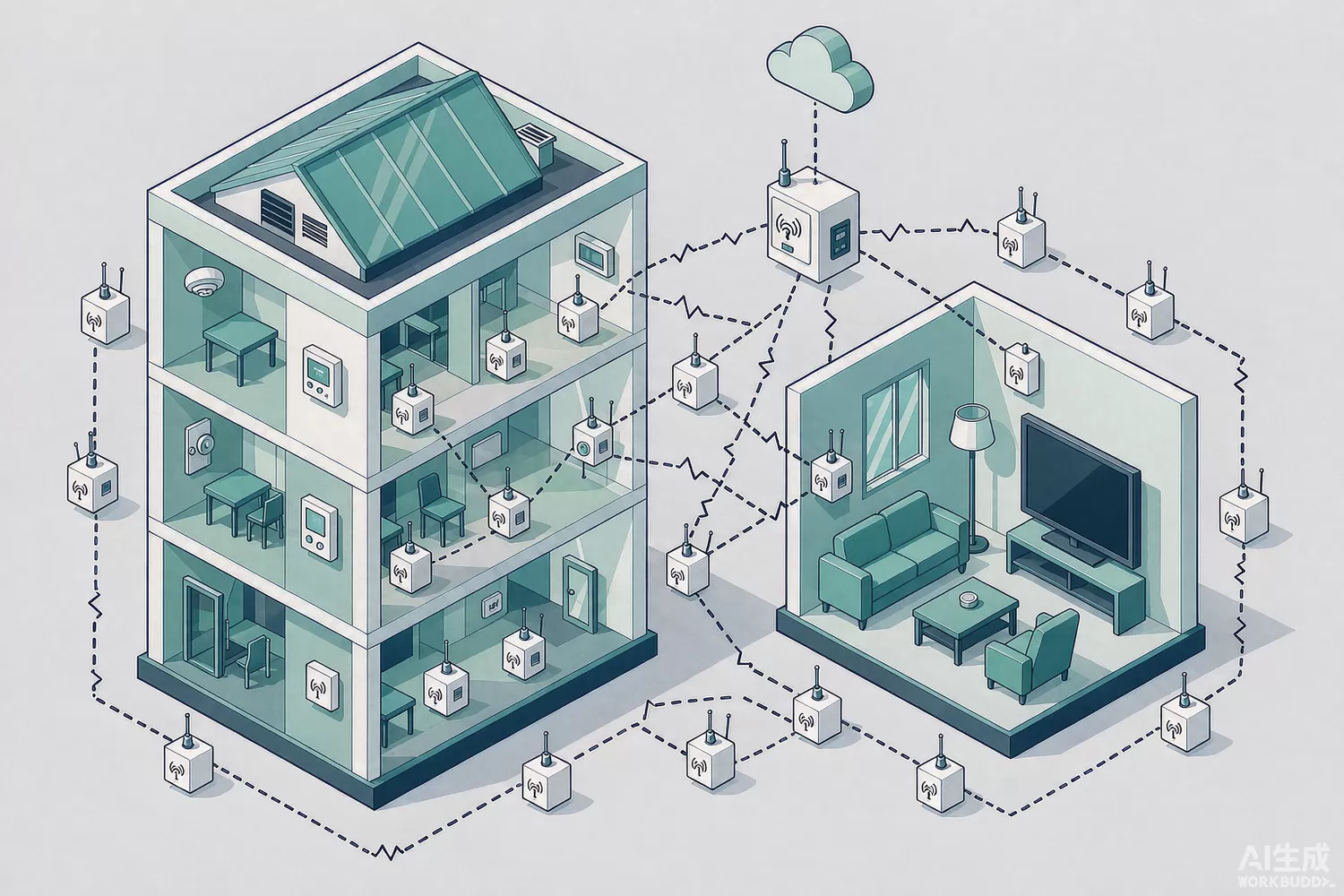
The 2.4 GHz band is crowded, and one of its oldest tenants is still one of its most useful: IEEE 802.15.4, the radio that carries Zigbee, Thread and, more recently, Matter. Where Bluetooth Low Energy optimises a link between two devices and Wi-Fi optimises throughput, 802.15.4 optimises a network of hundreds of small, cheap, battery-powered nodes that route for each other. That is why it ended up in lighting, building control, metering and sensors, and why it is now the transport under the smart-home interoperability effort.

Application logic: the mesh is the product
An 802.15.4 radio SoC integrates the transceiver, the media-access controller, usually an application microcontroller and a security engine, and it often shares the 2.4 GHz front end with a Bluetooth Low Energy radio so that one device can be provisioned by phone and then join a mesh. The system design questions are different from those of a point-to-point link. Link budget still matters — receive sensitivity and transmit power set the range between two nodes — but network reliability comes from route diversity. A mesh with weak individual links can be robust; a mesh with too few nodes is fragile no matter how sensitive the radios are.
The constraints that decide a design are the ones a datasheet does not quantify well. Coexistence: a mesh node inside the same enclosure as a Wi-Fi access point or a switching power supply will lose far more range to interference than to sensitivity. Antenna: a small printed antenna in a metal enclosure, or an antenna next to a battery, will detune, and the matching network has to be designed for the finished product, not for the development board. Power: sleepy end devices spend almost all their life asleep, so average current, wake latency and the timer architecture matter more than peak transmit current — the same discipline described in our note on radios that must run for years. And updates: a mesh that cannot be updated over the air in the field becomes a maintenance liability, so flash size and bootloader design are product decisions. Filter choice plays directly into coexistence; see how to choose between SAW, dielectric and LC filters at 2.4 GHz and keeping one radio from drowning out another.
On top of the radio sits the software decision that is now more consequential than the silicon: which stack, and which certification. Matter has pushed vendors towards multiprotocol devices that can run Thread and Bluetooth Low Energy concurrently, which is why the current generation of domestic and imported multiprotocol SoCs look so similar on paper — and why the differentiators are stack maturity, security certification and the quality of the development toolchain.
New technology in mesh radios
- Multiprotocol silicon that runs 802.15.4 and Bluetooth Low Energy concurrently, so a device can be commissioned from a phone and then operate in a Thread or Zigbee mesh.
- Matter and Thread support with certified stacks, moving interoperability from a vendor-specific feature into a standard requirement.
- Higher integration, with the radio, application core, security engine and flash in one device, which shrinks node cost and board area.
- RISC-V and dual-core architectures that separate the radio stack from the application, reducing certification effort when the application changes.
- Improved receive sensitivity and lower sleep current, extending battery life for battery-only sensors and switches.
- On-chip security including secure boot, key storage and hardware acceleration for the mesh encryption used by Thread and Zigbee.
- Wi-Fi plus 802.15.4 combination devices that allow one product to be both a Matter node and a network gateway.
Domestic alternatives: what to analyse before switching
- Check the protocol stacks that are actually certified, not only supported, and the version of the specification they track.
- Verify coexistence behaviour with a Wi-Fi radio in the same enclosure, measured in your product rather than on a development board.
- Compare sleep current and wake-up latency with your sensor's duty cycle, and confirm the timer and clock architecture supports your power target.
- Confirm the over-the-air update mechanism, dual-image support and the flash margin for future features.
- Review the security architecture: secure boot, key storage and the routines required by your certification scheme.
- Ask about the border router and gateway reference design, because that is where projects usually stall.
Indicative cost comparison: imported originals vs domestic candidates
Price figures below are indicative public-market reference ranges for moderate volumes, compiled from publicly observable listings. They fluctuate with the spot market, package option, grade (industrial, automotive, screened) and order quantity, and must not be read as a quotation. Ask us for a firm price on your exact part numbers and quantities.
| Device class | Common imported reference | Indicative imported unit price | Commonly referenced domestic candidate | Indicative domestic unit price |
|---|---|---|---|---|
| Multiprotocol 802.15.4 + Bluetooth Low Energy SoC with application core | TI CC2652 / CC2651 class; Silicon Labs EFR32MG24 class | USD 1.8–5.5 | Espressif ESP32-H2 / ESP32-C6 class; Telink TLSR9 series | USD 0.8–2.6 |
| Certified radio module (antenna and certification included) | Module built on the imported SoCs above | USD 3.5–9 | Module built on the domestic SoCs above | USD 1.8–5 |
| Border router / gateway SoC (radio plus host capability) | Imported gateway-class SoC | USD 4–12 | Domestic multiprotocol SoCs with host-capable cores | USD 2–6 |
| Sub-GHz 802.15.4 SoC for metering and long-range mesh | Imported sub-GHz 802.15.4 devices | USD 2.5–7 | Domestic sub-GHz mesh SoCs (family level) | USD 1.2–3.5 |
Two cost notes. First, on this class of device the silicon is a small part of the product cost, so the decisive comparison is engineering effort and certification, not the few cents saved on the radio. Choosing a device with a mature stack and a documented Matter path usually beats choosing the cheapest one. Second, module-level sourcing carries its own cost logic: an already-certified module can remove a regulatory test cycle, which is often worth more than the difference between module and chip pricing.
Commonly referenced alternative models
| Imported original (reference) | Domestic candidate (public sources) | Why it is referenced |
|---|---|---|
| TI CC2652-class multiprotocol 802.15.4 and BLE SoC | Espressif ESP32-H2 (802.15.4 + Bluetooth 5 LE, supporting Thread and Zigbee alongside Matter) | Publicly documented as a single-chip 802.15.4 and Bluetooth Low Energy SoC with an application core, positioned for Matter, Thread and Zigbee devices. |
| Silicon Labs EFR32MG24-class mesh SoC | Telink TLSR9 series multiprotocol SoCs | Publicly documented multiprotocol wireless SoC family used in smart-home and lighting products; compare the stack certification and the security features you require. |
| Imported combination Wi-Fi plus 802.15.4 device | Espressif ESP32-C6-class combination SoC | Cross-referenced where a product must be both an 802.15.4 mesh node and a Wi-Fi device, which is the common gateway architecture. |
| Imported sub-GHz 802.15.4 device for metering | Domestic sub-GHz mesh SoCs (family-level information in public sources) | Used in utility metering and long-range mesh; confirm the frequency plan and regulatory requirements of your destination markets. |
| Imported module with pre-certified antenna | Domestic modules with pre-certified antenna designs | Often the fastest route to a certified product; check the certification dossier and the antenna design for your enclosure. |
We source mesh radio SoCs and modules, and the general-purpose radio parts around them, including the ESP32-S3-WROOM-1-N16R8 module, ESP32-C3FN4, ESP32-WROOM-32E and ESP32-D0WDQ6, drawn from the microcontroller and SoC collection and the RF and interface chip collection. Tell us the network topology you are building and we will quote the node BOM.
Frequently asked questions
Frequently asked questions
How is 802.15.4 different from Bluetooth Low Energy?
Both live in the 2.4 GHz band, but 802.15.4 was designed for mesh-first networks: thousands of nodes, self-healing routing, and a small frame that suits control rather than streaming. BLE started as a point-to-point link and added mesh later. For building control, metering and lighting, the 802.15.4 mesh stack remains the simpler answer; for phones and accessories, BLE wins on ecosystem.
Do I need a separate gateway?
Yes, in almost every case. An 802.15.4 network needs a border router that carries traffic between the mesh and IP networks. That device is itself a radio SoC plus a host processor, and it is the node where memory footprint, security and update capability matter most.
What decides the radio specification in a mesh product?
Receive sensitivity and output power set the link budget, but the practical limits are usually co-existence with Wi-Fi in the same enclosure and the antenna arrangement. Mesh reliability comes from routing and from having enough nodes, not only from a few decibels of sensitivity.
Are domestic 802.15.4 SoCs competitive?
Yes. Several domestic families support 802.15.4 together with Bluetooth Low Energy and Thread/Zigbee stacks, and they are widely used in smart-home and building products. Compare the stack certification, security features and update mechanism as carefully as the radio performance.
About us & trademarks: JTDZ Tech (Shenzhen Jingteng Electronics Technology Co., Ltd.) is an independent distributor of electronic components. We are not an authorised distributor or representative of the imported manufacturers named in this article. Manufacturer, brand and part names are used for identification purposes only; all trademarks remain the property of their respective owners. Cross-reference information in this article is based on publicly available sources, is subject to change, and is not a substitute for your own engineering validation. Always verify specifications against the manufacturer's datasheet before design-in or purchase.
