
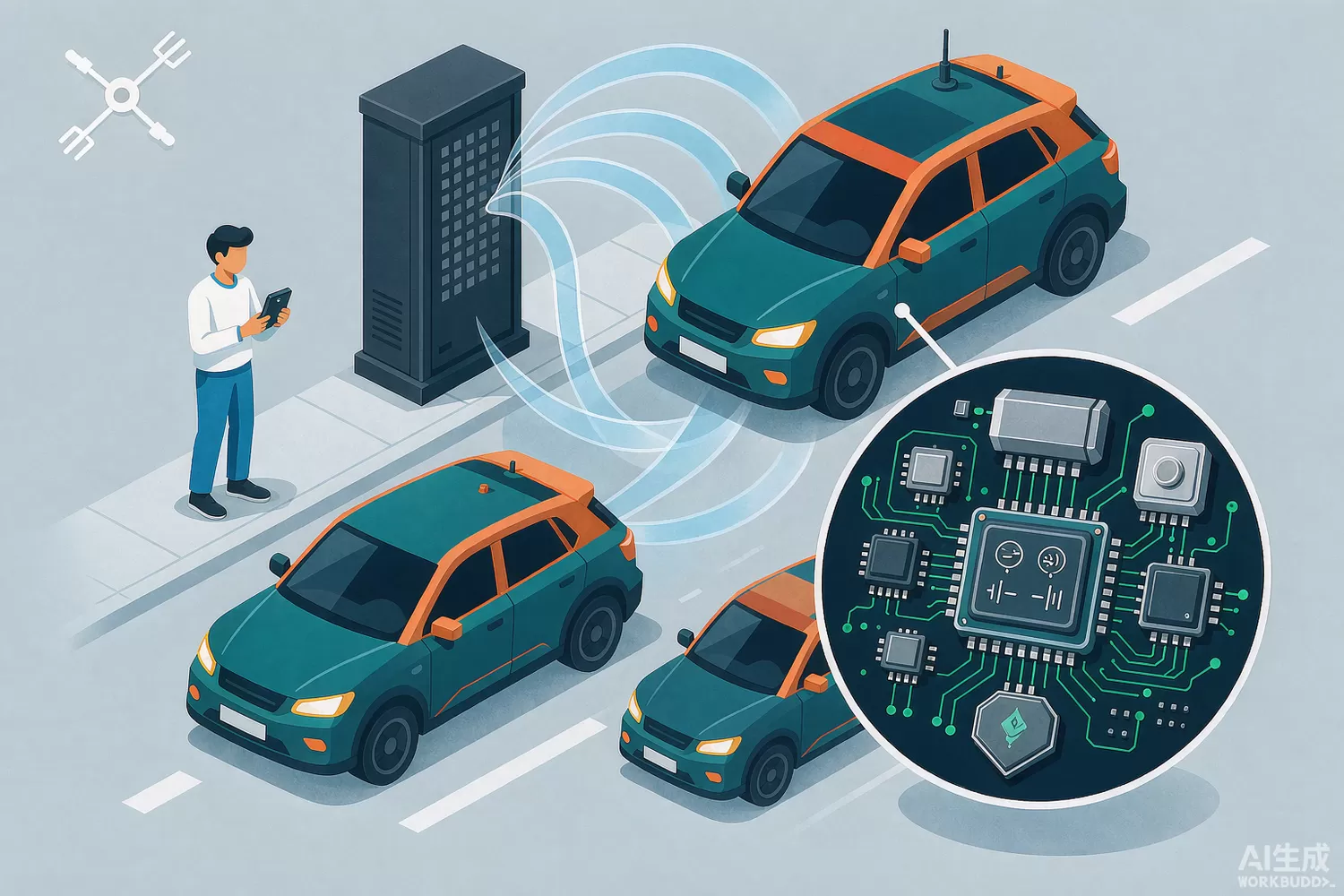
Vehicle-to-everything communication is the rare case where a radio is a safety device. A car cannot wait for a base station to relay a warning about the vehicle two cars ahead; the message has to travel directly, in a few milliseconds, to everyone in range. That requirement produced C-V2X: a radio that reuses the cellular waveform family but operates in sidelink mode, talking directly to other vehicles, roadside units and pedestrians' devices in a dedicated band around 5.9 GHz.

Application logic: a radio that must be trusted
The physical layer is the easier half. C-V2X devices alternate between scheduled transmission and reception on a shared channel, so the modem must acquire synchronisation — from the network when it is available and from other vehicles when it is not — and it must do so with the time alignment that the sidelink protocol requires. GPS or GNSS provides the time and position reference, which is another reason the RF chain cannot be designed in isolation. The radio must share spectrum with other users of the band, which puts sharp requirements on adjacent-channel emissions and on the filtering that follows the power amplifier. And because the messages affect safety, they are signed: the device needs a hardware security element and the computational budget to verify a message stream in real time.
The RF front end is a good example of a chain where the system requirement dictates the architecture. Transmit power and its linearity must satisfy a spectral mask; the receive path needs a low-noise amplifier with enough dynamic range to survive a crowded intersection where several vehicles transmit nearby; the switch or duplexer must handle the transmit-receive timing; and the antenna arrangement must work on a metal vehicle, often behind glass. Every one of these is also an automotive reliability problem: wide temperature range, vibration, humidity, long field life and traceability. That is why C-V2X silicon is normally specified to automotive qualification standards and why the supply chain — second sources, date codes and long-term availability — matters as much as the datasheet. The same requirements shape the wider automotive radio picture, and the level-plan thinking in our review of base-station front ends applies to the many-antenna, many-transmitter case.
Commercially, C-V2X is also interesting because it is one of the few RF categories where Chinese suppliers led the deployment. Roadside units and onboard units in China's pilot zones were built on domestic silicon years ago, and that installed base is now the reference point for anyone building for the same market.
New technology in V2X radios
- Software-defined radio SoCs that support C-V2X, satellite links and private-network waveforms in one device, so a platform can be re-used across vehicle programmes.
- NR-V2X sidelink, extending the technology beyond LTE-based C-V2X with higher throughput and support for higher levels of automation.
- Integrated security: on-chip key storage and cryptographic acceleration sized for the message-verification rate the standard demands.
- Multi-mode synchronisation, combining GNSS, network-derived and peer-derived timing so a vehicle keeps timing in tunnels and urban canyons.
- Reduced front-end count, with integrated power amplifier, low-noise amplifier and switch blocks to cut board area in a crowded vehicle electronics bay.
- Vehicle-to-grid and infrastructure integration, where the same radio carries charging and services traffic alongside safety messages.
Domestic alternatives: what to analyse before switching
- Confirm automotive qualification and the temperature grade, and ask for the qualification dossier rather than a marketing statement.
- Check the security architecture against the certification scheme of your destination market, including key provisioning and message-signing throughput.
- Verify band support and the synchronisation modes the device implements, then test them in a real urban environment.
- Review the reference design for the front end, especially filtering and antenna matching, which is where most V2X boards lose performance.
- Ask about long-term supply: automotive programmes run for a decade, so multi-source arrangements and product longevity commitments matter.
- Test interoperability against other suppliers' units before committing, because V2X only works when everyone's messages are understood.
Indicative cost comparison: imported originals vs domestic candidates
Price figures below are indicative public-market reference ranges for moderate volumes, compiled from publicly observable listings. They fluctuate with the spot market, package option, grade (industrial, automotive, screened) and order quantity, and must not be read as a quotation. Ask us for a firm price on your exact part numbers and quantities.
| Device class | Common imported reference | Indicative imported unit price | Commonly referenced domestic candidate | Indicative domestic unit price |
|---|---|---|---|---|
| C-V2X modem / radio SoC, automotive grade | Qualcomm 9150 C-V2X class; Autotalks SECTON / CRATON class | USD 18–45 | Morningcore CX1860 / CX1910 class C-V2X SoCs | USD 8–22 |
| C-V2X module with security element and GNSS | Imported OBU-grade module | USD 35–90 | Domestic OBU and RSU modules built on the SoCs above | USD 18–45 |
| 5.9 GHz front-end module (PA + LNA + switch) | Imported 5.9 GHz front-end modules | USD 4–12 | Domestic 5.9 GHz front-end designs (family level; confirm the device with the supplier) | USD 2–6 |
| Multi-mode SDR SoC platform (V2X plus satellite or private network) | Imported multi-mode communication SoC | USD 40–120 | Domestic SDR SoC platforms (e.g. Morningcore CX18xx / CX19xx series) | USD 20–70 |
Two cost notes. First, in this category the unit price is the least important number in the comparison. Automotive qualification, functional safety documentation, security certification and ten-year supply commitments dominate the total cost of ownership, so a marginally cheaper device without that paperwork is not cheaper. Second, the 5.9 GHz front-end parts are a smaller line item than the modem but a larger risk area: filter and antenna performance in a vehicle installation decides whether the system works, so evaluate the front-end reference design as carefully as the chip.
Commonly referenced alternative models
| Imported original (reference) | Domestic candidate (public sources) | Why it is referenced |
|---|---|---|
| Qualcomm 9150-class C-V2X modem for onboard units | Morningcore CX1860 (LTE-V2X SoC) and CX1910 (multi-mode C-V2X, automotive front-installation) | Morningcore (part of the China Information and Communication Technologies group) publicly describes CX1860 as an early LTE-V2X SoC used in vehicle and roadside terminals, with CX1910 as the second-generation device for front-installation designs. Confirm the certification status for your market. |
| Autotalks SECTON / CRATON-class V2X radio | Morningcore CX19xx series and other domestic C-V2X SoC platforms | Cross-referenced for the same direct-communication role; compare the sidelink feature set and the security throughput your application requires. |
| Imported 5.9 GHz front-end module | Domestic 5.9 GHz power amplifier, low-noise amplifier and switch combinations (family level) | Same function in the transmit and receive chains. Public device-level information is limited in this band, so ask suppliers for the current catalogue and for automotive-grade qualification evidence. |
| Imported multi-mode communication SoC | Domestic software-defined-radio SoC platforms supporting C-V2X together with private-network and satellite waveforms | Positioned for platforms that must serve several communication roles; evaluate toolchain and protocol-stack support as thoroughly as the radio. |
| Imported GNSS timing receiver for V2X synchronisation | Domestic GNSS receiver and module families | V2X timing depends on GNSS; a domestic receiver class is available for the same role. See our note on GNSS receiver RF for the link-budget considerations. |
We source the RF parts around a V2X design — switches, PIN diodes, front-end modules and the passive and filter chain — including the HSMP-3890-BLKG RF PIN switch diode, SW-456TR-3000 MACOM RF switch and SKY13575-639LF, drawn from the Skyworks collection and the RF and interface chip collection. Send us your level plan and qualification requirements and we will quote the front end.
Frequently asked questions
Frequently asked questions
What is C-V2X and why does it matter to a hardware designer?
C-V2X is the cellular-family technology for direct vehicle-to-everything communication. Its sidelink (PC5) mode lets vehicles, roadside units and vulnerable road users talk directly to each other at 5.9 GHz without going through a base station, which is what makes collision-avoidance and intersection warnings possible with a latency a mobile network link cannot guarantee.
How is it different from a Wi-Fi-based ITS link?
It uses the same radio family as LTE and 5G NR, with a synchronised, scheduled sidelink rather than contention-based access. That gives more predictable latency and better behaviour under congestion, at the cost of a more complex modem and a stricter certification and security regime.
What does the RF design actually involve?
A 5.9 GHz transmit and receive chain with a power amplifier, a low-noise amplifier, filtering for adjacent-channel and out-of-band requirements, and an antenna arrangement that survives a vehicle roof or a windscreen. Add GNSS for position and time synchronisation, a security element for the message signing required by the standard, and the thermal and vibration requirements of automotive qualification.
Are domestic C-V2X chips available?
Yes. Chinese chip and equipment suppliers have driven C-V2X deployment in pilot zones and volume programmes, and domestic C-V2X SoCs have been shipping since the first generation of the standard. Automotive qualification, security certification and long-term supply commitments are the questions to ask a supplier, not whether the silicon exists.
About us & trademarks: JTDZ Tech (Shenzhen Jingteng Electronics Technology Co., Ltd.) is an independent distributor of electronic components. We are not an authorised distributor or representative of the imported manufacturers named in this article. Manufacturer, brand and part names are used for identification purposes only; all trademarks remain the property of their respective owners. Cross-reference information in this article is based on publicly available sources, is subject to change, and is not a substitute for your own engineering validation. Always verify specifications against the manufacturer's datasheet before design-in or purchase.
