
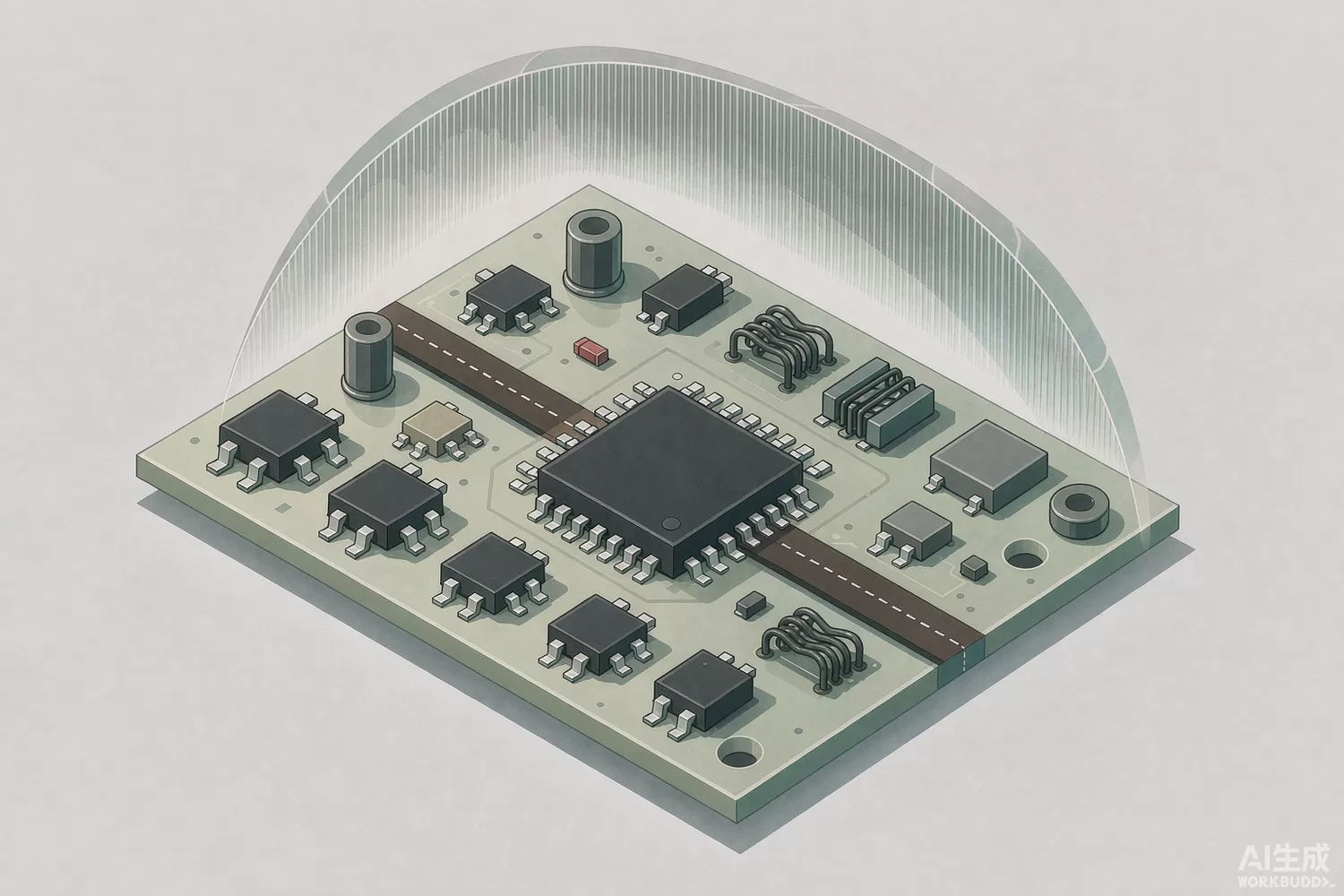
Not every amplifier in a radio needs to be a hero. Around each low-noise front end and each power stage sits a layer of quieter work: gain that has to appear at the right place, with the right level, across a band, without anyone designing a matching network for it. That is the job of the RF gain block — a small, internally matched, DC-blocked amplifier that behaves like a 50-ohm brick with a gain figure printed on it. It is also one of the easiest RF categories to buy badly, because the datasheet numbers that matter most are the ones nobody quotes first.

Application logic: what the gain block is actually deciding
A gain block is specified by gain, gain flatness, noise figure, output P1dB and OIP3 across the band, plus supply voltage and current. In a receive IF chain the first two stages set the noise figure, the last stage sets the linearity, and the middle ones exist to absorb losses and keep the level plan sane. In a transmit chain the same part plays a different role: the driver. A driver that runs 3 dB into compression will happily amplify your signal and just as happily manufacture adjacent-channel power that no filter can fully remove, so the driver's P1dB needs headroom above the power the PA expects at its input. Our notes on P1dB and compression and noise-figure budgets cover both ends of that arithmetic.
Because the part is broadband and internally matched, the system questions are cascade questions: how gain is distributed so that each stage sees a sensible level, whether the bias scheme survives supply ripple and temperature, and whether the DC blocks and bypassing are rated for the current. Cascade arithmetic is unforgiving: every decibel added after the front end adds directly to the output requirement of the last stage, and every decibel added before it trades against noise figure. That is why a three-part chain — LNA, filter, gain block — is usually planned together, and why our guides on gain-block selection and front-end building blocks treat the chain, not the part, as the unit of design.
There is also a logistics dimension. Gain blocks are commodity-adjacent parts with long lives and a large second-source ecosystem, but legacy families do get phased out, and a design built on a single EOL-prone reference part ages badly. We keep both the current families and hard-to-find legacy types in supply — see our notes on keeping legacy RF designs running.
New technology in gain blocks and drivers
- E-pHEMT and enhancement-mode pHEMT processes that deliver flat gain to 10 GHz and beyond from a single +5 V rail, with self-biased options that remove the negative rail from the layout.
- Active-bias gain blocks with on-chip temperature compensation, which hold quiescent current constant as the board heats instead of shifting gain with it.
- Higher linearity per milliamp: modern drivers hold OIP3 above 35 dBm at P1dB values that used to belong to much larger packages.
- Integrated ESD protection and DC-blocking on RF ports, which shortens assembly and removes two placement errors from the BOM.
- Wideband distributed amplifiers in QFN packages reaching 20 GHz and beyond for instrumentation and defence-grade links.
- Cost-down through standard plastic packages (SOT-89, SC-70) replacing hermetic parts in commercial bands, with screened grades still available where programmes require them.
Domestic alternatives: what to analyse before switching
- Compare S-parameters and gain flatness across your whole band, not the headline gain number at one frequency.
- Check noise figure where it matters to you: domestic parts are publicly documented below 1.5 dB in the HF-to-UHF range, which is competitive for IF and driver duty; front-end LNA duty needs its own comparison.
- Confirm the bias architecture. Self-biased and actively biased domestic parts save a rail; passive-biased parts need the same gate network as their imported equivalents.
- Ask which grade you are buying: commercial, industrial wide-temperature, or screened military-temperature. The same function can differ by an order of magnitude in price across grades.
- Verify package and land pattern: SOT-89 and SC-70 footprints are widely reproduced, but pin functions can differ even when the outline matches.
- Request lifecycle and second-source commitments in writing, exactly as you would from an imported vendor.
Indicative cost comparison: imported originals vs domestic candidates
Price figures below are indicative public-market reference ranges for moderate volumes, compiled from publicly observable listings. They fluctuate with the spot market, package option, grade (industrial, automotive, screened) and order quantity, and must not be read as a quotation. Ask us for a firm price on your exact part numbers and quantities.
| Device class | Common imported reference | Indicative imported unit price | Commonly referenced domestic candidate | Indicative domestic unit price |
|---|---|---|---|---|
| Broadband gain block, 50Ω matched, SOT-89 / SC-70 | Mini-Circuits GALI/PHA, Qorvo SGA, RFMD SNA classes | USD 1–6 | Domestic 50Ω MMIC gain-block families (CETC-13 series and commercial lines) | USD 0.5–4 (commercial); USD 15–60 (screened) |
| Medium-power driver amplifier, MSiP / SOT-89 | Mini-Circuits PHA-202+ class | USD 3–9 | Domestic pHEMT driver families, wide-temperature grades | USD 1.5–6 |
| Cascadable MMIC amplifier, DC–1 GHz, low noise | Mini-Circuits MAR/ERA legacy classes | USD 1–4 | CETC-13 HE388E / HEM388E / HES388E series | USD 8–30 (military-temperature) |
| High-linearity driver for PA pre-drive, QFN | Qorvo TQP3M / SGC classes; MACOM MAAL series | USD 2–8 | Domestic GaAs driver families (family level) | USD 1–5 |
Two cost notes. First, the meaningful comparison is at equal grade: a screened, wide-temperature domestic part is not cheaper than a commercial imported one, and a commercial domestic part is not a substitute for a screened imported one in a defence programme. Second, the saving per unit is modest — cents to a few dollars — but gain blocks appear three to six times per radio, so the board-level saving compounds, and the real money is in avoiding a second qualification cycle: pick candidates whose S-parameters you can measure against the incumbent on the same fixture.
Commonly referenced alternative models
The pairings below appear in publicly circulated domestic cross-reference material and vendor catalogues. Several are family-level references; treat each as a starting point for your own evaluation, not as a specification.
| Imported original (reference) | Domestic candidate (public sources) | Why it is referenced |
|---|---|---|
| Mini-Circuits MAR/ERA, PHA series — 50Ω cascadable MMIC gain blocks | CETC-13 (Hebei Semiconductor Research Institute) HE388E / HEM388E / HES388E broadband MMIC amplifier series | Publicly documented 30–1000 MHz, ~1 dB noise figure, 50Ω matched, active temperature-compensated bias, hermetic packages at −55 to +85 °C. Same role in IF and driver chains at military grade. |
| Qorvo SGA-4563Z / SGA5589Z, RFMD SNA-386 class gain blocks | Domestic commercial gain-block lines from GaAs foundries and design houses (family level) | Same SOT-89 internally matched concept; commercial grades target the same CATV, IF and buffer sockets. Compare gain flatness and current at your band. |
| Mini-Circuits GALI-21+ — DC–8 GHz gain block | Domestic wideband pHEMT gain-block families (family level, ask for S-parameters) | Publicly listed in domestic cross-reference tables for wideband buffer and LO-drive duty; package and bias differ between sources. |
| Avago/Broadcom MGA-30889 — cascadable gain block | Domestic pHEMT gain blocks of the same bias class (family level) | Referenced for the same low-current, medium-gain socket in receive IF chains. |
| MACOM MAAL-011136 — low-noise gain block, SOT-89 | Domestic low-noise amplifier families from CETC institutes and commercial vendors (family level) | Same socket: LNA or first IF stage at 0.4–4 GHz class; validate noise figure and OIP3 at your frequency. |
We stock the imported reference parts in this table — for example the SNA-386-TR1 gain block, SGA5589Z, PHA-202+ driver, MGA-30889-BLKG, INA-02186-TR1, GALI-21+, SGA-4563Z, NBB-310-T1 and SGC4363Z — and we source the domestic candidates referenced above. Both live in our RF and interface chip collection alongside the Qorvo and Mini-Circuits collections.
Frequently asked questions
Where does a gain block belong in a radio chain?
Almost anywhere a broadband, internally matched stage is easier than a tuned design: IF gain distribution, LO or clock buffering, driving a mixer or a modulator, pre-driving a power amplifier, or recovering level after a long cable, a switch or a filter. Because the part is matched to 50 ohms over its band, you cascade it without designing a matching network each time.
How many gain blocks can I cascade before it goes wrong?
Watch three budgets: total gain versus receiver stability (a chain with 80 dB of broadband gain will find a feedback path), accumulated output power (each stage must stay below its P1dB at the level it actually sees), and noise plus intercept adding stage by stage. A spreadsheet with Friis formulas takes ten minutes and prevents most redesigns.
Are domestic gain blocks really comparable to the imported ones?
Several domestic families now cover the same 50-ohm internally matched concept, including the CETC-13 broadband MMIC amplifier series publicly documented with noise figures around 1 dB and military-temperature ratings. Comparable is a matter of your band, gain flatness window and grade: compare the S-parameters and P1dB curves at your frequency, not the category name.
Can you quote the whole amplifier chain, not just one part?
Yes. We stock imported gain blocks and low-noise stages from Mini-Circuits, Qorvo, MACOM, RFMD and Avago families, and we source the domestically produced candidates referenced here. Send the chain diagram or the part numbers, the band and the annual volume, and we will quote the complete bill of materials.
About us & trademarks: JTDZ Tech (Shenzhen Jingteng Electronics Technology Co., Ltd.) is an independent distributor of electronic components. We are not an authorised distributor or representative of the imported manufacturers named in this article. Manufacturer, brand and part names are used for identification purposes only; all trademarks remain the property of their respective owners. Cross-reference information in this article is based on publicly available sources, is subject to change, and is not a substitute for your own engineering validation. Always verify specifications against the manufacturer's datasheet before design-in or purchase.
