
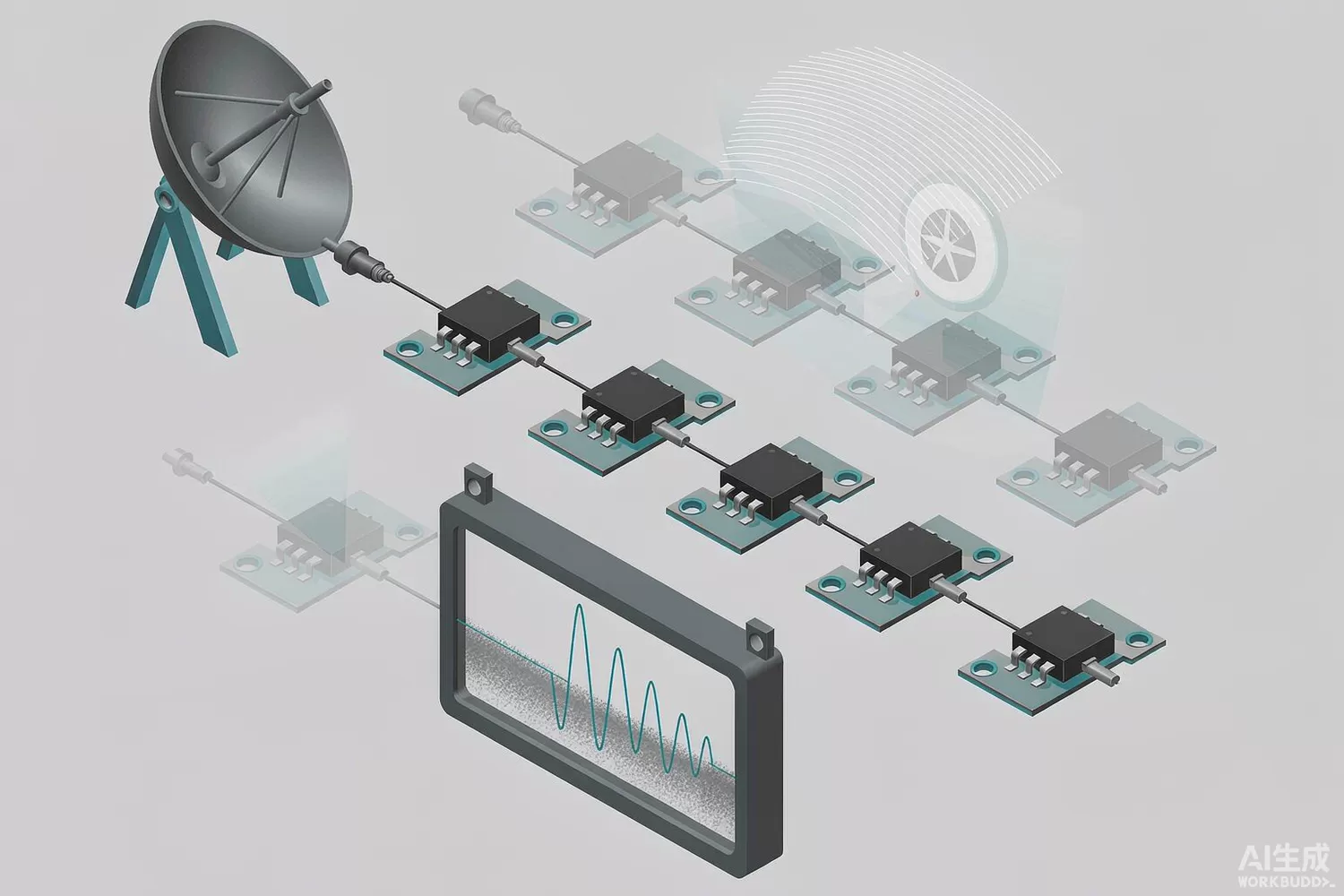
The first amplifier after the antenna has a privilege no other stage enjoys: its noise is amplified by everything that follows it. That is why the low-noise amplifier is the smallest part with the loudest voice in a receiver — and why a substitution exercise that looks only at gain and price on the LNA socket quietly gives range away. This article walks the LNA's place in the front end, the technology currently moving the category, and how to evaluate the domestic candidates that now crowd this socket.

Application logic: the LNA as a systems decision
System noise figure follows the Friis cascade: the first stage's noise figure adds directly, and every later stage is discounted by the gain in front of it. So the LNA decision is really three decisions. Where the filter sits relative to the amplifier (insertion loss before the LNA is system noise; compression risk says protect first). How much gain the LNA should have — typically 15 to 22 dB, enough to bury the second stage's noise, not so much that the following mixer or ADC is overloaded. And what linearity the front end needs, because a receiver lives in a spectrum full of neighbours: the input intercept IIP3 of the LNA, together with the filter's rejection, decides how gracefully the receiver degrades when a strong signal appears two channels away. Our articles on LNA fundamentals and module versus discrete front ends cover the architecture trade-offs in depth.
Bias and stability are where first prototypes fail. A conditional-stability part oscillates the moment a filter or a cable adds the wrong phase at some frequency; the fix is resistor loading, ferrite beads or choosing an unconditionally stable part. Bias networks decide how the noise figure moves with supply ripple and temperature, which is why actively biased parts have become the default outside handsets. And layout matters as much as silicon: the return path, the grounding of the bias network and the length of the input trace all show up in the measured noise figure, a theme we treat in RF layout practice and impedance control.
New technology in low-noise amplification
- GaN and high-linearity pHEMT processes that combine sub-1 dB noise figures with ruggedness, so the LNA survives the leakage of its own transmitter and of nearby strong signals without a limiter in many designs.
- Wideband noise-optimised MMICs covering 0.1–6 GHz and beyond in one package, serving SDR and multi-band receivers that used to need band-specific LNAs.
- Active bias and on-chip temperature compensation holding quiescent current — and therefore noise figure and gain — flat across the automotive and industrial temperature range.
- Bypass and LNA-gain-step functions integrated into front-end ICs for TDD systems, protecting the receiver during transmit bursts.
- Better noise-parameter data published at multiple temperatures, letting designers simulate rather than guess the optimum source impedance.
- Packaging moves: QFN and even SOT-89 plastic parts achieving hermetic-era stability, shrinking board area and cost in commercial bands.
Domestic alternatives: what to analyse before switching
- Ask for measured noise parameters (Fmin, gamma-opt, Rn) at your band and temperature, not just a typical noise-figure line in a table.
- Compare input P1dB and ruggedness if the LNA must survive co-sited transmitters; this is where cheap substitutes fail silently.
- Check stability data across the full band, including out-of-band, and confirm the recommended bias network matches your supply quality.
- Verify ESD and DC-block behaviour on the RF ports if your board expects it, and confirm the package land pattern pin by pin.
- For satellite, instrumentation and base-station sockets, request the same screening and lot data you would demand from an imported vendor.
- Pilot with a small build and A/B the measured system sensitivity; a system-level measurement beats any datasheet comparison.
Indicative cost comparison: imported originals vs domestic candidates
Price figures below are indicative public-market reference ranges for moderate volumes, compiled from publicly observable listings. They fluctuate with the spot market, package option, grade (industrial, automotive, screened) and order quantity, and must not be read as a quotation. Ask us for a firm price on your exact part numbers and quantities.
| Device class | Common imported reference | Indicative imported unit price | Commonly referenced domestic candidate | Indicative domestic unit price |
|---|---|---|---|---|
| Wideband low-noise MMIC, 0.1–6 GHz, SOT-89 / QFN | Mini-Circuits PHA-13LN+ class; Qorvo TQP3M9019 | USD 2–8 | Domestic pHEMT LNA families (CETC institutes and commercial lines) | USD 1–5 (commercial); USD 15–60 (screened) |
| Low-noise gain block, 0.4–4 GHz | MACOM MAAL-011136 class | USD 1.5–5 | Domestic low-noise amplifier families (family level) | USD 0.8–3.5 |
| Mobile-band LNA for handsets and CPE | Qorvo / Skyworks LNA families | USD 0.2–1.5 | Maxscend and other domestic LNA lines | USD 0.05–0.5 |
| Base-station / instrumentation LNA module | Distributed LNA modules, imported | USD 15–80 | Domestic module integrators using domestic MMIC dice | USD 8–45 |
Two cost notes. First, on the LNA socket the datasheet is not the product: two parts with identical typical noise figures can differ by a decibel of system sensitivity once real source impedances and temperature are applied, so budget for a measurement comparison, not just a price comparison. Second, the module-level row is where domestic supply has advanced fastest, because domestic module houses combine domestic dice with domestic filters and packages; the unit saving is larger there, but so is the duty to check the screening flow.
Commonly referenced alternative models
| Imported original (reference) | Domestic candidate (public sources) | Why it is referenced |
|---|---|---|
| Mini-Circuits PHA-13LN+ — low-noise MMIC, 10 MHz–13 GHz, SOT-89 | Domestic wideband low-noise MMIC families, incl. CETC-13 series of 50Ω low-noise amplifiers | Same socket: internally matched, single +5 V, low noise with medium power; the domestic series is publicly documented near 1 dB noise figure over HF–UHF at military temperature. |
| MACOM MAAL-011136 — low-noise gain block, 0.4–4 GHz | Domestic pHEMT low-noise families (family level) | Cross-referenced in domestic tables for the same first-IF and buffer sockets; compare noise parameters and bias current. |
| Qorvo TQP3M9019 / TQP3M9038 — high-linearity LNA & driver | Domestic high-linearity LNA families (family level) | Same class: ultra-low-noise, high-linearity cascadable amplifiers for 0.5–4 GHz links and CPE. |
| Qorvo QPL9096TR7 — base-station LNA | Domestic base-station LNA lines (family level) | Publicly positioned for the same macro and small-cell receive sockets; verify noise figure at 3.3–5 GHz and ruggedness. |
| Skyworks SKY65014 — 50Ω gain block | Domestic commercial gain-block / LNA lines (family level) | Listed in cross-reference tables for the same GPS, ISM and IF front-end duty. |
The imported references are in stock: the PHA-13LN+ low-noise amplifier, MAAL-011136-TR1000, TQP3M9019, TQP3M9038, QPL9096TR7 and SKY65014-70LF, with more in the RF and interface collection, the Mini-Circuits collection and the Qorvo collection. For first-stage protection, pair the LNA with the limiter parts discussed in our attenuators and limiters guide.
Frequently asked questions
What actually decides receiver range: the LNA or the antenna?
Both, but the LNA is where range is most often thrown away. Once the first stage is fixed, its noise figure and gain determine how much everything after it matters; a poor LNA (or a lossy filter placed before it) raises the system noise figure decibel for decibel, and every decibel is range, data rate or battery life.
Should the filter go before or after the LNA?
If out-of-band blocking is not a threat, put the filter after the LNA so its insertion loss does not multiply into the system noise figure. If strong interferers would drive the LNA into compression, protect the input first. That decision — and the limiter that sometimes goes with it — is the front end in miniature.
What is different about a good domestic LNA?
The good domestic parts no longer lose on the headline numbers; they differ in second-order things: S-parameter data quality over temperature, evaluation support, and grade availability. For satellite, base-station and instrumentation duty, ask for measured noise parameters rather than a typical figure, and check whether a screened version exists.
Is the LNA a good category for mixed sourcing?
Yes, and it is common practice: imported parts on the critical first stage where noise parameters are verified, domestic parts on IF and buffer stages where the requirement is flatter and the qualification faster. We supply both and quote the chain as one bill of materials.
About us & trademarks: JTDZ Tech (Shenzhen Jingteng Electronics Technology Co., Ltd.) is an independent distributor of electronic components. We are not an authorised distributor or representative of the imported manufacturers named in this article. Manufacturer, brand and part names are used for identification purposes only; all trademarks remain the property of their respective owners. Cross-reference information in this article is based on publicly available sources, is subject to change, and is not a substitute for your own engineering validation. Always verify specifications against the manufacturer's datasheet before design-in or purchase.
