
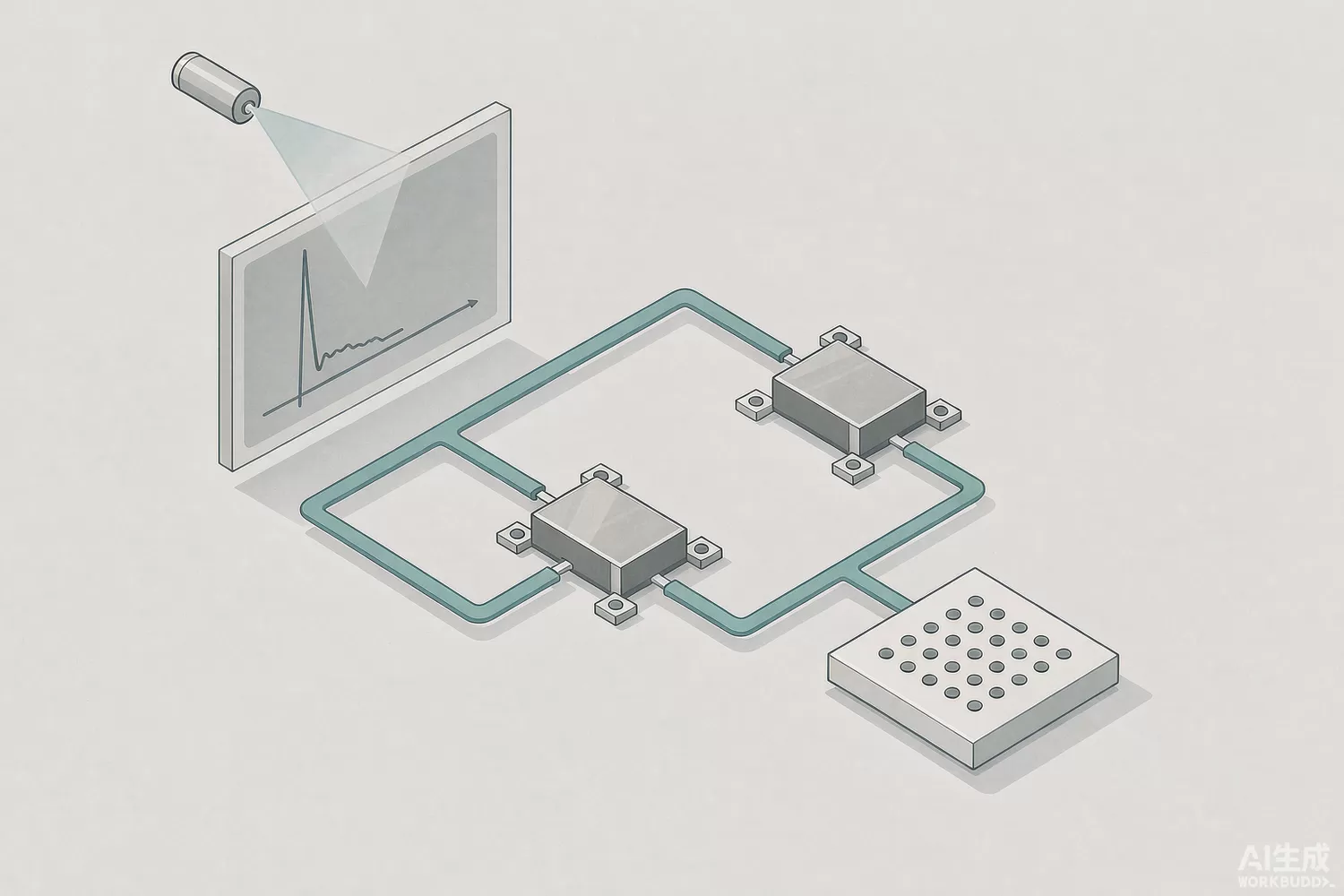
Every sensitive receiver is one strong transmitter away from a warranty claim. The limiter — usually nothing more exotic than one or two PIN diodes and a quarter-wave line — is the part that stands between the LNA and the world's transmitters. It is cheap, passive and easy to specify badly, and it is precisely the kind of component where a substitution decision needs physics, not a cross-reference table.

Application logic: protection without poisoning sensitivity
A PIN limiter works without bias: at small signals it is a capacitor-ish loss, at large signals the RF itself injects carriers into the diode's intrinsic layer and the impedance collapses, reflecting and absorbing the surge. The design quantities follow from that behaviour. Threshold (the power where limiting starts, often quoted as a P1dB of a few dBm) sets how much leaks through to the LNA during an event. Flat leakage — the power that still gets past the clamp — must sit below the LNA's rated maximum input. Recovery time decides whether a pulsed system (radar, TDD radio) gets its sensitivity back before the next receive window. And insertion loss in the small-signal state is paid as system noise figure, decibel for decibel. Our overview of PIN and limiter diodes and the companion piece on protecting the front end work through the numbers.
The same PIN physics plays a second role nearby: high-power switching and variable attenuation. Thick-I PIN diodes switch kilowatt-class transmit paths in T/R networks, and PIN-diode attenuator ICs (like the one referenced below) give analogue gain control where a step attenuator is too coarse. That is why limiter, switch and attenuator diodes belong to one sourcing conversation even though their datasheets look unrelated — a point our RF diodes in practice article develops.
Terminations matter here too. Limiters reflect what they cannot absorb; the reflected power has to go somewhere, and in test systems it goes into a termination. A SMT RF termination or a high-power chip termination such as the 700A3R9BW150XT RF capacitor-termination family from ATC completes the protection chain, a topic our passive components guide touches on.
New technology in limiter and PIN protection
- Thin-I silicon PIN limiter diodes with sub-nanosecond response and low flat leakage, packaged as single diodes, anti-parallel pairs and quad beams for balanced receivers.
- Integrated limiter-LNA modules where the clamp and the first amplifier are co-designed, removing the match uncertainty between them and cutting recovery time.
- High-power PIN switcher families rated for kilowatt pulses in hermetic ceramic packages for radar and T/R-module duty.
- Schottky-limiting hybrids for wideband instrumentation, combining fast clamp with good harmonic behaviour.
- Module-level SMA limiters covering 10 MHz–6 GHz with ~0.5 dB insertion loss and published per-unit test reports, making protection a purchasable block rather than a design task.
- Automotive-grade qualification of limiter diodes for antenna-sharing architectures in connected vehicles.
Domestic alternatives: what to analyse before switching
- Match the failure mode you are protecting against: peak power, pulse width and duty cycle, not just frequency.
- Ask for flat-leakage and recovery-time measurements at your pulse conditions; these are the numbers the LNA cares about.
- For diode-level substitution, check I-layer thickness class (limiter vs switcher) and capacitance at zero bias before comparing anything else.
- For module-level domestic limiters, request the per-unit test report — threshold, insertion loss, isolation — which reputable vendors supply as standard.
- Verify power-handling derating over temperature and the package thermal path if the limiter absorbs rather than reflects.
- Confirm lot traceability and screening options at the same level as your imported baseline.
Indicative cost comparison: imported originals vs domestic candidates
Price figures below are indicative public-market reference ranges for moderate volumes, compiled from publicly observable listings. They fluctuate with the spot market, package option, grade (industrial, automotive, screened) and order quantity, and must not be read as a quotation. Ask us for a firm price on your exact part numbers and quantities.
| Device class | Common imported reference | Indicative imported unit price | Commonly referenced domestic candidate | Indicative domestic unit price |
|---|---|---|---|---|
| Surface-mount Schottky / PIN diode family for switching & detection | Avago HSMS-286x series | USD 0.3–1.5 | Domestic SMT Schottky/PIN diode families (family level) | USD 0.1–0.8 |
| High-power PIN limiter diode, ceramic package | MACOM MA4L-series limiter diodes; MA4P-series switchers | USD 2–25 | Domestic silicon PIN limiter/switcher families (CETC institutes; family level) | USD 1–18 |
| PIN-diode attenuator IC / module | Avago ALM-38140 module; Skyworks ATN3580 attenuators | USD 3–30 | Domestic PIN attenuator families (family level) | USD 2–20 |
| Coaxial SMA limiter module, 10 MHz–6 GHz | Imported coaxial limiter modules | USD 25–120 | Shenzhen Alf (Alfu) Communication and similar domestic module vendors | USD 8–45 |
Two cost notes. First, at diode level the saving is real but the qualification is the cost: a limiter that is 60 cents cheaper and lets a 100 W pulse reach a $30 LNA has destroyed the saving several thousand times over. Second, module-level domestic limiters are the strongest value in this table because the per-unit test report is part of the product; treat a missing report as a price defect, whatever the sticker says.
Commonly referenced alternative models
| Imported original (reference) | Domestic candidate (public sources) | Why it is referenced |
|---|---|---|
| MACOM MA4L011 / MA4L-series — silicon PIN limiter diodes | Domestic PIN limiter-diode families from CETC-13 / CETC-55 programme lines (family level) | Same structure and role: zero-bias limiting for 10 MHz–18 GHz receiver protection. Compare I-region class, capacitance and peak-power rating. |
| MACOM MA4P7002F-1072T — high-power PIN switcher diode | Domestic high-power PIN switcher families (family level) | Same socket: T/R switching and high-power control with thick-I geometry and hermetic ceramic package. |
| Avago/Broadcom HSMS-2864-TR1G — SMT Schottky diode pair | Domestic SMT Schottky detector/switcher diode families (family level) | Referenced for detection and small-signal switching sockets in the same 940–286x family tradition. |
| Avago ALM-38140 — PIN-diode attenuator module | Domestic PIN attenuator families (family level) | Same function: reflective PIN attenuation for AGC and levelling loops. |
| Skyworks ATN3580-02 / -03 — voltage-variable attenuator ICs | Domestic VVA families (family level) | Cross-referenced for the same analogue gain-control sockets; verify control-law linearity over your band. |
| MITEQ-class coaxial limiter modules, 0.01–18 GHz | Shenzhen Alf Communication SMA limiter modules, 10 MHz–6 GHz, ~0.5 dB loss, per-unit test reports | Domestic module-level protection with published threshold/loss/isolation data; covers the common L/S/C-band receiver cases. |
We stock the imported protection parts referenced here — the HSMS-2864-TR1G Schottky pair, MA4P7002F-1072T high-power PIN diode, MA4L011-134 limiter diode, ALM-38140-BLKG attenuator module, ATN3580-02 and ATN3580-03 — plus terminations such as the SMT2010TALNF. See also the Avago/Broadcom collection, the Skyworks collection and our brand guides to Avago PIN diodes and MACOM microwave parts.
Frequently asked questions
Why does a receiver need a limiter at all?
Because receivers share the world with transmitters. Leakage from your own PA, a nearby repeater, or a radar pulse arrives at the LNA input with far more power than its gate can survive. A PIN-diode limiter is a passive, self-actuating clamp: below its threshold it is nearly invisible, above it, it reflects and absorbs the excess before the LNA dies.
What is the difference between a limiter diode and a switching PIN diode?
I-region geometry. Limiter diodes have thin I layers for fast carrier lifetime and fast recovery; switching PINs have thick I layers for high breakdown and low loss under bias. Substituting one for the other trades exactly the parameter you probably bought it for.
Do domestic limiter parts really protect high-value front ends?
The publicly documented domestic parts cover the same structure — silicon PIN limiter and switcher diodes, plus module-level SMA limiters up to 6 GHz with insertion loss around half a decibel. For high-reliability programmes, ask for the qualification data and per-part test reports the domestic module vendors publish; the diode level is more family-level.
Can the limiter hurt my noise figure?
Slightly, and measurably: a limiter adds its insertion loss ahead of the LNA, so the system noise figure rises by roughly that loss. Zero-bias limiter diodes are designed so the penalty is a few tenths of a decibel — worth verifying on your board, because a bad match can cost more than the datasheet loss.
About us & trademarks: JTDZ Tech (Shenzhen Jingteng Electronics Technology Co., Ltd.) is an independent distributor of electronic components. We are not an authorised distributor or representative of the imported manufacturers named in this article. Manufacturer, brand and part names are used for identification purposes only; all trademarks remain the property of their respective owners. Cross-reference information in this article is based on publicly available sources, is subject to change, and is not a substitute for your own engineering validation. Always verify specifications against the manufacturer's datasheet before design-in or purchase.
