
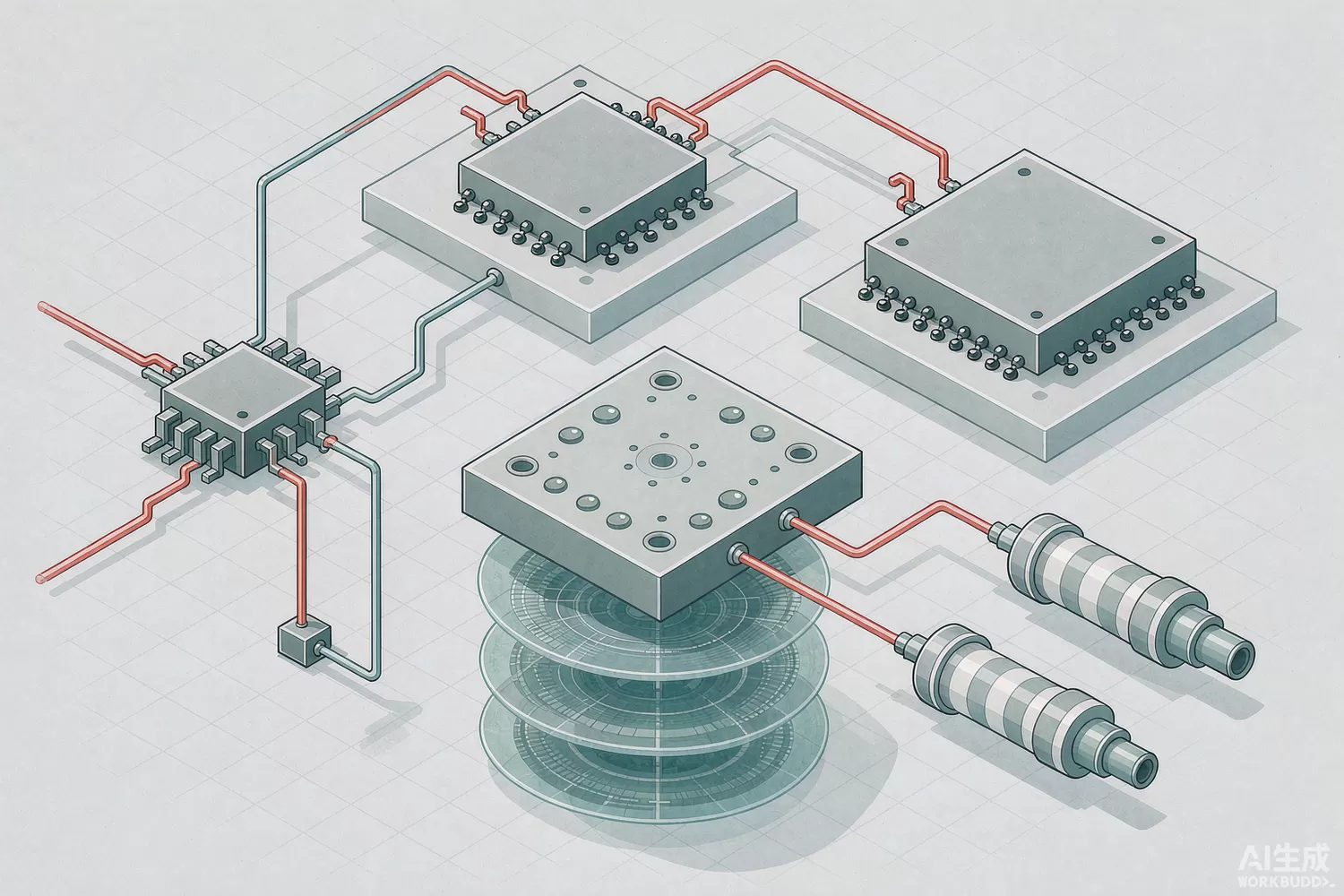
Between the antenna and the converter, radio signals change their mind about being single-ended. Mixers want balance, differential converters demand it, push-pull amplifiers assume it — and the component that delivers the about-face is the humble balun or transmission-line transformer, usually in a package smaller than a grain of rice. It carries no part number glamour, yet amplitude and phase imbalance here show up as image rejection, harmonics and EVM everywhere else.

Application logic: balance, impedance and power
Three parameter families decide a balun. Balance (amplitude and phase between the differential ports) sets how well common-mode noise and even-order products cancel; in an ADC clock path, imbalance converts directly into sampling jitter artefacts. Impedance ratio (1:1, 1:2, 1:4, plus 75-ohm broadcast variants) sets the matching plan between the single-ended and differential worlds. And power handling with insertion loss sets where in the chain the part may live — a splitter feeding two mixers needs different ratings than one sampling a PA output. Mini-Circuits' TC/TCM transformer families, MACOM's MABA line and Anaren's BD-series hybrids dominate the imported bench; our power dividers and baluns guide and the mixer substitution guide show the chain context.
Topology follows frequency. At HF and VHF, wound transmission-line transformers on ferrite cores dominate, and their low-frequency cutoff is set by the magnetising inductance. Through the UHF range, LTCC and thin-film baluns take over — small, repeatable, solderable by machine. In the low-GHz bands, 180-degree hybrids and Wilkinson splitters on soft substrates handle the power. Choosing across that boundary is an architecture decision: bandwidth versus size versus power, with cost as the tiebreaker. The same logic applies to directional couplers, where coupling flatness across the band decides how trustworthy your power measurement is.
Practical failure modes are worth listing: DC current through a wound transformer saturating the core and collapsing balance; layout asymmetry degrading a good part's phase balance; and splitters used with unterminated outputs, where the isolation spec evaporates. None of these appear in the datasheet; all of them appear on the bench.
New technology in baluns, splitters and couplers
- LTCC balun families with amplitude balance inside ±0.3 dB and phase balance inside ±3° across multi-decade ranges in 0402/0603 footprints.
- Thin-film silicon-based baluns for millimetre-wave converters, with repeatable balance that survives automated assembly.
- Surface-mount power splitters and combiners reaching 8 GHz and beyond in compact packages, replacing connectorised blocks in instruments.
- GaAs MMIC baluns and 90-degree hybrids for tight-tolerance converter front ends, with trim-free manufacturing.
- High-power coupler families for PA levelling and VSWR monitoring, integrated with directional detection.
- 75-ohm broadcast variants and transformer pairs for CATV and video distribution, keeping the analogue world supplied.
Domestic alternatives: what to analyse before switching
- Compare amplitude and phase balance curves over your whole band, not at a spot frequency; balance is the parameter the application actually consumes.
- Check the DC-isolation and current-rating behaviour if any bias flows through the transformer path.
- For LTCC candidates, verify termination structure and land pattern; 0402/0603 footprints are common but pad geometry differs between vendors.
- For power splitters, confirm isolation with all outputs terminated as you will terminate them, plus phase tracking between units for I/Q applications.
- For directional couplers, ask for coupling flatness and directivity across the band; these decide measurement accuracy.
- Ask for reel-level consistency data (balance distribution, not just typical), because these parts ship in tens of thousands.
Indicative cost comparison: imported originals vs domestic candidates
Price figures below are indicative public-market reference ranges for moderate volumes, compiled from publicly observable listings. They fluctuate with the spot market, package option, grade (industrial, automotive, screened) and order quantity, and must not be read as a quotation. Ask us for a firm price on your exact part numbers and quantities.
| Device class | Common imported reference | Indicative imported unit price | Commonly referenced domestic candidate | Indicative domestic unit price |
|---|---|---|---|---|
| RF transformer / balun, 0.1–300 MHz, wound | Mini-Circuits TC4-19+, T1-1T classes | USD 1–4 | Chengdu HenryTech HT-TC / HT-T1-1T series and peers | USD 0.5–2.5 |
| LTCC balun, 10–3000 MHz | Mini-Circuits TCM1/TCM8 classes; MACOM MABA-011040 | USD 1–3.5 | HenryTech HT-TCM1-63AX+ class LTCC baluns; Sunlord/Microgate families | USD 0.5–2 |
| Ultra-wideband transformer, 4.5–3000 MHz | Mini-Circuits TC1-1-13M+ class | USD 2–6 | HenryTech HT-TC1-1-13M+ class | USD 1–3.5 |
| Power splitter / combiner, 0.5–400 MHz and up | Mini-Circuits ADP-2-1+, BP2P+ classes | USD 2–8 | HenryTech HT-ADP-2-1+ class; domestic module houses | USD 1–5 |
| Directional coupler, surface mount | Mini-Circuits ADC/SYDC classes; Anaren BD-series | USD 2–10 | Domestic coupler families mirroring the ADC/SYDC scheme | USD 1–6 |
Two cost notes. First, baluns and splitters ship in volume and sit in the passive-cost band where a 40–50 percent domestic saving is genuinely material across a year of production. Second, the risk is asymmetrical: a bad balun does not fail loudly, it degrades image rejection and even-order performance by a few decibels, which surfaces weeks later as a missed specification. Budget a board-level A/B measurement for every candidate — it is hours, not weeks, and it converts a datasheet comparison into a fact.
Commonly referenced alternative models
| Imported original (reference) | Domestic candidate (public sources) | Why it is referenced |
|---|---|---|
| Mini-Circuits TC1-1-13M+ — 4.5–3000 MHz transformer, 1:1 | Chengdu HenryTech HT-TC1-1-13M+ (publicly listed corresponding part) | Same band, same 1:1 duty; publicly documented by the vendor as the corresponding domestic type. |
| Mini-Circuits TCM1-63AX+ / TCM1-83X+ — LTCC baluns to 2.5 GHz | HenryTech HT-TCM1-63AX+ and related HT-TCM series | Publicly published amplitude/phase balance specs for the same converter-front-end duty. |
| Mini-Circuits TC4-19+ — 1:4 impedance transformer, 0.3–500 MHz | Domestic wound-transformer families (HenryTech and peers) | Same 1:4 matching duty for high-impedance differential inputs and push-pull stages. |
| Mini-Circuits T1-1T+ / ADTT1-6+ / ADTL2-18+ — low-frequency baluns | HenryTech HT-T1-1T+, HT-ADTT1-6+, HT-ADTL2-18+ series | Vendor-published 0.015–1800 MHz coverage with 1:1 and 1:2 ratios, including 75-ohm variants. |
| Mini-Circuits ADP-2-1+ — 2-way power splitter, 0.5–400 MHz | HenryTech HT-ADP-2-1+ (0.5–400 MHz, ~0.3 dB loss) | Same splitter socket for measurement and combining chains; check isolation at your terminations. |
| MACOM MABA-011040 / Anaren BD1631J50100AHF — SMT balun/hybrid | Domestic LTCC and thin-film balun families (family level) | Same SMT balun and 90-degree hybrid duty in converter and PA front ends. |
The imported references are stocked — the MABA-011040 balun, TCM8-1+ transformer, TC4-19+, TCML1-19+, BD1631J50100AHF hybrid, BP2P+ splitter and LEE-59+ among them — and the domestic candidates above are available through our sourcing lines. Both worlds live in the RF and interface chip collection and the Mini-Circuits collection, and our RF sourcing guide explains how we verify either origin.
Frequently asked questions
Where does a balun decide system performance?
At every interface between a single-ended world and a differential one: mixer LO and RF ports, ADC and DAC front ends, push-pull PAs, and antenna feeds. Amplitude and phase imbalance there convert directly into image rejection, second-order distortion and EVM.
What is the real difference between a transformer balun and an LC balun?
Bandwidth and DC. A wound or LTCC transformer balun covers decades of bandwidth and passes DC, at the cost of size and, at high power, saturation. An LC or 180-degree hybrid balun is smaller and cheap in volume but narrow, and it blocks DC. The frequency plan usually makes the choice for you.
Are domestic baluns and splitters trustworthy for ADC clocking and mixer duty?
The publicly documented domestic families now mirror the imported part-number scheme (LTCC filters, baluns, splitters, couplers) with measured amplitude/phase balance figures. As always: compare balance over your band on the datasheet curves, then measure on your board, because balance is layout-sensitive.
How do I choose between a 1:1 and a 1:4 balun?
By the impedance step and the return loss you can afford. A 1:1 keeps 50-to-50 ohm duty simple; a 1:4 (2:1 turns ratio) steps 50 ohms to 200 ohms, which suits high-impedance differential inputs and raises voltage swing. Choose from the system impedance map, not from habit.
About us & trademarks: JTDZ Tech (Shenzhen Jingteng Electronics Technology Co., Ltd.) is an independent distributor of electronic components. We are not an authorised distributor or representative of the imported manufacturers named in this article. Manufacturer, brand and part names are used for identification purposes only; all trademarks remain the property of their respective owners. Cross-reference information in this article is based on publicly available sources, is subject to change, and is not a substitute for your own engineering validation. Always verify specifications against the manufacturer's datasheet before design-in or purchase.
