
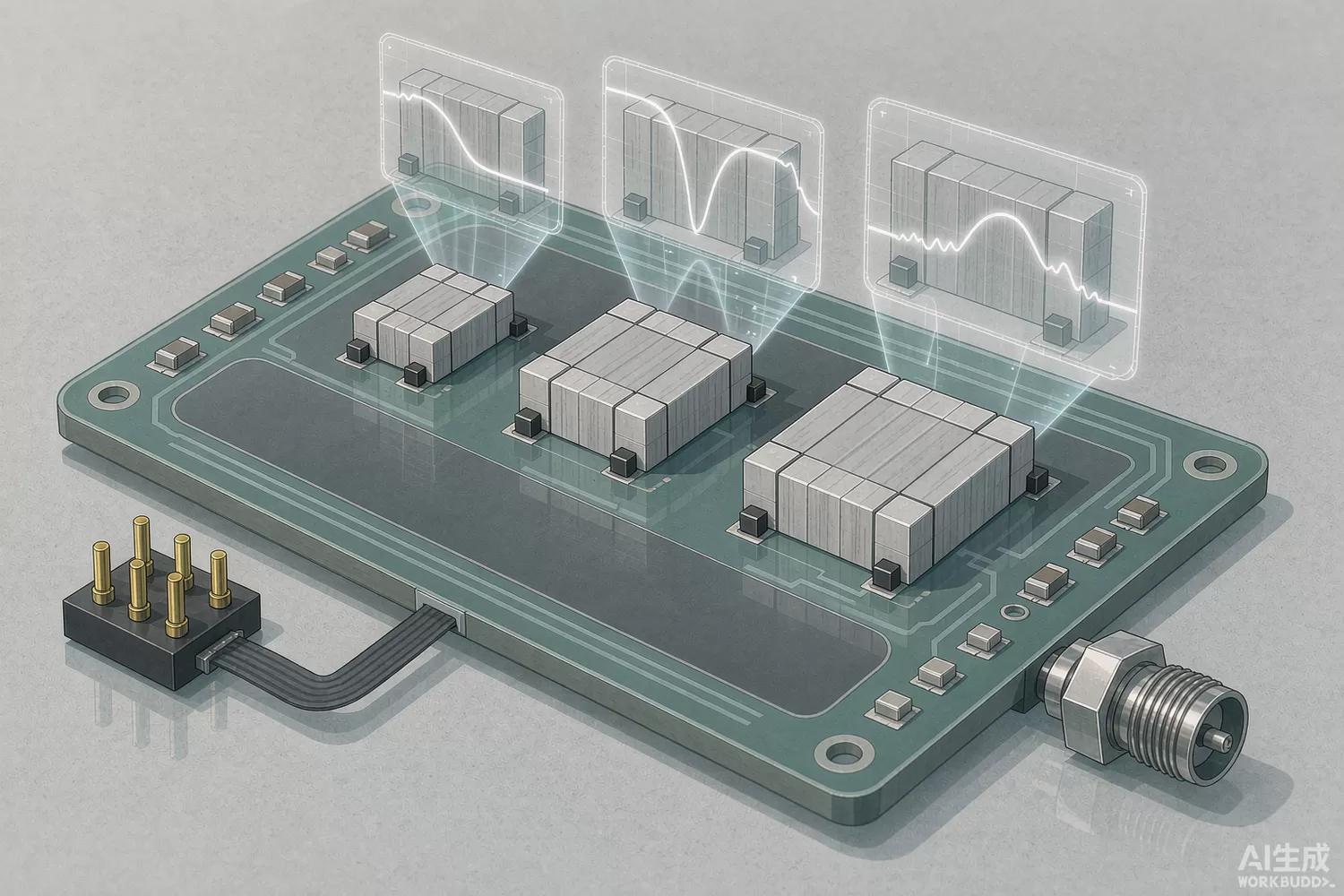
Filters are where a radio either respects the spectrum or insults it, and LTCC — low-temperature co-fired ceramic — has quietly become the workhorse technology for the broad, unglamorous filtering that keeps chains alive: anti-alias protection in front of converters, harmonic clean-up after mixers, bias-path shaping, and band definition where an acoustic filter would be overkill or impossible. This article walks the selection logic for LTCC low-pass, high-pass and band-pass parts, what is new, and how the domestic supply compares.

Application logic: what an LTCC filter is actually buying you
LTCC parts are lumped-element and distributed structures fired into a multilayer ceramic body: tiny, hermetic-ish, machine-placeable, stable over temperature and power-tolerant. Against that, SAW and BAW acoustic filters win on skirt steepness and narrow-band insertion loss — the technology comparison and the SAW versus dielectric versus LC analysis map the boundaries. In practice the LTCC socket appears wherever the requirement is broadband: a DC–2 GHz low-pass protecting a sampler from harmonics; a 5–8 GHz high-pass discarding HF interference ahead of an instrumentation amplifier; a 2.2–2.6 GHz band-pass shaping a private-network radio. The loss budget then gets checked the usual way, as in our insertion-loss budget guide: every decibel in the pass band is either link margin or noise figure.
Selection, then, is a four-column exercise. Cutoff or centre frequency and the guard bands around it. Rejection at the specific interferers and harmonics that matter — a datasheet rejection floor at 6 GHz is irrelevant if your threat is the second harmonic at 2.4 GHz. Power handling, because these parts sit after mixers and even after PAs, and a filter pushed past its power rating shifts its response and generates its own intermodulation. And package: 0402 and 0603 LTCC parts land on standard SMT lines, which is exactly why they replaced connectorised blocks in volume products. Our LTCC selection guide and the Mini-Circuits LFCN/HFCN family guide walk the imported families.
New technology in LTCC and thin-film filtering
- Sub-1 mm LTCC footprints: 0402-class low-pass parts at 180 MHz and below, sized for converter anti-alias duty where board space was previously the constraint.
- Wider high-pass families reaching 8–10 GHz cutoffs for instrumentation and wideband receiver chains.
- Band-pass LTCC parts with improved rejection slopes, narrowing the gap to dielectric filters at 2–6 GHz without their size.
- Better power ratings — 0.5 to 2 W continuous — letting LTCC parts live after mixer and driver stages, not only at low level.
- Tighter lot-to-lot consistency with published distribution data, which matters because filters ship in reels and one bad lot is a recall.
- Hybrid LC and thin-film families filling the millimetre-wave range where LTCC parasitics begin to bite.
Domestic alternatives: what to analyse before switching
- Compare the rejection curve at your actual threat frequencies, and ask for data at temperature extremes — LTCC dielectric constants drift, and the cutoff moves with them.
- Verify power handling at your worst-case sustained level, not the peak rating.
- Check the land pattern and termination plating against your assembly line; 1206-inch FV1206 footprints are common but pad geometry differs.
- Request reel-level S-parameter consistency data or sample-and-measure across at least three lots.
- Confirm the grade: commercial, industrial wide-temperature, or −55 to +125 °C screened.
- Pilot the swap on one filter position first — the one guarding the highest-value converter — and A/B the board measurement before rolling out to the full BOM.
Indicative cost comparison: imported originals vs domestic candidates
Price figures below are indicative public-market reference ranges for moderate volumes, compiled from publicly observable listings. They fluctuate with the spot market, package option, grade (industrial, automotive, screened) and order quantity, and must not be read as a quotation. Ask us for a firm price on your exact part numbers and quantities.
| Device class | Common imported reference | Indicative imported unit price | Commonly referenced domestic candidate | Indicative domestic unit price |
|---|---|---|---|---|
| LTCC low-pass filter, DC–100 MHz to DC–3.8 GHz | Mini-Circuits LFCN-95+ / LFCN-105+ / LFCN-3800+; LFCG / LFCW classes | USD 0.5–2.5 | Chengdu HenryTech HT-LFCN / HT-LFCG / HT-LFCW series; Sunlord, Microgate families | USD 0.25–1.5 |
| LTCC high-pass filter, 92 MHz to 8.4 GHz cutoff | Mini-Circuits HFCN-4400+ / HFCN-5500+ / HFCN-8400+ | USD 0.8–3 | HenryTech HT-HFCN series and peers | USD 0.4–2 |
| LTCC band-pass filter, ~2.3 GHz class | Mini-Circuits BFCN-2275+ | USD 1–3.5 | HenryTech HT-BFCN series; domestic LTCC houses | USD 0.5–2 |
| Thin-film / LC precision filter, mmWave-adjacent | Imported thin-film families | USD 3–15 | Domestic thin-film and LC filter programmes (family level) | USD 1.5–8 |
Two cost notes. First, this is the highest-leverage substitution category in the whole passive BOM: filters appear five to fifteen times per board, the imported parts are individually cheap, and a 40–50 percent saving multiplied across reels and boards is real money — which is precisely why domestic LTCC capacity grew so fast. Second, the qualification risk is drift, not catastrophe: a filter whose cutoff moves 5 percent over temperature passes the bench and fails the field. The two-sample temperature sweep is the cheapest insurance in RF sourcing.
Commonly referenced alternative models
| Imported original (reference) | Domestic candidate (public sources) | Why it is referenced |
|---|---|---|
| Mini-Circuits LFCN-105+ — LTCC low-pass, DC–105 MHz, FV1206 | Chengdu HenryTech HT-LFCN-105+ (vendor-published corresponding part) | Same pass band, SMD-4 3.2×1.6 mm footprint, 50 Ω; publicly listed by the vendor as the corresponding domestic type. |
| Mini-Circuits LFCN-180+ class — LTCC low-pass, DC–180 MHz | HenryTech HT-LFCN-180+ — 0.95×0.75 mm SMD-4, −55 to +125 °C, 0.5 W | Publicly documented with measured ~0.7 dB pass-band loss and ≥30 dB rejection at 270 MHz; aimed at IF and clock anti-alias duty. |
| Mini-Circuits LFCG-92+/490+/2500+/2600+, LFCW-143+/1062+ — low-pass families | HenryTech HT-LFCG / HT-LFCW series (mirrored part-number scheme) | Same 0805/0603 LTCC low-pass sockets from VHF to 2.6 GHz; compare rejection at your harmonic frequencies. |
| Mini-Circuits HFCN-4400+/5500+/5500D+/8400+ — high-pass families | HenryTech HT-HFCN series (mirrored scheme) | Same high-pass duty ahead of wideband amplifiers; check insertion loss at the low edge of your band. |
| Mini-Circuits BFCN-2275+ — LTCC band-pass, ~2.3 GHz | HenryTech HT-BFCN series; domestic band-pass LTCC families | Same band-pass socket for 2.2–2.6 GHz private-radio and ISM chains; verify the rejection skirt below the band. |
| Mini-Circuits LFCN-3800+ — LTCC low-pass, DC–3.8 GHz | Domestic LTCC low-pass families (family level) | Cross-referenced for sampler and mixer post-filtering duty in the low-GHz range. |
We stock the imported references — the LFCN-95+, LFCN-105+, LFCN-3800+, LFCG-92+, LFCG-490+, LFCG-2500+, LFCG-2600+, LFCW-143+, LFCW-1062+, HFCN-4400+, HFCN-5500+, HFCN-5500D+, HFCN-8400+ and BFCN-2275+. Acoustic filtering and its domestic candidates are covered separately in our SAW and BAW substitution guide; everything here lives in the Mini-Circuits collection and the filters and frequency-control collection.
Frequently asked questions
When should I pick an LTCC filter instead of a SAW filter?
When you need broadband behaviour, high power handling, small size and cost in volume rather than razor-narrow selectivity. LTCC low-pass and high-pass parts handle anti-aliasing, harmonic clean-up and IF shaping across DC-to-multi-GHz ranges that acoustic filters cannot reach, and they survive watt-level power that would age a SAW.
How do LTCC low-pass, high-pass and band-pass parts divide the work?
The low-pass (LFCN/LFCG/LFCW classes) kills harmonics and cleans up clock and IF edges; the high-pass (HFCN classes) strips low-frequency interference before a wideband amplifier; the band-pass (BFCN classes) does channel shaping where a SAW is overkill or the band is too wide. A two-part LPF+HPF pair often replaces a custom band-pass.
Are domestic LTCC filters qualified beyond consumer use?
Yes: the publicly documented domestic families publish military-temperature ranges (−55 to +125 °C), watt-level power ratings and per-part S-parameter data, and they are used in instrumentation, radio and industrial designs, not only consumer devices. Verify per part: temperature drift and power derating differ between vendors.
What do I measure before committing a design to a domestic filter?
Insertion loss and return loss across the pass band, rejection at the two or three frequencies that actually threaten your system, power handling at your worst-case level and temperature, and — often forgotten — the pass-band ripple and group-delay flatness if the filter sits in a modulation path.
About us & trademarks: JTDZ Tech (Shenzhen Jingteng Electronics Technology Co., Ltd.) is an independent distributor of electronic components. We are not an authorised distributor or representative of the imported manufacturers named in this article. Manufacturer, brand and part names are used for identification purposes only; all trademarks remain the property of their respective owners. Cross-reference information in this article is based on publicly available sources, is subject to change, and is not a substitute for your own engineering validation. Always verify specifications against the manufacturer's datasheet before design-in or purchase.
