
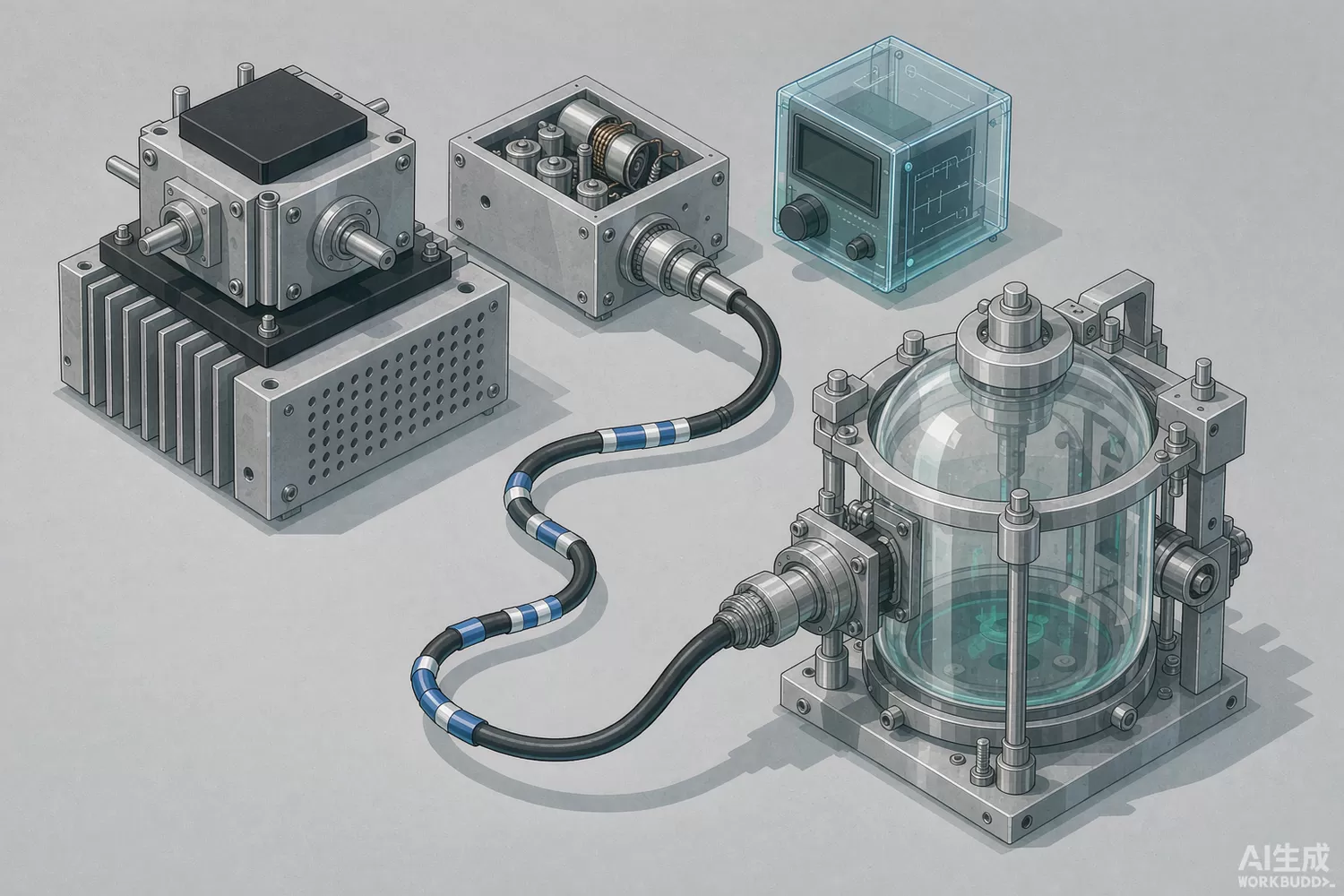
Radio gets the glory, but radio-frequency energy is an industrial tool in its own right: plasma excitation in semiconductor etching and PECVD, industrial heating and drying, medical ablation and physiotherapy, diamond deposition, RF beauty devices, and the 27 MHz and 40 MHz classics of industrial welding. The heart of every one of those systems is a power stage — RF power MOSFETs, GaAs FETs, LDMOS or GaN die plus their matching networks — and it is a component category where substitution decisions are made with a thermal camera and a spectrum analyser, not a spreadsheet alone.

Application logic: what the power stage must actually survive
An industrial RF power stage lives in three constraints at once. The load: an industrial chamber or applicator presents a wildly variable impedance — a plasma ignites, heats, shifts — so the amplifier sees reflections that consumer radios never encounter, and the device must survive full reflected power, which is why system builders add circulators and why device ruggedness ratings matter more than efficiency. The spectrum: ISM bands are regulated, so harmonic and spurious output decide the filter and bias architecture, and linearity decides whether the system can use pulsed or swept modes. The thermal design: a transistor running kilowatts at 60–70 percent efficiency deposits hundreds of watts of heat that the package, the flange and the coolant must move; die-attach and thermal resistance are as much a purchase criterion as gain. The system context — generators, matchers and their substitution landscape — is covered in our medical and industrial RF applications overview, and the device-level comparison for base-station-class power transistors in the GaN/LDMOS substitution guide.
Device choice then follows the band. At 13.56–40.68 MHz, silicon RF power MOSFETs rule: rugged, cheap, and forgiving at high supply voltages; the classic TO-style packages (and plastic derivatives like the PowerSO-10RF referenced below) dominate. From 100 MHz into the low GHz, LDMOS and GaN take over where efficiency and bandwidth matter; GaAs FETs remain the reference for high-linearity medium-power stages and for the enormous installed base of legacy UHF radio designs. MMIC power amplifiers (the Qorvo and Avago parts referenced below) cover the driver and medium-power tiers. Our notes on power-amplifier applications and P1dB and compression set the level-planning background.
New technology in industrial RF power
- Solid-state replacement of vacuum tubes across the ISM range: modular kW-class amplifiers built from LDMOS and GaN dice, with 24/7 duty, remote monitoring and instant spares instead of tube changes.
- GaN-on-SiC power die with higher power density and bandwidth, shrinking matcher size and enabling multi-band industrial generators.
- Digitally controlled RF generators — 2 to 60 MHz, 1–30 kW — with fast frequency tuning, arc suppression and pulsed modes for plasma processes.
- Wideband internal-input matching in MMIC PA dies, simplifying the driver tier of industrial amplifiers.
- Better thermal packages: ceramic and plastic power packages with lower thermal resistance and published transient thermal impedance.
- Domestic supply chains for the complete stack — power die, matching capacitors, circulators, matchers and generators — reducing single-source exposure for equipment makers.
Domestic alternatives: what to analyse before switching
- Compare output capacitance (Coss) and package parasitics first: the matching network is designed around them, and a mismatch forces a re-tune.
- Ask for ruggedness and load-mismatch data (VSWR tolerance at rated power) — the parameter that decides survival in plasma and heating duty.
- Check thermal resistance and die-attach technology, and request transient thermal data for pulsed processes.
- Verify harmonic performance in your actual class of operation (class C/E/D variants differ), not the class-A bench figure.
- For system-level substitution, review the domestic generator makers' published power stability, matching speed and interface compatibility with your chamber control.
- Plan a parallel-run validation: power stability over an eight-hour soak plus EMC pre-scan, before committing the production line.
Indicative cost comparison: imported originals vs domestic candidates
Price figures below are indicative public-market reference ranges for moderate volumes, compiled from publicly observable listings. They fluctuate with the spot market, package option, grade (industrial, automotive, screened) and order quantity, and must not be read as a quotation. Ask us for a firm price on your exact part numbers and quantities.
| Device class | Common imported reference | Indicative imported unit price | Commonly referenced domestic candidate | Indicative domestic unit price |
|---|---|---|---|---|
| HF/VHF RF power MOSFET, 100–600 W class | ST PD84008-E and similar European/Japanese RF MOSFETs | USD 15–45 | Domestic silicon RF power MOSFET families (CETC institutes; family level) | USD 8–30 |
| UHF RF power GaAs FET, 10–35 W class | Sumitomo FLU10XMT / FLU35XMT series | USD 25–140 | Domestic GaAs power FET families (CETC-13/55 lines; family level) | USD 15–90 |
| Driver / medium-power MMIC PA, UHF–S band | Qorvo SZM-3166Z, AH225-S8G, RFPA3800 class; Avago MGA-43528 / MGA-43828 | USD 8–60 | Domestic GaAs/GaN MMIC PA families (family level) | USD 5–40 |
| GaN power die / transistor, kW-class systems | Imported GaN die and transistor families | USD 60–400 | Domestic GaN families (Sanan IC, Dynasemi and institute lines; family level) | USD 35–250 |
| Complete solid-state RF generator, 13.56/27.12/40.68 MHz | Imported RF generator systems | USD 8,000–60,000+ | Chengdu Wattsine, Suzhou Semican and peer domestic generator makers | USD 4,000–35,000 |
Two cost notes. First, in the generator row the domestic saving is the headline — solid-state domestic sources now run plasma and heating systems at 13.56–60 MHz and 2.45 GHz — but the integration cost is control-software compatibility, so pick vendors with documented protocol compatibility. Second, at transistor level the saving is real yet secondary to ruggedness: one plasma arc that kills a cheap substitute costs more than a year of savings, so the VSWR-tolerance and thermal rows of the comparison carry more weight than the price row.
Commonly referenced alternative models
| Imported original (reference) | Domestic candidate (public sources) | Why it is referenced |
|---|---|---|
| ST PD84008-E — RF power MOSFET, PowerSO-10RF | Domestic silicon RF power MOSFET families from CETC institutes and domestic foundries (family level) | Same HF/VHF power socket in industrial generators and welding/heating amplifiers; compare Coss, VSWR ruggedness and thermal data. |
| Sumitomo FLU10XMT / FLU35XMT — UHF RF power GaAs FET | Domestic GaAs power FET families (CETC-13 / CETC-55 programme lines, family level) | Same medium-power, high-linearity UHF socket in legacy radio and industrial amplifiers. |
| Qorvo SZM-3166Z / AH225-S8G — MMIC power amplifiers | Domestic GaAs MMIC PA families (family level) | Same driver and medium-power duty in industrial and private-radio chains. |
| Qorvo RFPA3800TR13 — high-power driver amplifier | Domestic high-power driver MMIC families (family level) | Cross-referenced for the same pre-driver socket in UHF power chains. |
| Avago/Broadcom MGA-43528 / MGA-43828 — power amplifier MMICs | Domestic pHEMT power MMIC families (family level) | Same high-efficiency power MMIC socket; validate output match and harmonic mask in circuit. |
| Imported kW-class solid-state RF generators | Chengdu Wattsine (Wattsine) solid-state sources at 2–60 MHz and 433 MHz–2.45 GHz; Suzhou Semican RF generators to 40.68 MHz | Publicly documented domestic generator families running plasma, heating and medical systems; verify protocol compatibility and pulsed-mode features. |
We stock the imported device-level references — the PD84008-E RF power MOSFET, FLU10XMT and FLU35XMT GaAs FETs, SZM-3166Z, AH225-S8G, RFPA3800TR13, MGA-43528-TR1G, MGA-43828-TR1G and the ECG002B-G GaN die — in the RF and interface chip collection, the Qorvo collection and the Avago collection.
Frequently asked questions
Which ISM bands do industrial RF power systems actually use?
The classic plasma and heating bands — 13.56, 27.12, 40.68 MHz — plus 433, 915 MHz and 2.45 GHz for heating, medical ablation and industrial microwave. Each band has its own device and matching culture, so a power transistor substitution is always band-specific.
MOSFET, LDMOS or GaAs FET for the power stage?
At HF/VHF, silicon RF power MOSFETs dominate on ruggedness and cost. In the UHF and low-GHz bands, LDMOS and GaN take the efficiency crown; GaAs FETs hold the high-linearity, medium-power sockets and legacy radio designs. The band and the linearity mask decide, not fashion.
Are domestic power devices credible for 24/7 industrial duty?
For the transistor level, domestic silicon RF MOSFET and GaAs/GaN families from the CETC institutes and commercial foundries are publicly documented at comparable class levels, and domestic solid-state RF source makers run them in plasma and industrial-heating systems around the clock. For programmes, the question is lot consistency and thermal data — ask for both.
What is the biggest hidden cost in a power-stage substitution?
The matching network. Device output capacitance and package inductance set the load line; a substitute with different parasitics forces a re-tuned matcher and a re-run of thermal and EMC validation. Compare package parasitics before price.
About us & trademarks: JTDZ Tech (Shenzhen Jingteng Electronics Technology Co., Ltd.) is an independent distributor of electronic components. We are not an authorised distributor or representative of the imported manufacturers named in this article. Manufacturer, brand and part names are used for identification purposes only; all trademarks remain the property of their respective owners. Cross-reference information in this article is based on publicly available sources, is subject to change, and is not a substitute for your own engineering validation. Always verify specifications against the manufacturer's datasheet before design-in or purchase.
