
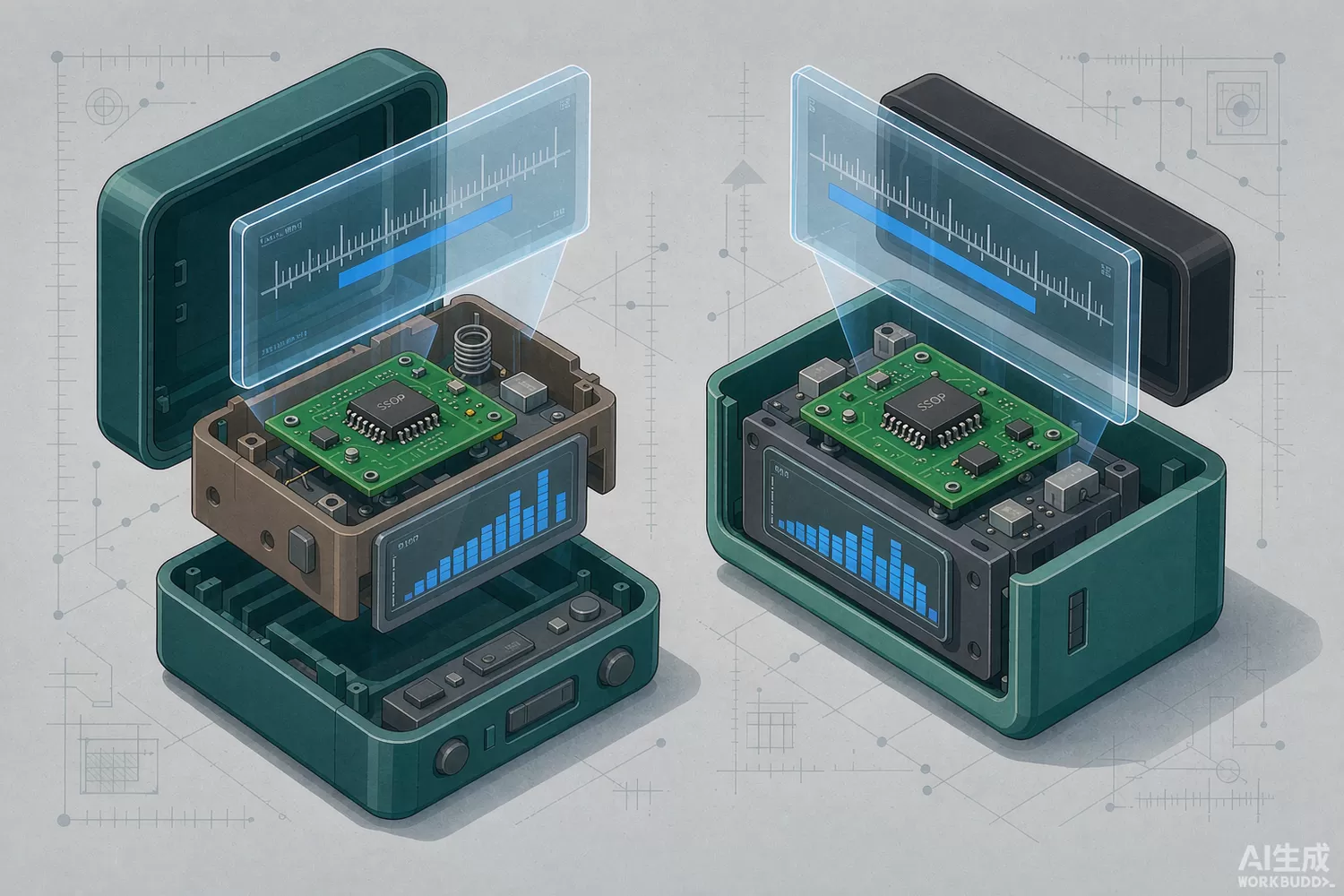
The radio receiver chip is one of the oldest stories in consumer silicon and one of the quietest domestic-substitution successes. What used to be a shelf of coils, IF cans and alignment jigs became a single digital-tuning chip; what used to be an imported monopoly in that chip is now a two-supplier market. For buyers of portable radios, clock radios, campus and emergency broadcast products, and car-audio modules, this is the cheapest substitution programme in RF — and also one of the easiest to get subtly wrong.

Application logic: what the tuner chip decides
A modern single-chip radio receiver integrates the complete receive chain: low-noise RF input, quadrature or low-IF down-conversion from an on-chip synthesizer, digital channel filtering, demodulation of AM, FM and often SW/LW bands, stereo decoding, RDS/RBDS processing on the automotive parts, and a line or headphone audio output. What separates good implementations is invisible on a block diagram: sensitivity with a short antenna (portable radios live or die here), adjacent-channel selectivity in crowded urban spectrum, the behaviour of the AGC and AFC across fading, and the audio signal-to-noise actually delivered to the ear. The imported references — Silicon Labs' Si473x portable family and Si476x automotive dual-tuner family — defined the benchmark; our front-end overview explains what still surrounds the chip, and the coexistence guide covers the selectivity arithmetic.
System integration is where these parts are won or lost. The reference clock input must match the host MCU's available clocks (the domestic parts accept 32.768 kHz to 26 MHz for exactly this reason). The control interface — I2C on both families — needs a firmware port: seek behaviour, band tables, de-emphasis and regional band plans all live in registers. And the analogue details remain analogue: antenna matching, audio output coupling and the headphone driver's load. IF selectivity is on-chip, but the board still needs the occasional IF or antenna SAW filter in demanding products — parts like the TB0614A and TA0224A SAW filters from our frequency-control collection still appear in tuner BOMs.
New technology in broadcast radio reception
- Fully integrated digital tuners with on-chip synthesizers, automatic antenna tuning and digitally adjustable AM channel filters (1–6 kHz), removing alignment labour from manufacturing.
- Multi-band coverage beyond broadcast: shortwave and longwave reception integrated into the same chip for world-band portables and emergency receivers.
- Automotive dual-tuner architectures running diversity and RDS/RBDS with seamless blending, at AEC-qualified grades.
- Low-power architectures running the whole receiver at ~22 mA from two cells, with standby modes that preserve station and volume without external memory.
- Wide reference-clock tolerance (32.768 kHz–26/40 MHz) so the tuner shares the host MCU's clock and removes a crystal from the BOM.
- Companion connectivity in the same product family — Bluetooth audio SoCs and DSP radios coexisting in one audio platform.
Domestic alternatives: what to analyse before switching
- Compare sensitivity and SNR at the same conditions: the domestic flagship publishes 1.6 μV EMF FM and 16 μV EMF AM with 60/55 dB SNR and 0.3 percent THD — put your incumbent's figures next to them at identical measurement conditions.
- Check band coverage you actually ship: the KT0913 series covers FM 32–110 MHz and AM 0.5–1.71 MHz; SW/LW variants differ between generations, so match the band table to your market.
- Verify the reference-clock range and the I2C register map against your firmware's tuning and seek logic.
- Confirm audio-path details: stereo headphone driver integration, line-in options and output level — these decide whether an audio amplifier stage survives the swap.
- Check package and pinout (SSOP16/SSOP20 classes) against your layout, and the standby-memory behaviour your product promises.
- For automotive-tier designs, ask each domestic candidate for qualification evidence before planning the swap; this tier is still maturing.
Indicative cost comparison: imported originals vs domestic candidates
Price figures below are indicative public-market reference ranges for moderate volumes, compiled from publicly observable listings. They fluctuate with the spot market, package option, grade (industrial, automotive, screened) and order quantity, and must not be read as a quotation. Ask us for a firm price on your exact part numbers and quantities.
| Device class | Common imported reference | Indicative imported unit price | Commonly referenced domestic candidate | Indicative domestic unit price |
|---|---|---|---|---|
| Single-chip AM/FM/SW receiver, I2C, portable radio | Silicon Labs Si4730 / Si4735 class | USD 1–3 | KTMicro KT0913 / KT0913L-D4 | USD 0.4–1.2 |
| Multi-band receiver with mechanical tuning support | Imported single-tuner families | USD 1–3 | KTMicro KT0913L-D4 (analog + digital tuning, SSOP20L) | USD 0.5–1.4 |
| Automotive dual-tuner with RDS and diversity | Silicon Labs Si4763 / Si479xx class | USD 2.5–6 | Domestic automotive tuner programmes (family level; verify qualification) | USD 1.5–4 |
| Tuner peripheral: IF / antenna SAW filter | Tai-Saw TB0614A / TA0224A, Taiyo Yuden FAR-F6KA class | USD 0.1–0.6 | Domestic SAW vendors for 10.7 MHz IF and GPS-class filters | USD 0.04–0.3 |
Two cost notes. First, at 50–70 percent saving on the tuner and a similar saving on the SAW, a portable-radio BOM sheds meaningful cost quickly — this is the rare substitution where the payback survives even a modest firmware port. Second, the automotive row is where diligence matters: dual-tuner domestic parts are publicly positioned but qualification evidence varies by programme, so buy that row with certificates, not with confidence.
Commonly referenced alternative models
| Imported original (reference) | Domestic candidate (public sources) | Why it is referenced |
|---|---|---|
| Silicon Labs Si4730-D60 — single-chip AM/FM/SW/LW receiver, I2C | KTMicro Electronics KT0913 — fully integrated AM/FM receiver, SSOP16L | Vendor-published full-band FM 32–110 MHz and AM 0.5–1.71 MHz coverage, integrated synthesizer, auto antenna tuning, 60/55 dB SNR, I2C control — the same portable-radio socket at consumer price. |
| Silicon Labs Si4735 class — world-band portable receiver | KTMicro KT0913L-D4 — newer-generation receiver, SSOP20L | Adds audio input, status indicators and improved EMI/EMC; supports analog dial and digital tuning variants for retrofit designs. |
| Silicon Labs Si4763-A42 — automotive dual-tuner | Domestic automotive tuner programmes (family level — qualification varies) | Publicly positioned for car-radio diversity and RDS duty; verify AEC evidence and second-source status per programme. |
| Imported tuner companion IF SAW filters | Tai-Saw (Taiwan/domestic supply chain) TB0614A, TA0224A; domestic SAW vendors | Same 10.7 MHz-class IF filtering duty in demanding tuner products; low-cost, low-risk substitution. |
| Imported stereo decoder / audio companion parts | Integrated in the domestic tuner (audio line-in, TPDT switch, headphone driver on-chip) | Integration absorbs companion parts, which is where part of the BOM saving actually comes from. |
We stock the imported references — the Si4730-D60-GUR and Si4730-D60-GMR portable receivers and the Si4763-A42-GMR automotive dual tuner — alongside tuner peripherals such as the TB0614A and TA0224A SAW filters and the FAR-F6KA-1G5754-L4AAMZ, and we source the domestic tuner families referenced above. Related reading: our IoT radio-chip overview for the connected-audio context.
Frequently asked questions
What does a DSP radio receiver chip replace in a traditional radio?
Almost the entire analogue front end: LNA, mixer, IF filtering, detection, stereo decoding and often the audio path. One chip plus a crystal, a coil for antenna matching and a small MCU gives you a world-band radio with digital tuning, seek, AGC and memory — which is why BOM cost fell so sharply over the last decade.
What is the practical difference between the Si4730-class single tuner and the Si4763-class dual tuner?
Architecture and application. The single-tuner parts serve portable and desktop radios, clock radios and toys; the automotive dual-tuner parts run two simultaneous receive paths for phase diversity, radio-data services and seamless source switching in the car, at automotive qualification levels.
How good are domestic radio-on-a-chip receivers today?
The publicly documented domestic flagship — the KTMicro KT0913 series — is a fully integrated AM/FM receiver with an on-chip synthesizer, automatic antenna tuning, adjustable AM channel filters, stereo headphone driver and I2C control, at 22 mA from two AAA cells. For FM/AM duty it covers the same application space as the imported single tuners; the automotive dual-tuner tier remains an area to check programme by programme.
Can a domestic radio chip drop into an existing radio design without changes?
Usually not without a small redesign: reference clocks, control interface mapping and audio output levels differ, and mechanical tuning variants behave differently. The cost advantage survives a modest layout revision; it rarely survives insisting on a zero-change swap.
About us & trademarks: JTDZ Tech (Shenzhen Jingteng Electronics Technology Co., Ltd.) is an independent distributor of electronic components. We are not an authorised distributor or representative of the imported manufacturers named in this article. Manufacturer, brand and part names are used for identification purposes only; all trademarks remain the property of their respective owners. Cross-reference information in this article is based on publicly available sources, is subject to change, and is not a substitute for your own engineering validation. Always verify specifications against the manufacturer's datasheet before design-in or purchase.
