
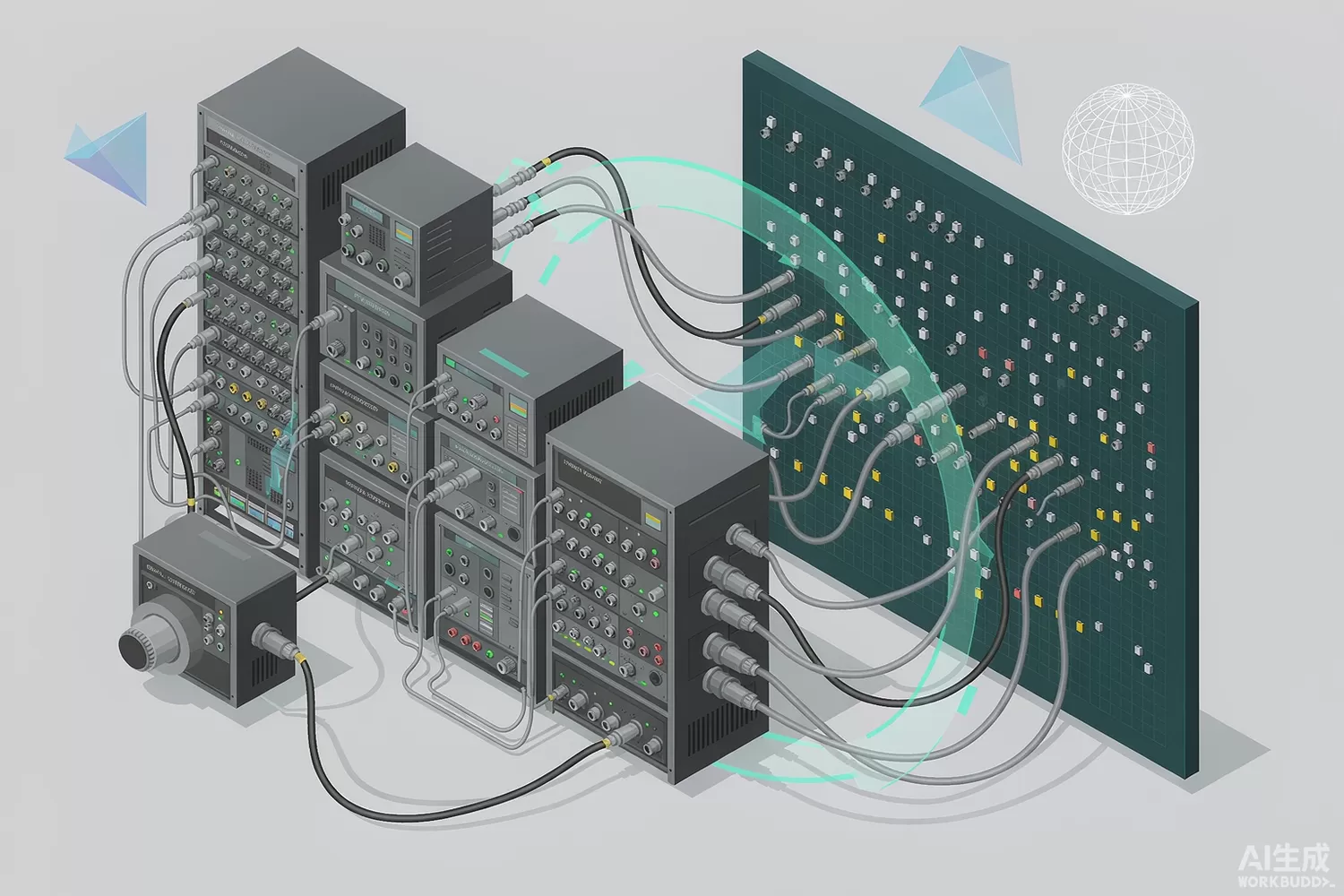
Behind every automated RF test station, every multi-antenna radio and every redundant transmit path stands an unglamorous class of parts: the RF switch ICs that decide, in nanoseconds, which signal goes where. Handset antenna switching has its own high-volume culture — covered separately in our SOI antenna-switch substitution guide — but the routing side of the family is where broadband performance, isolation and power handling earn their keep, and it is where this article concentrates.

Application logic: what a routing switch is actually deciding
A routing switch is judged by what it does to a signal that has already been carefully conditioned. Insertion loss and its flatness are paid at every hop: a matrix with four switch hops and 0.8 dB each has spent 3.2 dB of link or measurement margin before the instrument is even considered — arithmetic our loss-budget guide treats in general. Isolation matters at the frequencies you do not want to hear: an off-state leakage of −30 dB is fine for a radio, marginal for a receiver protector and unacceptable in a measurement path. Switching speed sets the throughput of automated test sequences; power handling sets whether the switch can sit before or after an amplifier; and the control interface — three logic pins or a decoded multi-throw with integrated driver — decides how much firmware the matrix costs. The specification vocabulary is unpacked in our switch specifications guide and the selection trade-offs in the insertion-loss and isolation selection guide.
Technology then sorts by job. GaAs FET MMIC switches dominate broadband routing to 20 GHz and beyond with fast switching and good isolation. SOI CMOS parts own the high-integration, low-voltage space. PIN-diode switches (with the diode families from our limiter article) own the high-power sockets. Electromechanical relays still hold the metrology-grade sockets where repeatability matters more than speed. The system builder's job is to place each technology where its physics wins — the technology comparison walks that ladder, and the module versus discrete analysis covers when to buy a FEM instead.
New technology in RF switching and routing
- Broadband SOI/CMOS switches reaching 6–8 GHz with sub-0.6 dB insertion loss and integrated decode logic, migrating from handsets into CPE and radio routing.
- GaAs MMIC SPDT–SP4T families covering DC–20 GHz and beyond in tiny QFN packages for instrumentation and defence routing.
- High-linearity handset-grade switches with P0.1dB above 45 dBm, blurring into small-cell and private-radio duty.
- Ruggedised switches with built-in ESD and over-voltage tolerance for outdoor and automotive radio units.
- Faster control logic with the state held during power-down, so a matrix recovers to a defined state after a brown-out.
- Integration trend: switches co-packaged with LNAs and attenuators in front-end ICs, reducing the hop count that pays the insertion-loss bill.
Domestic alternatives: what to analyse before switching
- Compare isolation at your highest operating frequency — and at the leakage frequencies that matter to your measurement, which can be higher.
- Check power handling in the off state as well as on; off-state leakage under power is a classic failure in transmit routing.
- Verify control logic compatibility: pin-out, truth table and supply range, and whether the part holds state through power cycling.
- For multi-throw parts, compare insertion-loss variation between throws; unmatched throws corrupt switched-difference measurements.
- Ask for S-parameters and switching-time histograms, not just typicals; these parts ship in matrices where unit-to-unit spread compounds.
- Qualify at the matrix level: measure the assembled path's loss, isolation and repeatability, because housing and bias routing add their own parasitics.
Indicative cost comparison: imported originals vs domestic candidates
Price figures below are indicative public-market reference ranges for moderate volumes, compiled from publicly observable listings. They fluctuate with the spot market, package option, grade (industrial, automotive, screened) and order quantity, and must not be read as a quotation. Ask us for a firm price on your exact part numbers and quantities.
| Device class | Common imported reference | Indicative imported unit price | Commonly referenced domestic candidate | Indicative domestic unit price |
|---|---|---|---|---|
| Broadband SPDT routing switch, 0.1–6 GHz | Qorvo RFSW1012; MACOM MASWSS0162; MACOM SW-456 class | USD 0.8–3 | Maxscend MXD8721-class SPDT (0.5–6 GHz, ~0.55 dB loss); domestic GaAs SPDT families | USD 0.15–1 |
| SP4T / multi-throw switch, integrated decode logic | Qorvo RFSW6024; Skyworks SE2595L class | USD 1–4 | Maxscend MXD8545B-class SP4T (0.1–3 GHz, 45 dBm linearity); domestic multi-throw families | USD 0.3–1.8 |
| High-linearity front-end switch / FEM switch | Qorvo QPC6044 class | USD 1.5–4 | Domestic front-end switch and FEM-switch families | USD 0.5–2 |
| High-power PIN switch / wideband MMIC switch, instrument grade | MACOM MA4L/MA4P diode-based switch assemblies; imported GaAs MMIC switches to 20 GHz | USD 5–60 | CETC institute GaAs MMIC switch families and domestic PIN assemblies (family level) | USD 3–40 |
Two cost notes. First, this is the second-highest-leverage passive-adjacent substitution after filters: routing switches appear four to ten times in a test system or multi-antenna radio, and the domestic broadband parts now undercut the imported references by 50–80 percent at comparable published specs. Second, the saving evaporates in rework if isolation is qualified at room temperature only — leakage currents rise with temperature, and a matrix that passes on the bench can fail in a warm cabinet. Add a hot-box spot check to the qualification and the comparison stays honest.
Commonly referenced alternative models
| Imported original (reference) | Domestic candidate (public sources) | Why it is referenced |
|---|---|---|
| Qorvo RFSW1012TR7 — GaAs SPDT switch | Maxscend MXD8721 — SOI SPDT, 0.5–6 GHz, ~0.55 dB loss, 32 dB isolation (publicly listed specs) | Same broadband SPDT routing socket at commodity price; verify power handling and control truth table against your matrix. |
| Qorvo RFSW6024TR13 — multi-throw switch with logic | Maxscend MXD8545B — SOI SP4T, 0.1–3 GHz, integrated decoder, P0.1dB 45 dBm | Same multi-throw, logic-controlled duty for antenna and channel routing; publicly published specs support direct comparison. |
| MACOM MASWSS0162 / SW-456 — MMIC switches | Domestic GaAs MMIC switch families from CETC institutes and commercial lines (family level) | Same MMIC switch sockets across DC–multi-GHz routing; compare isolation curves and switching speed. |
| Skyworks SE2595L — front-end switch module | Domestic FEM-switch families (family level) | Same integrated front-end switching duty in CPE and small-cell radios. |
| Qorvo QPC6044TR13 — high-linearity switch | Domestic high-linearity switch families (family level) | Cross-referenced for the same high-power TX routing sockets; check off-state ruggedness. |
| MACOM MA4L011-based PIN switch assemblies | Domestic PIN-diode switch assemblies and CETC GaAs MMIC switches (family level) | Same high-power and wideband instrument routing duty; validate recovery and video leakage for pulsed systems. |
We stock the imported references — the RFSW1012TR7, RFSW6024TR13, QPC6044TR13, SW-456TR-3000, MASWSS0162TR-3000, SE2595L-R and the MA4L011-134 limiter/switcher diode — in the RF and interface chip collection, the Qorvo collection and the Skyworks collection. Our Qorvo part-number guide and Skyworks buyer's guide map the rest of those families.
Frequently asked questions
How is a signal-routing switch different from the antenna switch in a phone?
Different optimisation point. Handset antenna switches chase tiny size and handset-band linearity on SOI; test, instrumentation and radio-routing switches chase bandwidth (DC to 20 GHz and up), isolation at high frequency, power handling and repeatable S-parameters. The same word "switch" hides two different component cultures.
What decides a routing switch in practice?
Insertion loss and flatness across your band, isolation at the frequencies that leak into your measurement, switching speed for automated sequences, power handling (0 dBm in a receiver vs 30 dBm in a test path), and the control interface — bare control pins for speed, or logic with integrated decoders for MCU friendliness.
Can one domestic switch vendor cover both cultures?
Increasingly yes at the routing end: Maxscend's published broadband SPDT/SP4T parts reach 6 GHz and beyond with sub-decibel loss, and the CETC institutes publicly document GaAs MMIC switch families for wideband and high-power routing. For the highest-frequency instrument sockets, compare isolation curves, not categories.
Why do switch matrices still get built from discrete SPDT parts?
Flexibility and signal integrity: a matrix of quality SPDTs lets you define topology, add attenuators and amplifiers where needed, and replace a single stage instead of a multi-throw module. The discrete approach survives because the matrix requirements keep changing with the test plan.
About us & trademarks: JTDZ Tech (Shenzhen Jingteng Electronics Technology Co., Ltd.) is an independent distributor of electronic components. We are not an authorised distributor or representative of the imported manufacturers named in this article. Manufacturer, brand and part names are used for identification purposes only; all trademarks remain the property of their respective owners. Cross-reference information in this article is based on publicly available sources, is subject to change, and is not a substitute for your own engineering validation. Always verify specifications against the manufacturer's datasheet before design-in or purchase.
