
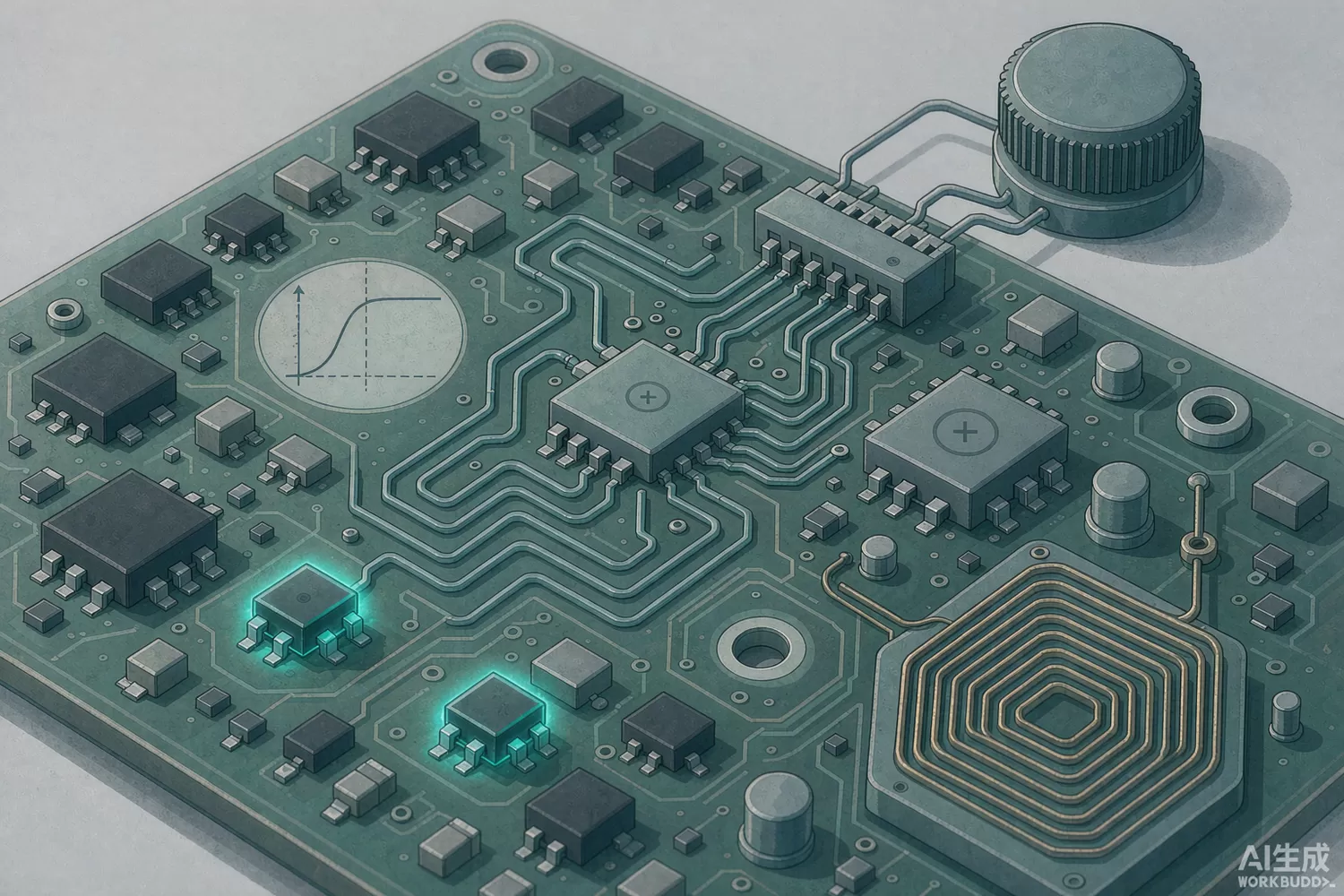
A varactor is a diode operated in reverse bias so that its junction capacitance follows the applied voltage. That single property turns a small SOT-23 part into the tuning element of virtually every analogue frequency source: VCOs, voltage-tuned preselection filters, tunable matching networks and analog phase shifters. This article walks through the application logic, the specification parameters that actually decide performance, and the domestic families that engineers now cross-reference against Skyworks SMV, MACOM MAVR-000400 and M/A-COM MA4ST400 series parts.

Application logic: where varactors earn their place
In a Colpitts or Clapp VCO, the varactor sits in the resonant tank and converts a 0–20 V tuning voltage into an inductance-capacitance product that sweeps the oscillation frequency. Two numbers matter more than any others: the capacitance ratio (C at minimum reverse bias divided by C at maximum) decides the achievable tuning octave, and the quality factor Q sets how much the diode damps the tank — which shows up directly as degraded phase noise. The Z-Communications SMV2020L VCO module is a practical example: inside the shielded package, a silicon hyperabrupt varactor plus a printed resonator deliver a wide tuning band from a single control pin.
Voltage-tuned filters follow the same logic. A varactor-loaded LC band-pass filter lets one hardware design cover several radio bands, trading filter Q and linearity for agility. The same technique appears in antenna matching networks, where a varactor absorbs the drift of an electrically small antenna across temperature and hand effect.
Choosing between abrupt and hyperabrupt profiles
The doping profile decides how capacitance changes with voltage. An abrupt-junction diode gives high Q and excellent linearity of C–V over a narrow range — ideal where phase noise dominates. A hyperabrupt profile (gamma roughly 1 or higher) gives a steeper, more linear frequency-versus-voltage curve across an octave or more — ideal where the PLL loop needs to sweep fast and predictably. The Skyworks SMV1148 and the MACOM MAVR-000401 family both target this hyperabrupt role; the MAVR-000400 series documents a capacitance ratio of up to 9.5:1 and Q of about 250 at 4 V / 50 MHz in a common-cathode SOT-23 pair.
Specification checklist before design-in
- Cj at your working bias (e.g. 11 pF at 4 V for MAVR-000401) and the ratio Cmin/Cmax.
- Q at the frequency you actually use, not the 50 MHz headline figure.
- Breakdown voltage versus your maximum tuning voltage (22 V is typical for silicon parts such as MA4ST409CK).
- Series resistance and its temperature behaviour — it dominates loaded Q at VHF.
- C–V lot repeatability for production tuning; ion-implanted processes document SPC monitoring.
- Single or common-cathode pair configuration, which decides your bias network.
New technology in tuning elements
Three trends are visible in current designs. First, lower-voltage hyperabrupt families allow tuning from 3 V logic rails, removing the 12–30 V bias generator that older designs needed. Second, matched pairs in one package (common-cathode duals such as the MA4ST409CK) halve the C–V spread between the two arms of push-push or differential VCOs. Third, at the system level, digitally tunable capacitor ICs and MEMS varactors now compete with diodes where discrete step control is acceptable; diode solutions keep the edge where continuous tuning, very low capacitance step size and cost in volume matter. For a system view of how the tuning element interacts with the loop, see our article on PLL synthesis and integrated-VCO LO generation.
Domestic alternatives: families and indicative cost
Publicly documented domestic capability for silicon tuning varactors exists chiefly at family level: compound-semiconductor and silicon-diode lines operated by China Electronics Technology Group Corporation research institutes (CETC-13 and CETC-55) publish abrupt and hyperabrupt tuning-diode families in SOT-23-style packages for VCO and voltage-tuned-filter use. Detailed C–V curves are typically shared under NDA rather than on open catalogues, so we list the domestic side at family level and encourage a direct comparison on your working bias points.
Price figures below are indicative public-market reference ranges for moderate volumes, compiled from publicly observable listings. They fluctuate with the spot market, package option, grade (industrial, automotive, screened) and order quantity, and must not be read as a quotation. Ask us for a firm price on your exact part numbers and quantities.
| Function (imported anchor) | Example import part | Indicative import price (USD) | Domestic candidate (family level) | Indicative domestic price (USD) |
|---|---|---|---|---|
| Hyperabrupt tuning varactor, SOT-23 | MAVR-000401-0287FT (MACOM) | 0.45 – 1.20 | CETC-13/55 silicon tuning-diode families | 0.20 – 0.60 |
| Broadband hyperabrupt varactor | SMV1236 / SMV1281 (Skyworks) | 0.08 – 0.25 | CETC-13/55 hyperabrupt families | 0.05 – 0.20 |
| High-Q abrupt varactor | SMV1493 / SMV1234 (Skyworks) | 0.10 – 0.30 | CETC-13/55 abrupt families | 0.05 – 0.20 |
| Dual common-cathode varactor | MA4ST409CK (M/A-COM) | 0.50 – 1.50 | CETC-13/55 dual-diode families | 0.30 – 0.90 |
| Tuning element inside VCO module | SMV2020L VCO module (Z-Comm) | 3.00 – 8.00 | Domestic VCO-module vendors (module level) | 2.00 – 6.00 |
Because varactor pricing is dominated by C–V tolerance screening rather than die cost, the premium for tight matching at multiple bias points is often larger than the brand gap. Compare at your exact bias points and tolerance grades before switching sources.
Selection and qualification flow
Bench validation takes one afternoon: build the intended tank on a test PCB, sweep the tuning voltage with a supply and a DMM, and read frequency and output power on a counter or spectrum analyser. Record C–V-derived tuning slope, phase noise at 10 kHz and 100 kHz offsets, and pushing level. Only then compare domestic candidates on the identical fixture — layout parasitics shift both tuning range and phase noise by measurable margins.
Frequently asked questions
Can I substitute a hyperabrupt varactor for an abrupt one in an existing VCO?
Not blindly. The steeper C–V curve changes the tuning slope and can push the loop out of its designed gain margin. Re-measure tuning sensitivity (MHz/V) and loop phase margin on the real board.
Which parameter decides VCO phase noise most?
Loaded Q of the whole resonator; the varactor's series resistance is usually the biggest single contributor inside the tank. Compare Q at your operating bias, not the datasheet headline at 50 MHz.
Are dual (common-cathode) varactors worth the premium?
In push-push or differential tanks yes: the two junctions come from the same wafer lot, so C–V spread between arms is much tighter than two singles.
Do domestic varactor families support tight C–V matching?
Family-level documentation indicates matched and screened grades are offered, but detailed curves are usually shared under NDA. Ask us to arrange a comparison kit before committing a design.
About us & trademarks: JTDZ Tech (Shenzhen Jingteng Electronics Technology Co., Ltd.) is an independent distributor of electronic components. We are not an authorised distributor or representative of the imported manufacturers named in this article. Manufacturer, brand and part names are used for identification purposes only; all trademarks remain the property of their respective owners. Cross-reference information in this article is based on publicly available sources, is subject to change, and is not a substitute for your own engineering validation. Always verify specifications against the manufacturer's datasheet before design-in or purchase.
