
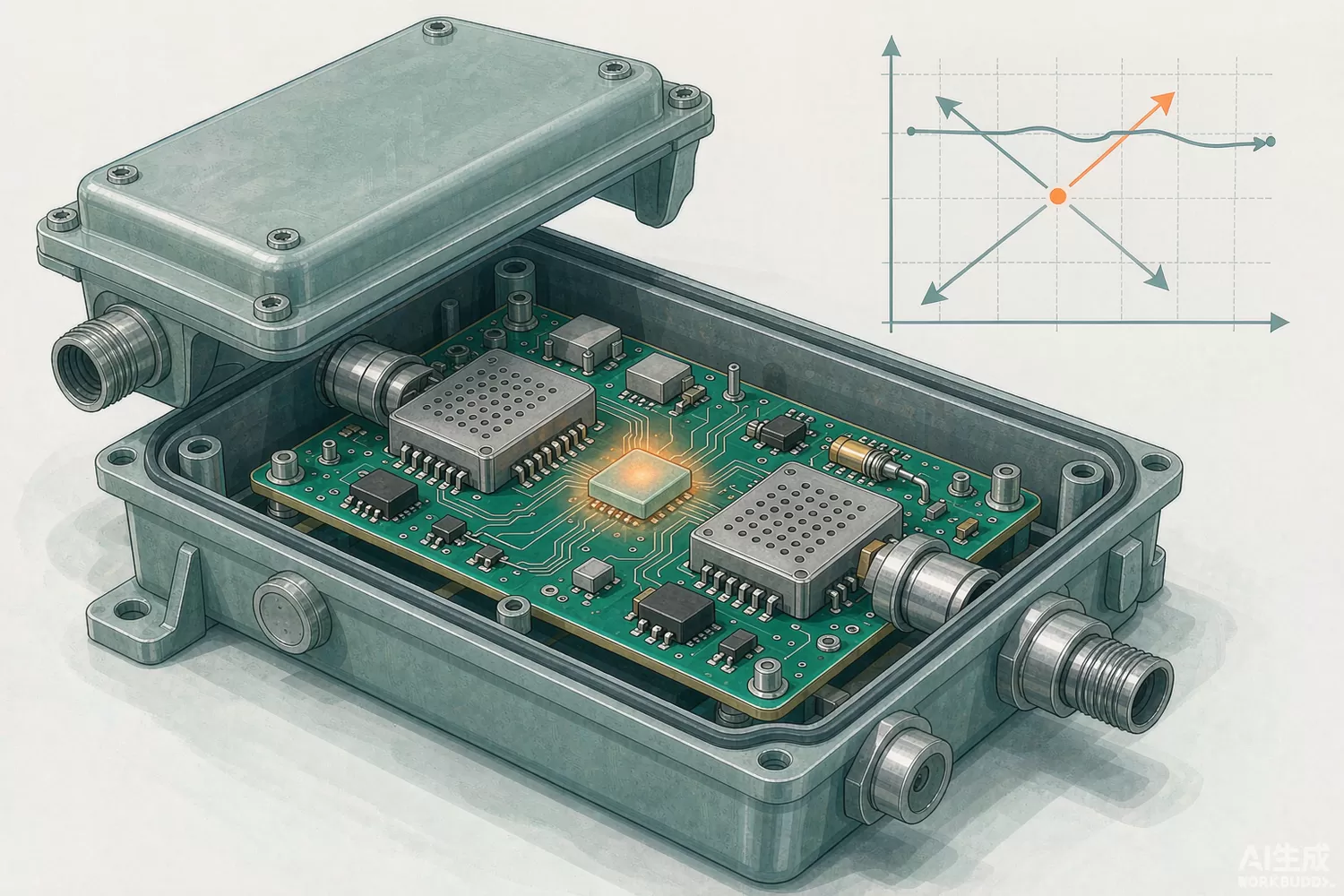
Every amplifier chain drifts. GaAs and GaN gain stages lose roughly 0.006–0.015 dB/°C per stage, so a four-stage outdoor PA can swing 1.5–3 dB between a cold night and a hot noon. A temperature-variable attenuator — universally nicknamed a thermopad — is a passive two-port whose attenuation rises with temperature at a fixed slope, deliberately placed so that its drift cancels the amplifiers' drift. No supply, no control loop, no firmware: just thick-film or thin-film resistors engineered with the right temperature coefficient.

Application logic: where a thermopad goes
The classic insertion point is between gain stages, or immediately after the driver, where signal level is high enough that the pad's insertion loss does not hurt noise figure but low enough that its power rating is not challenged. Placement rules of thumb:
- Between stage 2 and stage 3 of a receiver chain: compensates cumulative drift of both preceding stages with minimal noise-figure penalty.
- After the driver, before the PA: keeps the PA's input drive constant as the driver's gain drifts, protecting linearity and adjacent-channel power.
- In front of a detector or power-control loop: stabilises the level that the detector sees, so the control loop does not chase temperature.
- Any point where two high-gain MMICs are cascaded and oscillation margin is tight — the pad's return loss improves inter-stage isolation at the same time.
The imported anchors in this article are EMC Technology TVA and MTVA series parts stocked on our shelves, for example the TVA0500N03W3 and TVA0600N09F coaxial-style parts plus chip-style MTVA0200N06F and MTVA0300N09F thermopads. The suffix convention encodes the compensation slope; in practice you select slope in dB/°C and total attenuation to cancel your measured chain drift.
Specifying the slope: measure first, then order
Thermopads are ordered by slope, not by part number folklore. The workflow that works:
- Measure chain gain at +25°C and at +60°C (or your worst case) and compute drift in dB/°C.
- Choose a thermopad whose slope is the negative of that drift, within about 10%.
- Check the flat operating band: chip-style parts cover DC to tens of GHz; coaxial styles each have a defined band.
- Verify power handling at your highest sustained RF level, derated for the enclosure's ambient.
- Confirm return loss over the full temperature range — good parts stay near 20 dB across the sweep.
New technology: chip-scale thermopads for phased arrays
The current generation push is miniaturisation. Chip-style thermopads in 0.8×0.85 mm footprints with gold electrodes for wire bonding now target T/R-module boards, where hundreds of channels each need drift compensation and no one can afford a DAC plus temperature sensor per channel. Thin-film processes give tighter slope tolerance and better repeatability than classic thick film, and laser trimming lets vendors hit non-standard slopes for volume customers. The passive approach is also immune to the oscillation and power-cycling failure modes of active compensation circuits — one reason satellite and defence programmes still specify it.
Domestic alternatives: families and indicative cost
Domestic supply here is unusually well documented at product-family level. Shenzhen Yantel (Yantel Corp.) publishes ultra-small passive temperature-compensated attenuator chips down to DC–20 GHz with selectable compensation slopes and gold-bondable electrodes, alongside fixed chip attenuators. Fujian Millimeter Electronics offers chip-style passive temperature-compensated attenuators in its NTVA series, with quality grades aligned to military reliability testing, and Chengdu Hongke Electronics and Shaanxi Huajing Microelectronics also advertise thermopad families. Industry media reported in 2026 that a Chinese group standard for temperature-compensated attenuators (T/CEAC 079-2024) now defines type designation and test methods — a useful cross-check when comparing vendor datasheets.
Price figures below are indicative public-market reference ranges for moderate volumes, compiled from publicly observable listings. They fluctuate with the spot market, package option, grade (industrial, automotive, screened) and order quantity, and must not be read as a quotation. Ask us for a firm price on your exact part numbers and quantities.
| Function (imported anchor) | Example import part | Indicative import price (USD) | Domestic candidate | Indicative domestic price (USD) |
|---|---|---|---|---|
| Coaxial-style thermopad, 0.5 dB/C class | TVA0500N03W3 (EMC Technology) | 2.50 – 7.00 | Yantel TC-attenuator chip family | 0.80 – 2.50 |
| Thermopad, higher slope class | TVA0600N09F / TVA0500N06W3F (EMC Technology) | 2.50 – 7.00 | Yantel / Chengdu Hongke families | 0.80 – 2.50 |
| Chip-style thermopad (SMD) | MTVA0200N06F / MTVA0300N09F (EMC Technology) | 1.50 – 5.00 | Fujian Millimeter NTVA chip series | 0.50 – 2.00 |
| Companion fixed chip attenuation | DAT-31575+ DSA (Mini-Circuits, control side) | 6.00 – 14.00 | Yantel fixed chip attenuators | 0.30 – 1.00 |
Thermopads are commodity-adjacent but slope-screened, so price tracks slope tolerance and band flatness more than brand. For volume programmes, asking two domestic vendors and the import source for the same slope spec on the same substrate is the fastest way to see the real gap.
Qualification checklist
Sweep the assembled chain from -40°C to +85°C twice and confirm total gain flatness within your budget; check that the thermopad's own insertion loss at +25°C leaves enough margin for the compensation to add attenuation at temperature extremes; and run a power-soak at maximum input level to confirm no resistance drift. A properly specified thermopad will outlive the transistors around it.
Frequently asked questions
Can one thermopad compensate a whole receiver?
Yes, if the chain's drift is dominated by two or three MMIC stages with similar coefficients. Measure the total drift, then place the pad where insertion loss and power rating are both comfortable.
Thermopad versus digital step attenuator for drift control?
A DSA plus a temperature sensor actively trims drift and can adapt to different boards, at the cost of control logic, supply current and step quantisation. A thermopad is set-and-forget, needs no supply, and never mis-programmes — the usual choice for fixed outdoor units.
What slope values are standard?
Common chip families cover roughly 0.002 to 0.01 dB/C slopes in several steps; vendors such as Yantel list multiple selectable slopes. Measure first, then pick the nearest standard slope.
Do domestic NTVA-style chips match EMC Technology parts electrically?
Public documentation covers slope, band and reliability grading, so a first-order match is usually achievable. Validate return loss and slope tolerance on your own fixture before approving a second source.
About us & trademarks: JTDZ Tech (Shenzhen Jingteng Electronics Technology Co., Ltd.) is an independent distributor of electronic components. We are not an authorised distributor or representative of the imported manufacturers named in this article. Manufacturer, brand and part names are used for identification purposes only; all trademarks remain the property of their respective owners. Cross-reference information in this article is based on publicly available sources, is subject to change, and is not a substitute for your own engineering validation. Always verify specifications against the manufacturer's datasheet before design-in or purchase.
