
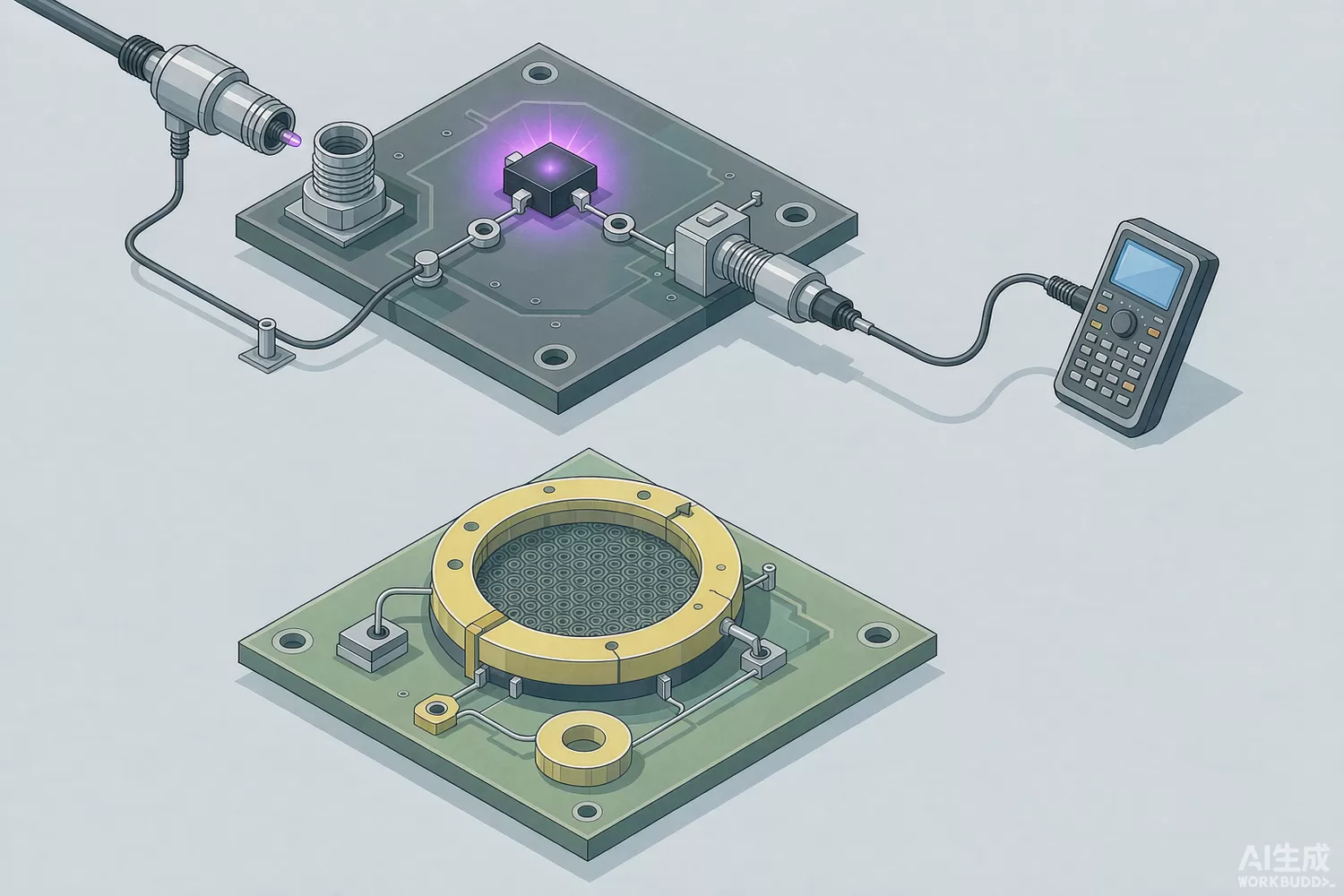
Long before integrated log detectors existed, a single Schottky diode converted RF into DC. The discrete diode survives — and in several niches dominates — because it beats IC solutions on bandwidth, noise floor and power consumption: a passive diode detector needs no supply at all. This article covers the three classic roles, the datasheet parameters that decide success, and the domestic families engineers benchmark against Skyworks SMS/HSMS/HSMG and Broadcom MADP parts.

Application logic 1: zero-bias and biased detection
A zero-bias Schottky detector rectifies RF into DC with no DC bias, which is why it powers power meters, crystal-video receivers, RFID wake-up circuits and levelling loops. Sensitivity is set by the barrier height: low-barrier silicon parts (the Skyworks SMS7621 class, e.g. the SMS7621-074) give usable output at -50 dBm and below, while higher-barrier parts need bias but handle more power. The classic Avago/Broadcom HSMS-285x zero-bias family and the biased HSMS-286x family (e.g. HSMS-2864) illustrate the trade: the 285x wins sensitivity, the 286x wins dynamic range and temperature stability. Detection circuits are still used where an IC log amplifier cannot reach the frequency or the power budget — see our IC-level discussion in the power-detector and log-amplifier article for the crossover point.
Application logic 2: mixing and harmonic generation
Schottky diodes remain the mixing element of choice well into the millimetre bands, where transistor mixers lose the speed race. GaAs Schottky mixer diodes such as the HSMG-C150 pair document sub-1 pF capacitance and very high cutoff frequency, enabling subharmonic and fundamental mixers beyond 100 GHz. In test hardware, step-recovery and harmonic-mixing diodes extend counters and spectrum analysers; and in lab practice the same diodes sample gates of sampling oscilloscopes. The broadband silicon families (e.g. HSMS-2820, HSMS-2812 un-biased general-purpose parts and the dual HSMS-282C) cover the everyday 1–6 GHz detector and mixer sockets.
Reading the datasheet: four numbers that matter
- Cj0, zero-bias junction capacitance — sets the upper frequency corner; 0.1–0.3 pF class for microwave detectors.
- VF at a defined current — proxy for barrier height and therefore sensitivity versus power handling.
- Rs, series resistance — dominates the video equivalent circuit and conversion loss.
- Thermal resistance and power rating — decides survivability when the detector is accidentally over-driven.
New technology: low-barrier and film-compensated detectors
Two developments keep discrete diodes relevant. Modern low-barrier silicon processes push zero-bias tangent sensitivity below -55 dBm while holding video resistance low enough for fast video amplifiers. And detector-pair packages (antiparallel or series pairs such as the MADP-000907) cancel even-order distortion and DC offset, which matters in direct-conversion receivers and power probes. GaAs zero-bias families extend useful detection beyond 40 GHz where silicon rolls off. Legacy parts such as the HP 5082-2811 remain in demand for service and instrument repair — a reminder that the physics has not changed, only the packaging.
Domestic alternatives: families and indicative cost
Domestic capability in microwave Schottky diodes is publicly documented at family level: China Electronics Technology Group Corporation research institutes (notably CETC-55 in Nanjing) publish GaAs and silicon Schottky detector and mixer diode families covering zero-bias detection, low-barrier detection and millimetre-wave mixing, typically with datasheets available through controlled channels. For commodity-grade detector roles, domestic discrete-diode lines are straightforward to benchmark; for millimetre-wave mixing dies, ask for wafer-lot S-parameters and barrier data.
Price figures below are indicative public-market reference ranges for moderate volumes, compiled from publicly observable listings. They fluctuate with the spot market, package option, grade (industrial, automotive, screened) and order quantity, and must not be read as a quotation. Ask us for a firm price on your exact part numbers and quantities.
| Function (imported anchor) | Example import part | Indicative import price (USD) | Domestic candidate (family level) | Indicative domestic price (USD) |
|---|---|---|---|---|
| Zero-bias detector diode, SOT-23 | SMS7621-074 (Skyworks) | 0.10 – 0.35 | Domestic silicon low-barrier detector lines | 0.05 – 0.20 |
| Biased detector / general purpose | SMS3922 / HSMS-2805 (Skyworks) | 0.08 – 0.30 | Domestic silicon Schottky lines | 0.05 – 0.20 |
| Broadband detector pair | MADP-000907 (Broadcom) | 0.60 – 2.00 | CETC-55 detector-pair families | 0.30 – 1.20 |
| GaAs mixer diode, beam-lead style | HSMG-C150 / HSMG-C170 (Broadcom) | 1.50 – 5.00 | CETC-55 GaAs Schottky die families | 1.00 – 3.50 |
| Legacy instrument-repair diode | HP 5082-2811 | 2.00 – 8.00 | CETC-55 equivalents (die level) | 1.50 – 5.00 |
For detector sockets the domestic price advantage is real but modest; the decisive factor is usually temperature-stable sensitivity, so compare tangent sensitivity across temperature, not just at +25°C. For mixer diodes, conversion loss in your own fixture is the only verdict that counts.
Practical design notes
Keep the video path short: every picofarad of stray capacitance at the detector node costs sensitivity. Terminate the RF side properly — a detector is only as flat as its input match. And if the diode will ever see transmit leakage, add a limiter or a resistor ahead of it: Schottky junctions die quietly and without symptoms. For front-end protection pairings, see our PIN limiter protection article.
Frequently asked questions
When should I choose a discrete diode over an integrated log detector?
Below roughly -50 dBm inputs, above tens of GHz, when zero power consumption is required, or when you need video bandwidths and form factors ICs do not offer. Inside those corners, IC log amplifiers are easier to use.
Zero-bias or biased detection?
Zero-bias wins sensitivity and simplicity; biased detection wins dynamic range, temperature stability and video bandwidth. If your level range spans more than about 35 dB, plan for bias and temperature compensation.
Can domestic Schottky diodes replace Skyworks parts one for one?
At commodity detector level, usually yes with fixture validation. At mixer and millimetre-wave die level, request barrier height, C-V data and conversion-loss test data before approving.
Why do my detector readings drift with temperature?
Barrier height falls about 2 mV per degree C. Either choose a low-barrier part with a compensation scheme, switch to a temperature-compensated pair package, or add a reference detector on the same substrate.
About us & trademarks: JTDZ Tech (Shenzhen Jingteng Electronics Technology Co., Ltd.) is an independent distributor of electronic components. We are not an authorised distributor or representative of the imported manufacturers named in this article. Manufacturer, brand and part names are used for identification purposes only; all trademarks remain the property of their respective owners. Cross-reference information in this article is based on publicly available sources, is subject to change, and is not a substitute for your own engineering validation. Always verify specifications against the manufacturer's datasheet before design-in or purchase.
