
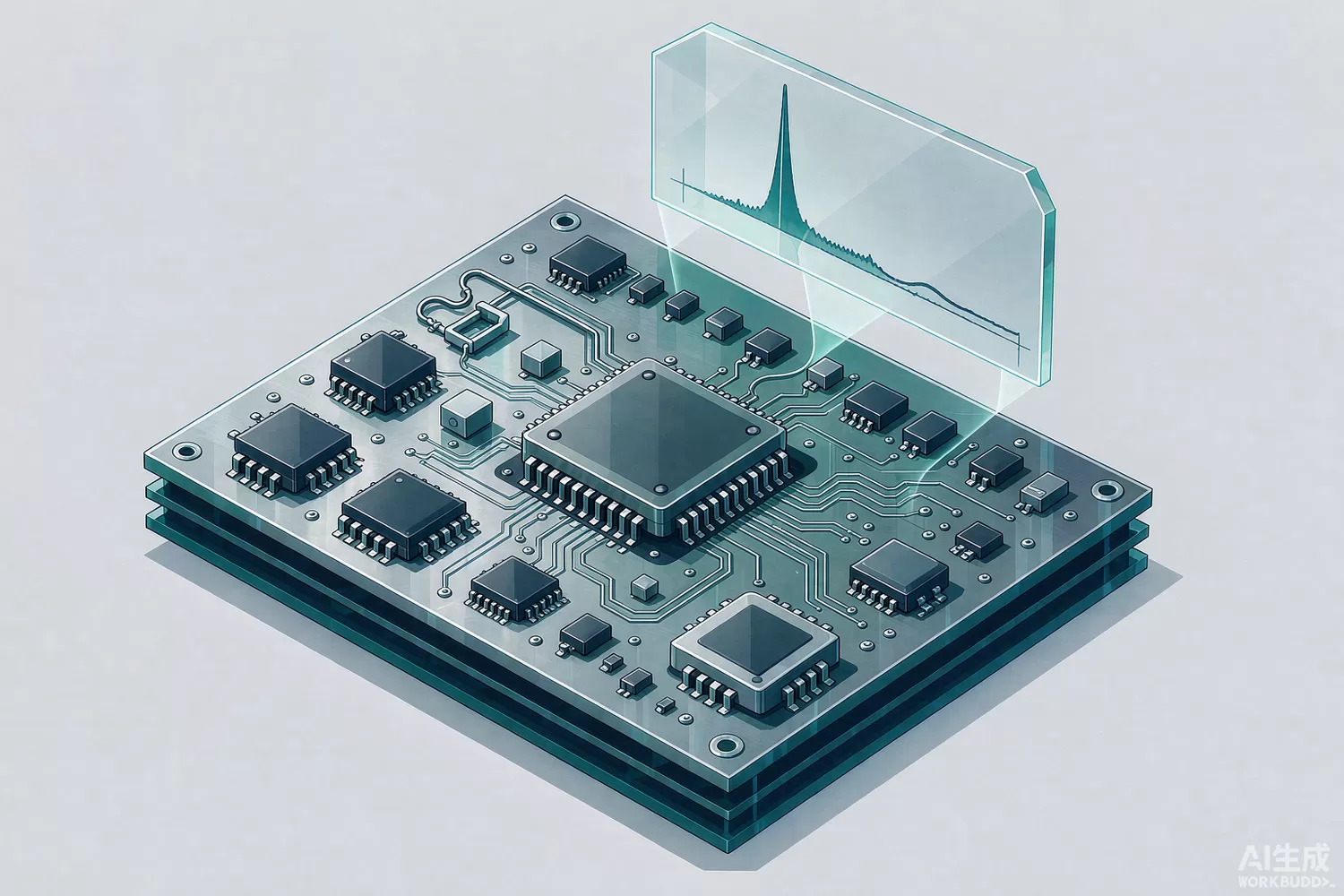
Every radio has a heartbeat, and that heartbeat is the local oscillator. The synthesizer that generates it decides how far a receiver can hear, how clean a transmitter looks on a spectrum analyser, and whether a phased array can steer its beam without the elements fighting each other. It is also one of the quieter corners of the RF BOM: a synthesiser is a small part of the cost and a large part of the risk.

Application logic: what the synthesizer is actually deciding
A PLL synthesizer locks a voltage-controlled oscillator to a divided version of a reference clock, so that the output frequency is N/M times the reference. That one sentence hides the whole design trade-off. The loop bandwidth sets where the synthesizer stops cleaning up the VCO and starts following it: wide loops lock fast and suppress VCO noise at low offsets, narrow loops reject reference spurs and reference jitter but take longer to settle. In a time-division system the lock time is part of the frame budget; in a satellite or instrument application the same silicon may be specified for phase noise instead. Designers cannot optimise both at once, so the frequency plan and the loop filter have to be set from the system requirement downwards.
The practical parameters that decide whether a part fits are phase noise at the relevant offsets, the maximum phase-detector frequency (higher is better for in-band noise), whether the VCO is integrated or external, output division range, lock time in the mode you will actually use, and the reference path. Reference quality is where many designs quietly lose their budget: the jitter of a cheap crystal or TCXO multiplies into the RF output, so a synthesizer is often paired with a jitter-cleaning clock device. For the same reason, microwave point-to-point radios and base-station transceivers treat the radio's clock tree as part of the RF chain rather than as housekeeping. Our notes on base-station front ends and GNSS receivers show the same discipline applied to receivers that must pull signals out of the noise.
On a phased array the synthesizer becomes a distribution problem as well as a noise problem. Every channel needs a coherent reference, so multi-synthesizer synchronisation, deterministic phase relationship and skew control between devices move up the requirement list. That is why the same silicon families appear both in single-loop radios and in large arrays.
New technology in PLL and clock synthesis
- Wideband integrated VCOs with octave or multi-octave tuning ranges, so one device covers the sub-6 GHz spectrum and removes the external resonator that used to dominate board area.
- High phase-detector frequencies combined with fractional-N engines, pushing in-band noise down without forcing a narrow loop.
- Jitter-cleaning clock devices with dual-loop and digital PLL architectures, delivering sub-100 fs RMS jitter to data converters and SERDES as well as to RF mixers.
- Fractional spur cancellation and on-chip loop-filter calibration, which reduce the reliance on hand-tuned external components.
- Multi-device phase synchronisation and sysref-style alignment, aimed at phased arrays and multi-channel instruments.
- Integrated low-dropout regulators and supply-domain isolation to keep digital switching noise out of the VCO core.
Domestic alternatives: what to analyse before switching
- Compare phase-noise plots at the offsets that matter to your standard, not the headline single number, and ask for data over temperature.
- Check the tuning range against your full frequency plan, including the guard bands and the divider settings you will actually program.
- Confirm the phase-detector frequency limit and whether fractional mode is supported with the spur performance your mask requires.
- Ask for measured lock time in the mode you intend to use, and for the register map and programming guide in a form your firmware team can port.
- Verify the reference input requirements (level, slew, jitter) against the clock source you plan to use.
- Confirm the product stage of each candidate: several publicly referenced domestic PLL devices are in sampling or development rather than volume production, and the article says so where that is the case.
Indicative cost comparison: imported originals vs domestic candidates
Price figures below are indicative public-market reference ranges for moderate volumes, compiled from publicly observable listings. They fluctuate with the spot market, package option, grade (industrial, automotive, screened) and order quantity, and must not be read as a quotation. Ask us for a firm price on your exact part numbers and quantities.
| Device class | Common imported reference | Indicative imported unit price | Commonly referenced domestic candidate | Indicative domestic unit price |
|---|---|---|---|---|
| Wideband fractional-N synthesizer with integrated VCO | TI LMX2594 / LMX2592; ADI ADF4351 / ADF5356 class | USD 8–25 | XND259x (CETC-24 Southwest), CSCG2594 (CETC-58), STF2594-class, CLM4351, BR9177FL | USD 4–12 |
| Jitter-cleaning clock / synthesizer for converters and SERDES | TI LMK04828; ADI HMC7044 class | USD 20–60 | GMD04828 / GMD7044N (Chengdu Zhenxing), CSCG04828-class | USD 9–28 |
| Single-chip clock generator (multi-output) | Skyworks Si5351 class | USD 1.5–4 | Domestic multi-output clock generators from the same Si535x-class roadmap | USD 0.6–2 |
| Discrete VCO module (narrowband, low phase noise) | Mini-Circuits ROS-series; ADI HMC-series VCOs | USD 12–40 | Domestic VCO modules from Chengdu and Nanjing suppliers | USD 6–20 |
Two cost notes. First, the synthesizer is rarely the largest line in an RF BOM but it is frequently the largest schedule risk, because a phase-noise or spur problem is discovered late, at EMC or type-approval time, when re-layout is expensive. Budget the comparison around validation cost, not only unit price. Second, a screened or wide-temperature grade can double the price of either an imported or a domestic device; check that the cheaper candidate you are comparing is offered in the same grade as the part it replaces, or the comparison is not like for like.
Commonly referenced alternative models
The rows below are pairings that appear in publicly circulated domestic cross-reference lists and in vendor catalogues. Several of them are family-level or sampling-stage; treat each one as a starting point for your own evaluation, not as a specification.
| Imported original (reference) | Domestic candidate (public sources) | Why it is referenced |
|---|---|---|
| TI LMX2594 — wideband fractional-N synthesizer with integrated VCO | XND2594 / XND2595 (CETC-24 Southwest), CSCG2594 (CETC-58), STF2594-class | Same class of wideband integrated-VCO synthesizer; publicly listed as the corresponding domestic device. Compare phase noise at your offsets and confirm production stage. |
| ADI ADF4351 — fractional-N / integer-N synthesizer with VCO | CLM4351 series (Qilong Microelectronics); XND4351-class | Publicly documented as a functionally corresponding 3.0–3.6 V synthesizer covering the same 35 MHz–4.4 GHz output range; verify loop filter and register compatibility. |
| ADI ADF5356 — 6.8 GHz synthesizer | BR9177FL (Bonray); CLF5356-class | Listed as the corresponding domestic device; note that package and register details may differ even when the frequency plan matches. |
| TI LMK04828 / ADI HMC7044 — jitter-cleaning clock for converters | GMD04828, GMD7044N (Chengdu Zhenxing); CSCG04828-class | Same function: multi-output clock distribution with jitter cleaning. Availability of the highest-performance variants changes quickly; ask us for current status. |
| ADI HMC830 / HMC833 — low-phase-noise synthesizer | XND830MQM, XND833MQM (CETC-24 Southwest); GM4384A (Chengdu Zhenxing) | Cross-referenced for narrowband low-phase-noise designs. Validate the tuning range and the charge-pump current range against your loop filter. |
| ADI HMC703 — fractional-N synthesizer | GMD703 (Chengdu Zhenxing), CSCG703 (CETC-58), SIPL194 (Chengdu Shixin) | Publicly listed in the same cross-reference group as the imported part; useful where an external VCO must be retained. |
Availability of the parts above — and whether they belong to volume production, sampling or development programmes — changes month to month. Tell us the imported part number you are replacing and the annual quantity, and we will confirm what is genuinely obtainable on your schedule. We also stock imported reference-clock and VCO hardware such as the Si5351C-B-GMR multi-output clock generator and the SMV2020L-LF VCO module, and we source from the wider frequency-control collection and the RF and interface chip collection.
Frequently asked questions
Frequently asked questions
Why does phase noise of the local oscillator matter so much?
In a receiver, LO phase noise is reciprocal-mixing noise: a strong adjacent-channel signal is down-converted onto your wanted signal by the LO's own skirt. In a transmitter it shows up directly as EVM and as spectral regrowth in the adjacent channel. A synthesizer that meets the frequency plan but misses the phase-noise budget will pass a bench test on a clear channel and fail in a real spectrum.
Integrated VCO or external VCO module?
Integrated-VCO synthesizers trade some phase noise at high offsets for a much smaller footprint, no tuning-line layout problem and a repeatable design. External VCO modules still win where the required tuning range, phase noise or output power is beyond what a single integrated core can deliver, and they let you place the resonator away from digital noise.
What usually goes wrong in a first PLL design?
Four things: a loop filter dimensioned for lock time rather than phase noise, a reference clock whose jitter was never budgeted, supply noise coupling into the charge pump or VCO core, and register writes that leave the device in a fractional mode with spurs nobody measured. All four are measurable with a spectrum analyser and a phase-noise plot before the board is released.
Can you supply both imported and domestic synthesizers?
Yes. We quote imported PLL and clock devices as well as the domestically produced candidates referenced in this article, including screened and industrial-grade options. Send your part numbers, package preference and annual volume and we will come back with availability, date codes and indicative pricing.
About us & trademarks: JTDZ Tech (Shenzhen Jingteng Electronics Technology Co., Ltd.) is an independent distributor of electronic components. We are not an authorised distributor or representative of the imported manufacturers named in this article. Manufacturer, brand and part names are used for identification purposes only; all trademarks remain the property of their respective owners. Cross-reference information in this article is based on publicly available sources, is subject to change, and is not a substitute for your own engineering validation. Always verify specifications against the manufacturer's datasheet before design-in or purchase.
