
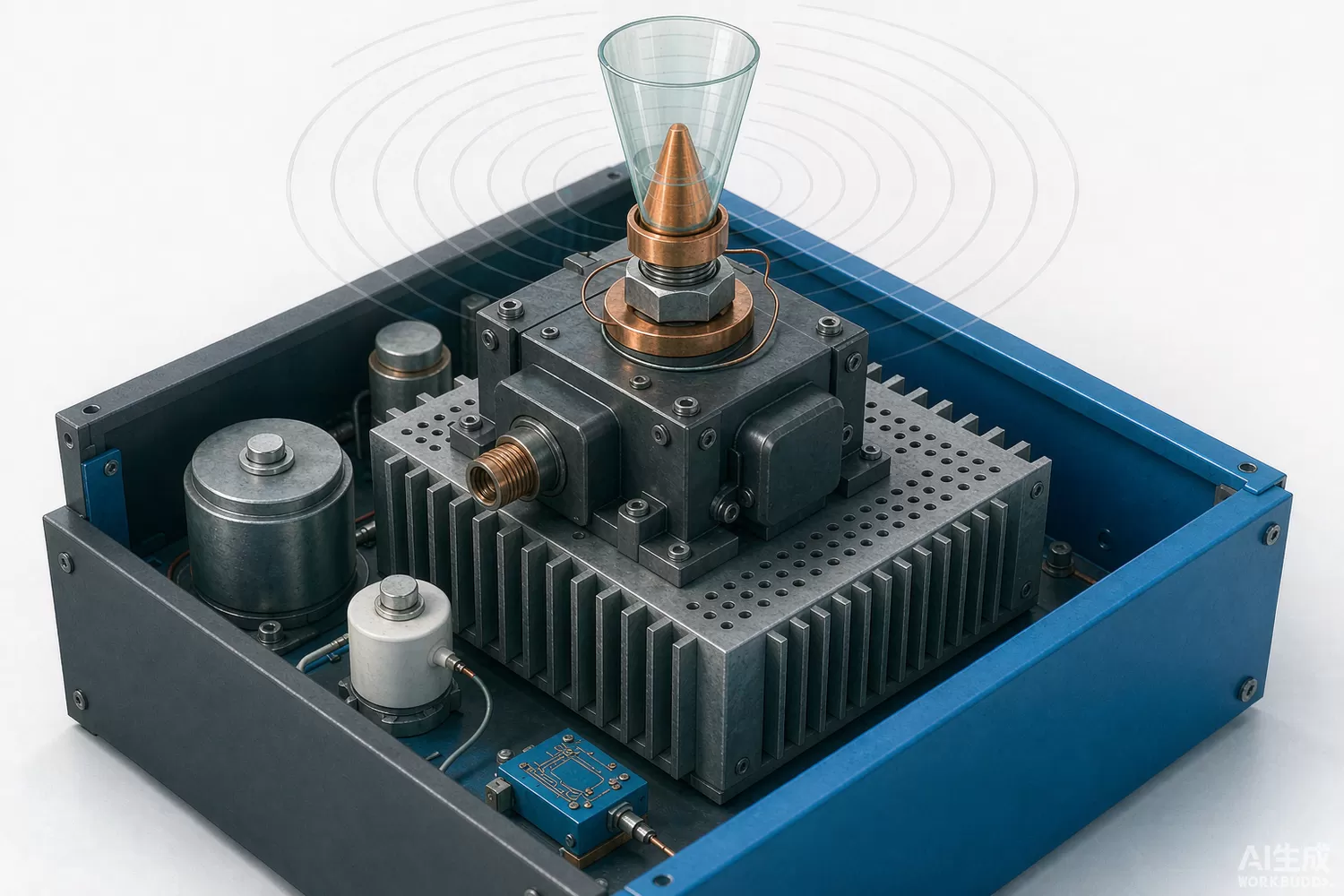
Not every radio is a receiver listening for a whisper. A significant part of the RF industry is about putting power into the air: broadcast transmitters, industrial RF heating and plasma generation, medical ablation, plasma etch in semiconductor fabs, radar transmitters, EMC test amplifiers and satellite uplinks. The devices doing that work are RF power transistors, and the technology contest between silicon LDMOS and gallium-nitride-on-silicon-carbide is one of the most consequential in RF engineering today. It is also a category where domestic supply has matured quickly, driven by China's investment in compound semiconductors.

Application logic: what defines an RF power stage
An RF power transistor is specified by output power, gain, drain efficiency and the ruggedness of its load line. LDMOS devices are lateral MOS structures on silicon: robust, inexpensive, capable of high breakdown voltage and well matched to the 1–4 GHz range where most industrial and broadcast applications live. GaN-on-SiC devices use a wide-bandgap semiconductor on a thermally conductive substrate, which allows much higher power density, higher operating voltage and better efficiency at high frequency, at a higher device cost and with more demanding bias and protection requirements.
Around the transistor, the designer must build an impedance-matching network that transforms the low device impedance to 50 ohms across the operating band, a bias network that sequences gate and drain voltages correctly and protects against overdrive, and a thermal path that keeps junction temperature inside the derated limit. For linear applications, pre-distortion or feed-forward linearisation is needed to meet spectral masks. Reliability engineering — derating, load-mismatch tolerance, and life testing — matters more here than in any small-signal design, because these devices operate at hundreds of watts and a failure is a service event. Our wide-bandgap semiconductors overview covers the device physics in more detail.
New technology in RF power devices
- GaN-on-SiC maturity: higher power density per die, wider bandwidth and improved reliability data, now covering L-band through Ka-band products.
- Plastic and low-cost packages: air-cavity and over-moulded packages that reduce assembly cost for GaN devices while preserving thermal performance.
- Integrated Doherty and asymmetric designs: packaged architectures for base-station efficiency.
- Higher-voltage LDMOS: 50 V and 65 V devices that improve efficiency in broadcast and industrial amplifiers.
- Broadband GaN amplifiers spanning multiple octaves, replacing narrowband LDMOS stages in test and EMC systems.
- On-die temperature and current sensing: monitoring built into power devices so control loops can protect the stage in real time.
Domestic alternatives: what to analyse before switching
- Compare output power, gain and drain efficiency at the same bias point and frequency, using s-parameters and load-pull data rather than marketing figures.
- Check the load-mismatch tolerance and the safe operating area: in industrial systems a mismatched load happens, and the device must survive it.
- Review the bias and protection requirements, and whether the vendor provides a reference design or evaluation board.
- Model the thermal path: device power density determines heatsink and airflow requirements, so layout and mechanical design both change.
- Assess reliability data and qualification evidence: accelerated life testing and, for broadcast or medical use, the evidence your certification requires.
- Confirm supply and packaging options — package compatibility determines how much of the amplifier hardware you can keep.
Indicative cost comparison: imported originals vs domestic candidates
Price figures below are indicative public-market reference ranges for moderate volumes, compiled from publicly observable listings. They fluctuate with the spot market, package option, reel size and order quantity, and must not be read as a quotation. Ask us for a firm price on your exact part numbers and quantities.
| Device class | Common imported reference | Indicative imported unit price | Commonly referenced domestic candidate | Indicative domestic unit price |
|---|---|---|---|---|
| LDMOS RF power transistor, 1–2 GHz, 100–300 W | Ampleon BLF-class; NXP MRF-class LDMOS | USD 25–95 | Domestic LDMOS and GaN devices for the same power class | USD 11–48 |
| GaN-on-SiC RF power transistor, 1–4 GHz | Qorvo QPD-class; Wolfspeed CGH-class; Ampleon GaN | USD 45–180 | Domestic GaN-on-SiC devices from Sanan IC, Dynax and comparable suppliers | USD 22–90 |
| GaN power device, 4–8 GHz (radar, satcom uplink) | Imported GaN-on-SiC high-frequency devices | USD 90–350 | Domestic high-frequency GaN programmes (availability by frequency band) | USD 45–180 |
| RF power MOSFET / GaAs FET for moderate power stages | ST PD84008-class RF power MOSFET; Sumitomo GaAs FETs | USD 8–35 | Domestic RF power MOSFETs and GaAs FETs (series-level) | USD 4–18 |
Domestic GaN-on-SiC devices typically price 45–60 percent below imported equivalents in the same power class, and domestic silicon power RF devices land at a similar discount. The savings are meaningful because these are high-value components, but the switching cost is higher than in small-signal categories, since bias, matching, thermal and mechanical design all change, and any broadcast, medical or aviation application brings qualification evidence into scope. We recommend evaluating a domestic device against an imported part with the same evaluation fixture and the same load-pull setup before making a cost-driven decision, because device-level numbers alone do not predict amplifier-level behaviour.
Commonly referenced alternative models
| Imported original (reference) | Domestic candidate (public sources) | Why it is referenced |
|---|---|---|
| NXP MRF-class LDMOS RF power transistors | Domestic LDMOS and GaN devices in the same power class | Direct functional substitution for industrial, broadcast and medical amplifiers; bias voltage and matching must be re-designed. |
| Ampleon BLF-class LDMOS (broadcast and industrial) | Domestic GaN-on-SiC devices with comparable output power | Higher efficiency and smaller die for the same output; thermal and protection design need updating. |
| Qorvo QPD-class GaN-on-SiC power devices | Sanan IC and Dynax GaN-on-SiC RF power devices | Domestic compound-semiconductor supply chain with published power products; band and power coverage must be confirmed per part. |
| ST PD84008-class RF power MOSFET | Domestic RF power MOSFETs in similar packages | Cost reduction for moderate power industrial designs; verify ruggedness and thermal derating. |
Our catalogue carries the imported devices these designs were built around, including ST PD84008-E RF power MOSFET, Sumitomo FLU35XMT RF power GaAs FET, Sumitomo FLU10XMT RF power GaAs FET and MRF581A RF transistor. For new designs we will quote domestic GaN or LDMOS devices alongside them so the comparison can be made on real numbers, samples and delivery.
Validation checklist
- Output power, gain and drain efficiency measured in your own fixture at the operating bias and frequency.
- Load-pull behaviour and load-mismatch survival across the full VSWR circle your application can produce.
- Junction temperature verification with the real heatsink, airflow and ambient conditions.
- Bias sequencing and protection circuit behaviour under start-up, shutdown and fault conditions.
- Spectral compliance after linearisation, including intermodulation and harmonic levels.
- Reliability and lifecycle evidence matched to the application's qualification requirements.
Related reading on our blog
Wide-bandgap semiconductors: SiC and GaN · RF power amplifiers: where they are used · Power amplifier compression
Frequently asked questions
Why does RF power design still use LDMOS when GaN exists?
Because LDMOS is cheaper, extremely rugged and well understood, and it works well below about 4 GHz, which covers a large part of the industrial, broadcast and medical market. GaN wins where frequency, bandwidth or power density exceed what LDMOS can deliver economically.
What is the main advantage of GaN-on-SiC?
Power density and bandwidth at high frequency. A GaN-on-SiC device delivers several times the output power from the same die area as silicon, with better thermal conductivity through the SiC substrate, which matters for radar, satellite uplinks and compact transmitters.
Are domestic GaN RF power transistors in production?
Yes. Chinese suppliers have brought GaN-on-SiC RF power devices to market, supported by a domestic compound-semiconductor supply chain, with published products across L-band and S-band and increasing coverage at higher frequencies. Availability at your specific frequency and power level must be checked per product.
What is the biggest hidden cost when switching RF power devices?
The surrounding design, not the transistor. Bias sequencing, thermal design, matching networks, and for high-power stages the protection and monitoring circuitry, all have to be re-worked. A device that is cheaper per unit can cost more in engineering if the reference design is thin.
About us & trademarks: JTDZ Tech (Shenzhen Jingteng Electronics Technology Co., Ltd.) is an independent distributor of electronic components. We are not an authorised distributor or representative of any manufacturer named in this article. Manufacturer, brand and part names are used for identification purposes only; all trademarks remain the property of their respective owners. Cross-reference information in this article is based on publicly available sources, is subject to change, and is not a substitute for your own engineering validation. Always verify specifications against the manufacturer's datasheet before design-in or purchase.
