
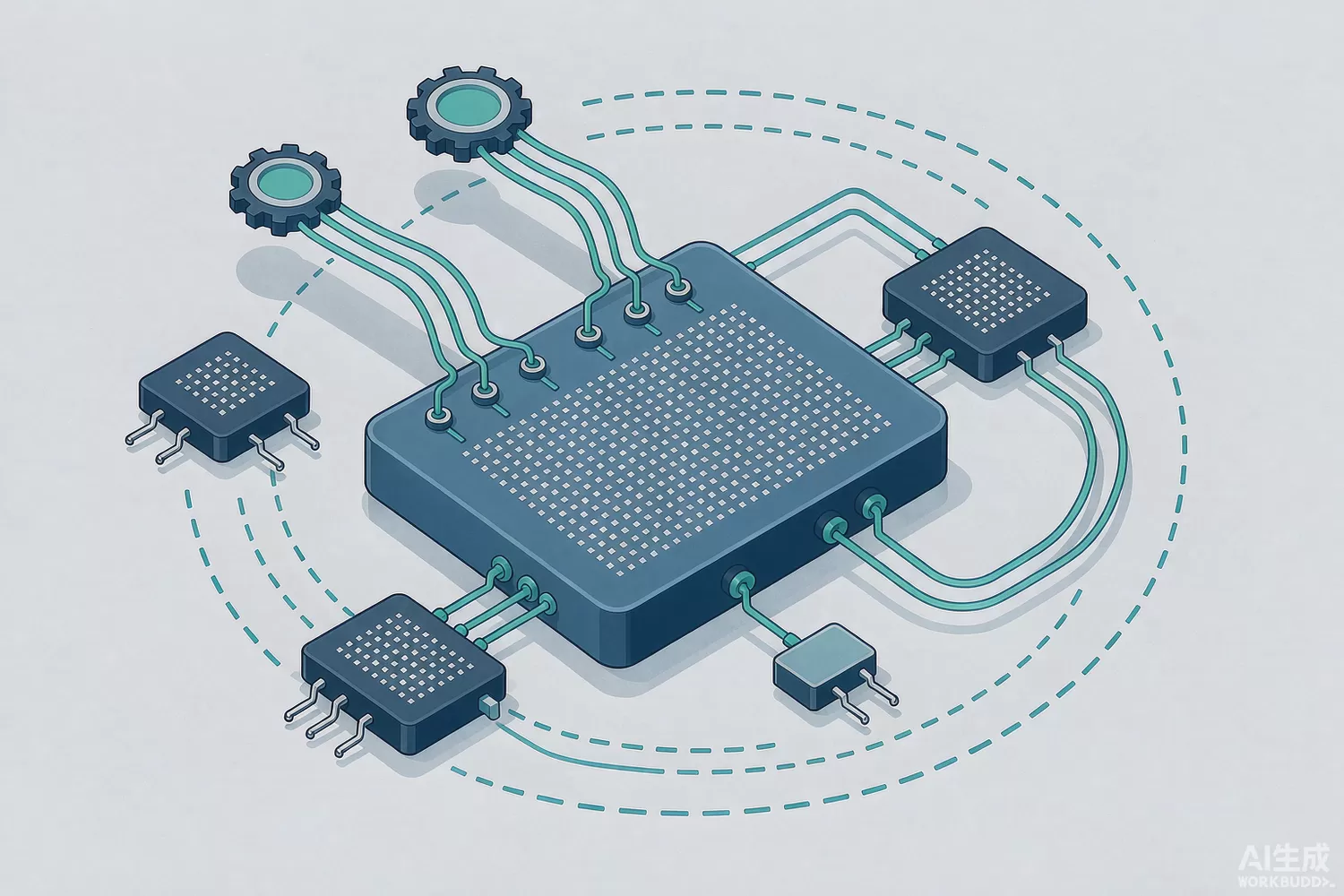
Software-defined radio stopped being exotic the moment a single chip could hold two transmit and two receive chains, programmable filters and the data converters to feed them. That chip — the wideband RF transceiver SoC — is now the default architecture for anything that has to work across bands or protocols: 4G and 5G small cells, private networks, drones, radar front ends, industrial links and bench instruments. It is also the category where domestic silicon has moved fastest from announcement to production.

Application logic: one chip, many radios
A wideband transceiver integrates the receive and transmit signal chains around a direct-conversion architecture: low-noise receive path, quadrature down-conversion, programmable analogue low-pass filters, analogue-to-digital conversion, and the mirror image of that on the transmit side, plus the local oscillator synthesis and the calibration engines that make a direct-conversion radio usable. The host — an FPGA, a SoC or a microcontroller — programs frequency, bandwidth, gain and sample rate through SPI or a JESD204-style high-speed link.
What decides whether a part fits is rarely the headline frequency range. It is analogue bandwidth (the instantaneous span the device can process), noise figure and linearity (which together set the dynamic range), channel-to-channel isolation and phase coherency (which decide whether you can build a phased array or a MIMO radio with it), the transmitter's error-vector-magnitude and spectral performance, and the maturity of the calibration engine. A device with a spectacular frequency range and a weak receive noise figure will be beaten by a narrower part in every real link budget. The interface matters just as much: a device with a well-documented register map and a working evaluation platform saves months, while one with a thin programming guide costs them back. Related reading: front-end module versus discrete design and what instrument signal chains require.
Power is the other axis. A transceiver that must run from a battery, or inside a sealed enclosure with no fan, is specified by its sleep architecture and its current in receive-only mode, not by its peak transmit capability. Devices aimed at the industrial and drone markets are optimised exactly there.
New technology in wideband transceivers
- Ultra-wideband coverage: the newest parts span roughly 30 MHz to 7 GHz in one device, which covers short-wave through Sub-7 GHz and removes band-specific front-end variants from a product family.
- Configurable channel bandwidth up to hundreds of MHz, enabling both narrowband telemetry and wideband video or radar chirps from the same silicon.
- Multi-channel reconfigurable architectures with on-chip digital down/up conversion, so the host receives decimated baseband instead of raw converter data.
- Multi-chip synchronisation and deterministic latency, the enabler for phased arrays, MIMO and multi-channel instruments.
- Integrated calibration for IQ imbalance, LO leakage, image rejection and transmit power monitoring, which is what makes direct conversion usable in production rather than only on a bench.
- Tighter integration with the digital side, up to converter-adjacent RF tiles and RF-SoC devices that pair wideband analogue with programmable logic.
Domestic alternatives: what to analyse before switching
- Compare analogue bandwidth and receive noise figure at your frequency of interest, not the frequency-range claim.
- Verify channel-to-channel isolation and phase coherency if you intend to build a beam-forming or MIMO product.
- Check the transmit chain for EVM and adjacent-channel performance with the modulation you will actually use.
- Confirm the host interface: four-wire SPI, LVDS or JESD204B/C, and whether the driver and programming guide are available in a language your team maintains.
- Ask for multi-chip synchronisation evidence if more than one device must be aligned.
- Evaluate the reference design and evaluation board first. On this class of device the support material is a larger differentiator than a few decibels of specification.
Indicative cost comparison: imported originals vs domestic candidates
Price figures below are indicative public-market reference ranges for moderate volumes, compiled from publicly observable listings. They fluctuate with the spot market, package option, grade (industrial, automotive, screened) and order quantity, and must not be read as a quotation. Ask us for a firm price on your exact part numbers and quantities.
| Device class | Common imported reference | Indicative imported unit price | Commonly referenced domestic candidate | Indicative domestic unit price |
|---|---|---|---|---|
| 2T2R wideband transceiver SoC, 30 MHz–6 GHz, up to 100 MHz bandwidth | ADI AD9361 / AD9363 class | USD 45–120 | Geo-Chip GC0801 class | USD 18–50 |
| Wideband transceiver for 5G small cells and private networks | ADI ADRV9002 / ADRV9009 class | USD 90–260 | Geo-Chip GC0802 class; additional domestic families | USD 40–130 |
| Ultra-wideband transceiver, 30 MHz–7.125 GHz, up to 400 MHz bandwidth | Imported ultra-wideband transceiver class | USD 120–350 | Geo-Chip GC080X series | USD 60–160 |
| RF-sampling SoC (converters plus programmable logic) | ADI RFSoC / AD9081-class integrated platforms | USD 900–4,000+ | Domestic RF-SoC and converter-plus-logic platforms (family level) | USD 500–2,000 |
Two cost notes. First, the transceiver is typically 20–30 percent of the cost of a small-cell radio system, which is exactly why it became a target for domestic development: the saving at board level is material, but the switching cost sits in software and re-validation. Second, an integrated RF front-end module can look more expensive than a discrete chain on the line item and still win on total cost, because it removes matching, layout iterations and the EMC risk that comes with them. Compare the whole radio, not the chip.
Commonly referenced alternative models
| Imported original (reference) | Domestic candidate (public sources) | Why it is referenced |
|---|---|---|
| ADI AD9361 — 2T2R wideband transceiver, 70 MHz–6 GHz | Geo-Chip GC0801 (Hangzhou Geo-Chip) — 30 MHz–6 GHz, configurable bandwidth, 144-ball CSP_BGA | Publicly documented as a functionally corresponding wideband transceiver covering the same class of applications, with an integrated 12-bit converter pair and programmable filters. Depends on your frequency plan: confirm the exact coverage you need. |
| ADI AD9371 / ADRV9002 class — small-cell transceiver | Geo-Chip GC0802 series (30 MHz–6 GHz, up to 100 MHz bandwidth) | Positioned for 4G/5G small cells and private networks. Verify the transmit EVM and the receive blocking performance with your own waveform. |
| Imported ultra-wideband transceiver — multi-band SDR platforms | Geo-Chip GC080X series (30 MHz–7.125 GHz, 400 MHz configurable bandwidth) | Same role in the architecture, wider coverage; publicly presented as an end-to-end domestic supply-chain design. Check bandwidth, interface and synchronisation support against your requirement. |
| ADI ADRV9009 class — multi-channel observation receiver | Domestic multi-channel transceiver families (public information is at family level) | Cross-referenced for multi-channel receive applications; the device-level picture changes quickly, so ask for current status rather than relying on a catalogue entry. |
| Imported SDR platform with converter-plus-logic integration | Domestic RF-SoC programmes (public information is at programme level) | Same integration concept: wideband analogue combined with programmable logic. Toolchain maturity and support are the decisive factors here, not the datasheet. |
We supply the transceiver, the surrounding RF chain and the reference clock as one package: imported gain blocks and amplifier stages such as the TQP3M9038 and QPL9096TR7, a programmable clock generator for the reference path, and parts drawn from the RF and interface chip collection and the Qorvo collection. Tell us the radio you are building and we will quote the whole chain.
Frequently asked questions
Frequently asked questions
What is a wideband RF transceiver SoC used for?
It replaces most of a radio chain with one device: dual transmit and receive channels, integrated mixers, programmable analogue filters, data converters and a serial interface to the host. Because the frequency plan and bandwidth are programmed rather than soldered, the same part serves a small cell, a radar front end, an instrument, a drone data link or a private-network base station.
How do I compare a domestic wideband transceiver with an imported one?
Start with the analogue bandwidth, not the frequency range. Frequency coverage is easy to quote and bandwidth, noise figure, linearity and channel-to-channel isolation are what actually decide the application. Then compare the digital interface, calibration features, multi-chip synchronisation and the maturity of the programming guide.
Do I need an external RF front end with it?
Almost always yes: a power amplifier for the transmit side, a low-noise amplifier and filters for the receive side, and usually a switch or duplexer. The transceiver sets the interface and the level plan; the front end decides the range, so the integration trade-off between a module and a discrete chain is worth reading before you fix the block diagram.
Are domestic wideband transceivers in volume production?
Several domestic families are in production and shipping into small cells, private networks, industrial links and radar designs. Coverage and bandwidth continue to grow, and the newest ultra-wideband devices are the ones to check for availability and support maturity before committing a programme.
About us & trademarks: JTDZ Tech (Shenzhen Jingteng Electronics Technology Co., Ltd.) is an independent distributor of electronic components. We are not an authorised distributor or representative of the imported manufacturers named in this article. Manufacturer, brand and part names are used for identification purposes only; all trademarks remain the property of their respective owners. Cross-reference information in this article is based on publicly available sources, is subject to change, and is not a substitute for your own engineering validation. Always verify specifications against the manufacturer's datasheet before design-in or purchase.
