
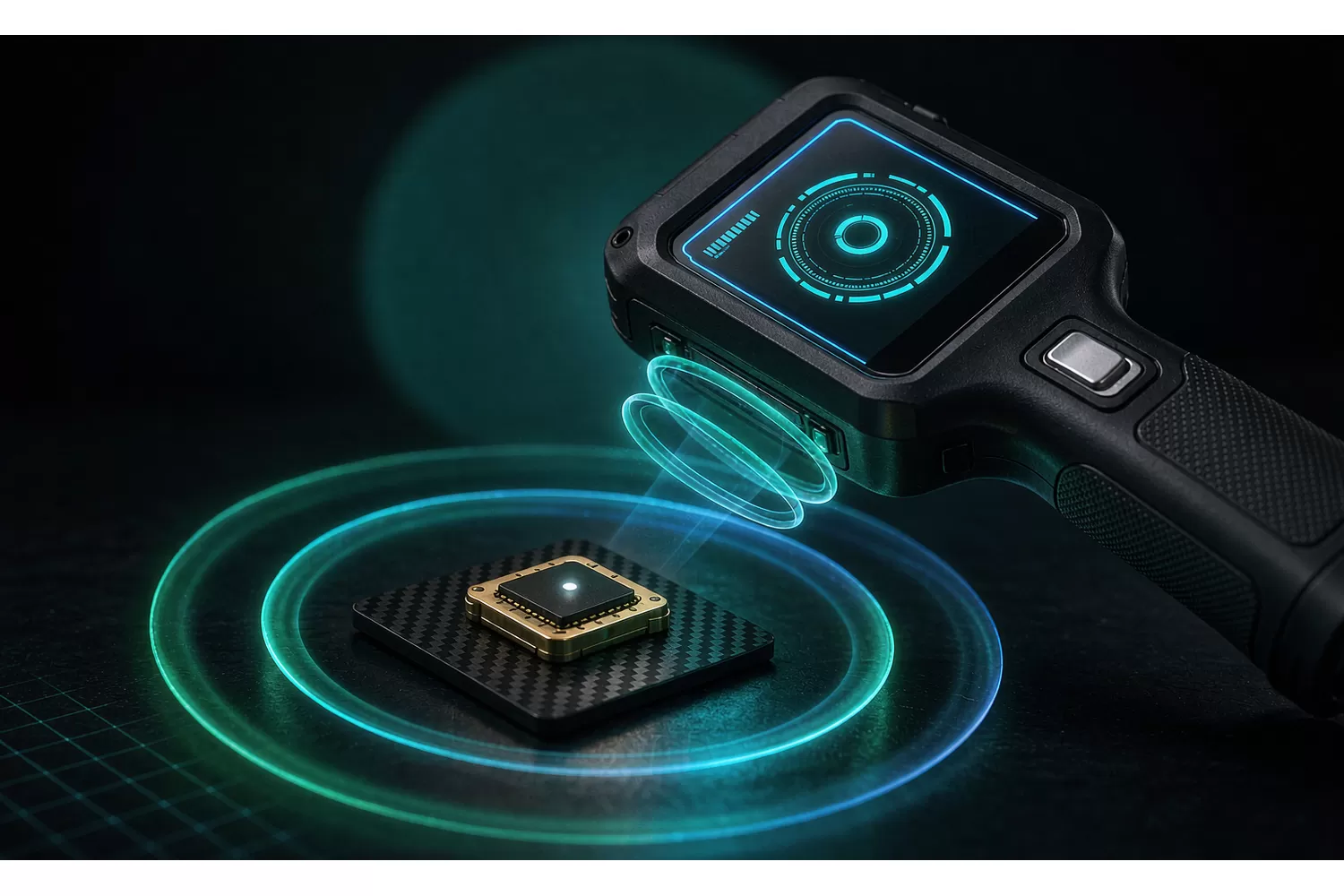
RFID and RF energy harvesting sit at opposite ends of the same idea: one uses radio to identify, the other uses radio to power. Both depend on an RF chain that is unusually good at the two things radios find hardest — transmitting cleanly and listening for a signal far below its own noise.

The RFID reader: loud and quiet at once
A UHF RFID reader blasts a modulated carrier to energise passive tags, then must hear the tag's backscattered reply, which arrives at a tiny fraction of the transmit power and at the same frequency. Separating transmit and receive (with a circulator or a switch), rejecting self-interference, and recovering the faint reply demands a clean low-noise amplifier and careful filtering. We stock transmit and driver amplifiers such as the RFPA3800TR13 and the SBB-3089Z, low-noise amplifiers such as the TQP3M9019 and the SGA-6389Z, and switches like the AS179-92LF and QPC6044TR13.
Keeping the band clean
RFID readers operate near other UHF users, so filtering rejects out-of-band energy and protects the sensitive receiver. We stock LC filter families such as the LFCN-3800+ low-pass and HFCN-5500+ high-pass filters, plus the PE4302-52 step attenuator and fixed pads like the ATN3580-02 for level calibration.
RF energy harvesting: rectifying the air
A rectenna turns ambient or dedicated RF into DC to trickle-charge a low-power sensor or beacon. The art is in matching and low-loss conditioning: every dB lost before the rectifier is power you never recover. The supporting RF parts — low-loss switches, filters and gain blocks such as the ERA-1SM+ and GALI-21+ — decide how much usable energy survives.
Sourcing for high-volume tags and readers
RFID and energy-harvesting products are typically high volume with thin margins, so a single allocated line can ripple through the bill of materials. We help by supplying the RF discretes from traceable sources and finding alternatives when a part is unavailable. Browse the RF and interface chip range and the Mini-Circuits collection for related devices.
Frequently asked questions
How does an RFID reader's RF chain work?
A UHF RFID reader transmits a modulated carrier to power and talk to tags, then listens for the tag's faint backscatter reply. It needs a power amplifier on the transmit side, a low-noise amplifier on the receive side, a circulator or switch to separate the paths, filters, and precise attenuators for calibration. The reader must be both loud and able to hear a whisper.
What is RF energy harvesting?
It is the idea of powering a device by rectifying ambient or dedicated RF energy into DC — a rectenna (antenna plus rectifier) instead of a battery. It suits very low-power sensors and beacons. The RF conditioning around it (matching, filtering, low-loss paths) decides how much usable power is recovered.
Why is the reader's receive path so demanding?
The tag has no battery to shout with; it reflects the reader's own signal back at a tiny fraction of the transmit power. The reader must therefore listen far below its own transmit level without being desensitised by its own transmitter. Low-noise amplification, isolation and filtering do the heavy lifting.
Can you supply RFID and energy-harvesting RF parts?
Yes. We stock power and driver amplifiers, low-noise amplifiers, RF switches, filters and step attenuators commonly referenced in UHF RFID readers and low-power RF designs. Send your part numbers and quantity for a quote.
About us & trademarks: JTDZ Tech (Shenzhen Jingteng Electronics Technology Co., Ltd.) is an independent distributor of electronic components. We are not an authorised distributor or representative of the manufacturers named in this article. Manufacturer and part names are used for indicative purposes only, to help identify the components discussed; all trademarks remain the property of their respective owners. Always verify specifications against the manufacturer's datasheet before design-in or purchase.
