
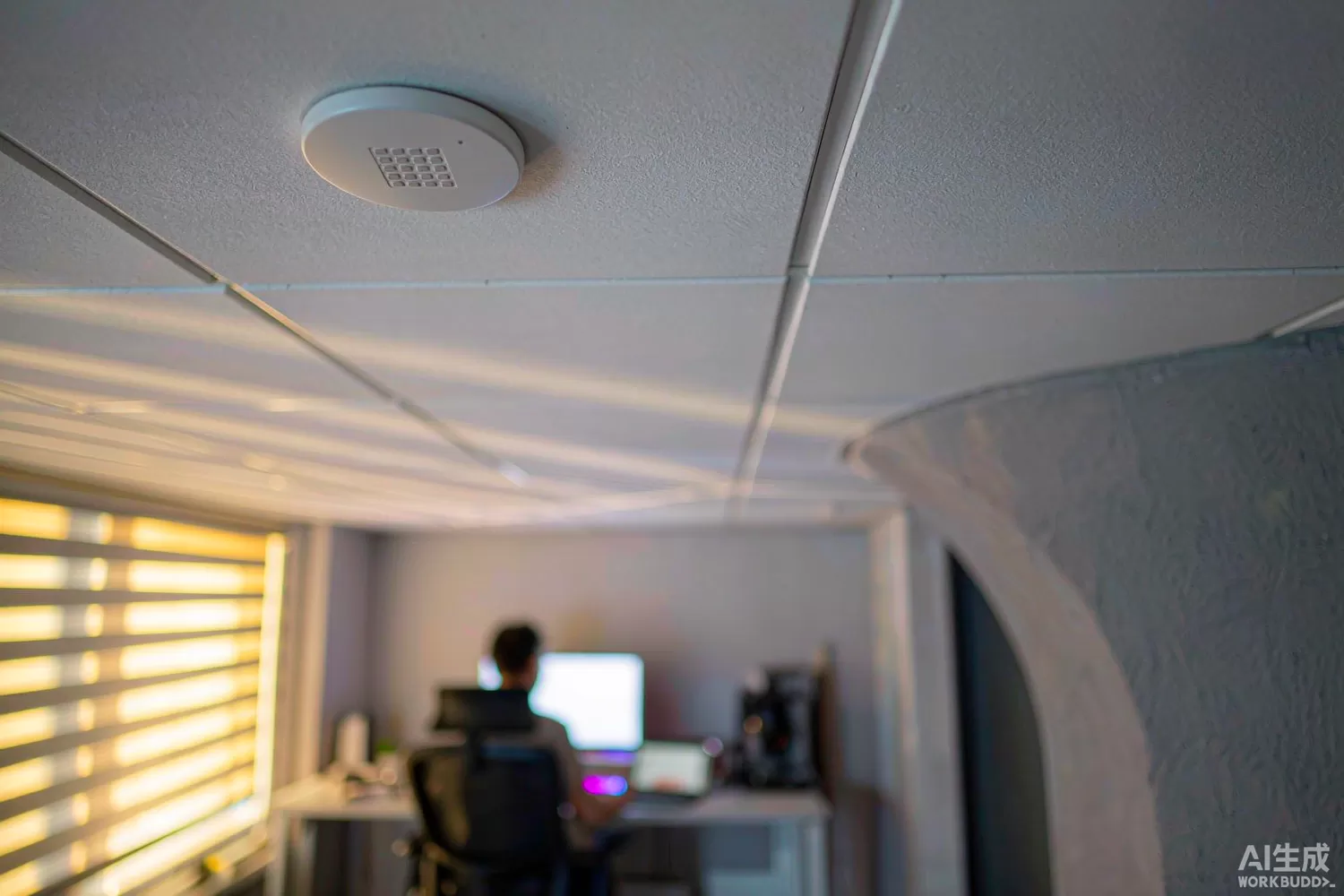
A 60 GHz radar sensor is a complete sensing chain in a package smaller than a postage stamp: an FMCW transmitter, a receive path, an ADC and a small processor that outputs presence, distance or vital-sign information. It sees through plastic and drywall, does not care about lighting or dust, and reports range as well as motion — which is why the 57–64 GHz band has quietly become the default for occupancy detection in lighting and HVAC, for tank and silo level measurement, and for contactless breathing and heart-rate monitoring.

This article treats the radar sensor as a chip-level choice: the sensing logic that decides whether 60 GHz is the right band, the parameters that set what the sensor can resolve, the technology shifts inside the package, and the domestic supply picture. For automotive radar at 77–79 GHz — a different band with different regulatory and functional-safety requirements — see our automotive RF overview.
Application logic: what a 60 GHz sensor can and cannot do
The band choice is regulatory first. 57–64 GHz is available for general short-range radar in most major markets with modest power limits, which suits sensors that look a few metres and never need long range. The physics then follows: at 60 GHz a wavelength is about 5 mm, so a four-element receive array with half-wavelength spacing fits inside 15 mm and still gives a usable angular aperture. Range resolution depends only on swept bandwidth — about 15 cm for 1 GHz of sweep — while maximum unambiguous range depends on the sweep repetition and the ADC's sample rate. Angular resolution, not range, is what usually limits a presence sensor: with a small aperture you get a broad beam, which is fine for "is somebody in the room" and useless for "which person moved".
The application logic then breaks into four tiers, each with a different specification pressure:
- Occupancy and presence — sub-watt, always-on, needs micro-motion detection (breathing) rather than gross movement, because a person sitting still must not switch the lights off. Sensitivity to a millimetre of chest displacement is the real specification.
- Level and distance — tanks, silos, bins, dispenser fill levels; needs range accuracy and a narrow beam to avoid returns from tank walls, plus a housing that survives condensation and dust.
- Vital signs and human presence — breathing and heart rate at 0.5–2 m; needs phase coherence and very low phase noise close to carrier, not raw output power.
- Gesture and proximity — human-machine interfaces at 5–50 cm; needs fast chirp repetition and a processor that can classify micro-Doppler signatures locally.
Where 60 GHz loses to alternatives is equally important to state. It cannot measure through metal, it is attenuated by water and foliage, and its angular resolution at sensor-sized apertures is coarse compared with a camera. Sensors that must classify what a person is doing usually end up fusing radar with another modality — which is exactly why the chip vendor's ecosystem, not just the chip, matters.
Datasheet parameters that decide sensing performance
- Swept bandwidth and chirp linearity — bandwidth sets range resolution; linearity error sets the range sidelobes that hide a small target beside a large one.
- Transmit power and antenna gain as EIRP, not bare output power; the regulatory limit is on radiated power and the antenna-in-package is part of the answer.
- Receiver noise figure — at 60 GHz a 3 dB improvement buys roughly 40% more range at the same detection threshold.
- Phase noise at 100 kHz to 1 MHz offset — it sets the noise floor in range bins near strong reflectors and is the limiting parameter for vital-sign work.
- Number of receive channels and array geometry — this, not the ADC, determines angular resolution and the ability to separate two people.
- ADC resolution and sample rate — 12-bit at tens of megasamples per second is now standard and determines how much processing can move on-chip.
- Power consumption in duty-cycled and continuous modes — a battery-powered sensor that wakes every 100 ms has a completely different budget from a mains-powered one.
- Processor headroom and output interface — presence flags over UART or I2C versus raw IQ over SPI changes your bill of materials and your firmware effort.
What is new: antenna-in-package, on-chip processing and the software layer
Three shifts define the current generation. First, antenna-in-package: the radiating elements are built into the laminate or embedded wafer-level package, so the designer no longer needs a millimetre-wave substrate, a waveguide transition or an RF connector. This single change is why 60 GHz sensors went from laboratory instruments to components that cost a few dollars in volume. Second, processing moved on-die: range FFT, Doppler FFT, CFAR detection and even small neural networks now run inside the sensor, so the host microcontroller receives a decision rather than a data cube. That lowers the system cost but raises a new dependency — the detection algorithm is now part of the component you cannot inspect.
Third, the software layer became the differentiator. Two sensors with identical silicon behave very differently depending on the presence-detection state machine behind them: how long a target must be absent before the light goes off, how the sensor handles a fan blade or a curtain moving in an air current, whether it can distinguish a pet from a person. When you evaluate a domestic sensor SoC, the algorithm maturity and the field data behind it matter as much as the RF numbers, and that is much harder to read from a datasheet.
The support circuitry around the SoC has also simplified but not disappeared. A clean low-noise rail for the RF section, a well-decoupled supply for the digital core, an ESD-protected interface to the outside world and a host MCU for the product-level state machine are still required. Parts such as the SGA5589Z gain block or the PHA-202+ amplifier are useful when a discrete front end must be built beside a sensor SoC, and the TS2502PN ESD array protects the exposed interface lines.
Domestic alternatives: families and indicative cost
The domestic radar-sensor ecosystem has two distinct tiers, and it is worth being precise about which is which. In the sensor-SoC tier, SiliconRadar (Shanghai, “Xidianwei”) publishes 24 GHz and 60 GHz presence-sensing radar SoC families aimed squarely at lighting, HVAC and security, with on-chip detection algorithms. Milliway Microelectronics (Nanjing) publishes millimetre-wave front-end MMIC and radar module families spanning 24 GHz, 60 GHz and 77 GHz, which suits designs that need a discrete front end rather than a closed SoC. In the automotive tier, Calterah Semiconductor publishes 77–79 GHz radar SoCs with functional-safety documentation — a different product class from the 60 GHz sensing parts, and worth knowing about if your roadmap crosses into vehicle applications.
Imported anchors are Infineon's BGT60 family, Acconeer's A1/A2 pulsed-coherent sensors and Texas Instruments' IWR/AWR mmWave family. All three are well documented and well supported; the domestic argument is cost, local support and supply continuity rather than a capability gap at 60 GHz for presence sensing.
Price figures below are indicative public-market reference ranges for moderate volumes, compiled from publicly observable listings. They fluctuate with the spot market, package option, grade (industrial, automotive, screened) and order quantity, and must not be read as a quotation. Ask us for a firm price on your exact part numbers and quantities.
| Function (imported anchor) | Example import part / class | Indicative import price (USD) | Domestic candidate | Indicative domestic price (USD) |
|---|---|---|---|---|
| 60 GHz FMCW radar SoC with antenna-in-package, presence output | Infineon BGT60-class sensor | 3.0 – 9.0 | SiliconRadar 60 GHz sensor SoC family | 1.2 – 4.0 |
| Pulsed coherent radar sensor with integrated processing | Acconeer A1/A2-class sensor | 8 – 25 | SiliconRadar / Milliway sensor module family | 3 – 10 |
| Millimetre-wave front-end MMIC (24/60/77 GHz) for discrete designs | TI IWR-class front end; Infineon MMIC | 6 – 30 | Milliway Microelectronics mmWave MMIC family | 2 – 11 |
| Host microcontroller for product state machine | STM32F103-class MCU | 1.2 – 3.5 | AT32F403ACGT7 (Artery) | 0.35 – 0.9 |
| Low-noise rail for the RF section | TPS7A4700-class LDO | 1.5 – 4.0 | COS2991S (COSINE) | 0.15 – 0.50 |
| Interface ESD protection | Littelfuse SP-class array | 0.05 – 0.20 | TS2502PN (Titan Micro) | 0.01 – 0.06 |
The cost comparison needs one caveat that matters more here than in most categories: for a sensor SoC, the algorithm licence and the field-validated detection library are a real part of the value. A domestic part that is 60% cheaper but requires you to write and tune the presence state machine yourself may cost more in engineering hours than it saves in silicon. Ask the supplier what ships in the firmware, what the false-trigger data looks like across the scenarios you care about, and whether the detection parameters are exposed or fixed.
Validation flow before you commit
Radar sensors fail in the field for reasons that never appear in a bench test, so build the test around your actual installation. Mount the sensor in its production housing — radome, paint, gasket and all — and measure detection range and false-trigger rate with a human target at 0.5, 2 and 5 m, sitting still, typing, and walking tangentially. Repeat with a curtain moving in front of an air conditioner, with a ceiling fan running, and with the sensor beside a Wi-Fi access point and a switching power supply. Then run a 72-hour soak at the temperature extremes the product will see and count false positives; drift in the detection threshold with temperature is the single most common field complaint.
For level sensing, replace the human target with the real material: a granular solid reflects very differently from water, and a tank with a stirrer produces a moving clutter background that a simple threshold detector will read as level change. Validate range accuracy against a physical measurement at three fill levels and check performance at the empty-tank case, where the return is weakest and the multiple reflections are strongest.
Frequently asked questions
Is 60 GHz radar better than PIR for occupancy?
For presence while a person is still, yes: radar detects micro-motion such as breathing, which PIR cannot see. For very low power and the lowest cost, PIR still wins; many products combine the two.
How much range can I expect at 60 GHz?
With a sensor-sized antenna and regulatory EIRP limits, useful detection is a few metres for a person and less for a small target. Range scales with the fourth root of EIRP in the worst case, so doubling power buys only about 19% more range.
Can one sensor measure both presence and distance?
Yes - FMCW gives range and Doppler in the same chirp, and most 60 GHz SoCs output both. Angular separation of two targets is limited by the number of receive channels.
Do domestic radar SoCs match imported detection performance?
Silicon and RF performance at 60 GHz are comparable in published families; the difference is usually in the detection algorithms and the field data behind them. Demand false-trigger statistics from real installations, not bench demos.
About us & trademarks: JTDZ Tech (Shenzhen Jingteng Electronics Technology Co., Ltd.) is an independent distributor of electronic components. We are not an authorised distributor or representative of the imported manufacturers named in this article. Manufacturer, brand and part names are used for identification purposes only; all trademarks remain the property of their respective owners. Cross-reference information in this article is based on publicly available sources, is subject to change, and is not a substitute for your own engineering validation. Always verify specifications against the manufacturer's datasheet before design-in or purchase.
