
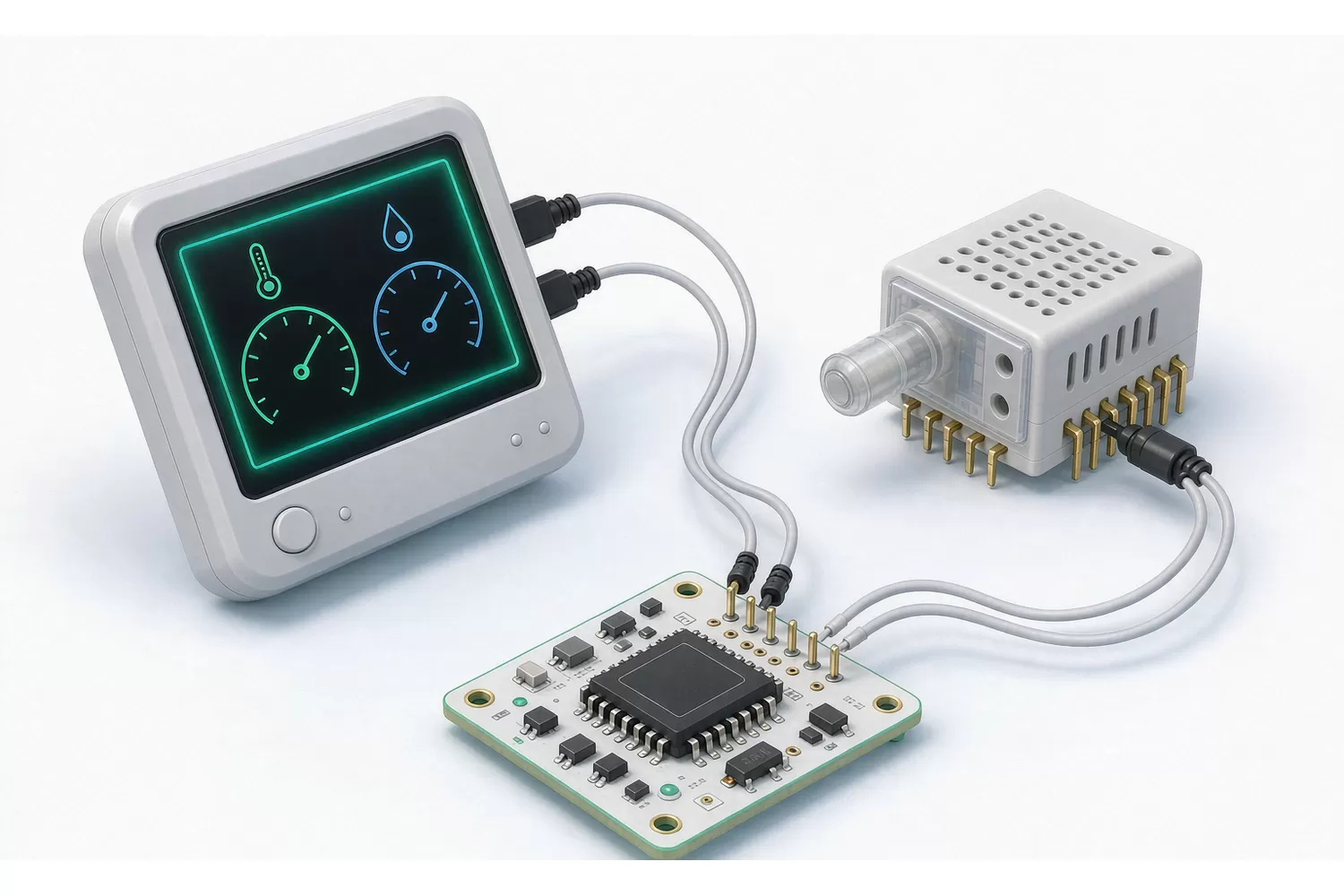
Products with a screen and a few sensors — thermostats, instrument panels, small appliances, handheld tools — are where the bill of materials quietly grows with extra chips: a display controller here, a sensor hub there. The AT32 family is broad enough that a single mainstream part often absorbs all of it. This article is a cost view of one-chip HMI and sensor fusion.

Parts discussed: AT32F415CBT7, AT32F403ARGT7, AT32F413RBT7 and AT32F425C8T7.
One part instead of two or three
A mid-range AT32 with enough flash and RAM can drive a small display and still poll sensors, decode buttons and run a communication link, because those tasks are light next to the frame buffer. The win is one part, one power rail and one firmware image rather than a separate display controller and a separate sensor MCU.
| Design | Split approach | Consolidated AT32 | Saving |
|---|---|---|---|
| Thermostat with display | Sensor MCU + display IC | One AT32 | One part, one rail |
| Instrument panel | MCU + TFT controller | AT32 with RAM for buffer | Fewer support parts |
| Handheld tool | MCU + sensor hub | One AT32, fused sensors | One firmware base |
Memory is the constraint, not the core
A small OLED over I2C or SPI needs almost no RAM; the frame buffer fits in a few hundred bytes. A colour TFT needs markedly more — often external serial RAM or a part with larger on-chip RAM — because you hold a screen of pixels. Size the RAM to the display, not to the core's headline speed, and the right part becomes obvious instead of a guess.
- Character OLED: minimal RAM, almost any mainstream AT32.
- Small colour TFT: budget for the frame buffer; pick a part with the RAM headroom.
- Rich animated GUI: consider an external controller before overspecifying the MCU.
Fusion is cheaper than it looks
Combining a temperature, a humidity and a proximity reading into one state is mostly fixed-point maths and scheduling, which a mainstream AT32 handles comfortably. The trap is picking a part too small and then finding the fusion task plus the display buffer no longer fit in RAM. Choose for the combined load and the single-chip solution stays cheap.
The real saving is recurring
Consolidation saves more than silicon. One part means one supplier relationship for that function, one power design, one firmware base to maintain and one qualification to track. Across a product line those recurring savings dwarf the few cents between two small chips, which is why one-chip HMI is usually the cheaper architecture, not just the cheaper BOM.
Related: Sensors and optoelectronic devices and Microcontrollers and MCUs, plus the AT32F423RCT7.
Frequently asked questions
Can one AT32 replace a separate display controller and a sensor MCU?
Often, yes. A mid-range AT32 with enough flash and RAM can run a small display — an OLED or a modest TFT — and still handle sensor polling, button decoding and a communication link, because those tasks are light compared with the display frame buffer. The saving is one part, one power rail and one firmware image instead of two or three.
What memory do I need for a small display on AT32?
A small OLED driven over I2C or SPI needs almost no RAM; the frame buffer fits in a few hundred bytes. A TFT with a colour GUI needs markedly more — often external serial RAM or a part with larger on-chip RAM — because you must hold a screen's worth of pixels. Size the RAM to the display, not to the marketing of the core, and the part choice becomes obvious.
Is an AT32 good enough for touch and a GUI, or do I need a dedicated GUI chip?
For a simple menu, a status screen or a small instrument panel, a mainstream AT32 is plenty, and avoiding a dedicated GUI chip saves board area and cost. For a rich, animated interface with many screens, a dedicated display MCU or an external controller earns its price by offloading the pixel work. Match the interface to the screen, not the other way round.
How does sensor fusion change the MCU choice?
Fusion — combining a temperature, a humidity and a proximity reading into one state — is mostly fixed-point maths and scheduling, which a mainstream AT32 handles easily. The trap is choosing a part too small and then discovering the fusion task plus the display frame buffer no longer fit in RAM. Pick for the combined load, and the single-chip solution stays cheap.
What is the real cost win of consolidating onto one AT32?
It is not only the silicon. One part means one supplier relationship for that function, one power design, one firmware base to maintain and one qualification to track. Across a product line those recurring savings dwarf the few cents difference between two small chips, which is why consolidation is usually the cheaper architecture, not just the cheaper BOM.
About us & trademarks: JTDZ Tech (Shenzhen Jingteng Electronics Technology Co., Ltd.) is an independent distributor of electronic components. We are not an authorised distributor or representative of the manufacturers named in this article. Manufacturer and part names are used for indicative purposes only, to help identify the components discussed; all trademarks remain the property of their respective owners. Always verify specifications against the manufacturer's datasheet before design-in or purchase.
价格随采购数量与行情流动,所示价格仅供参考。欢迎询价获取实时报价,量大从优。
