
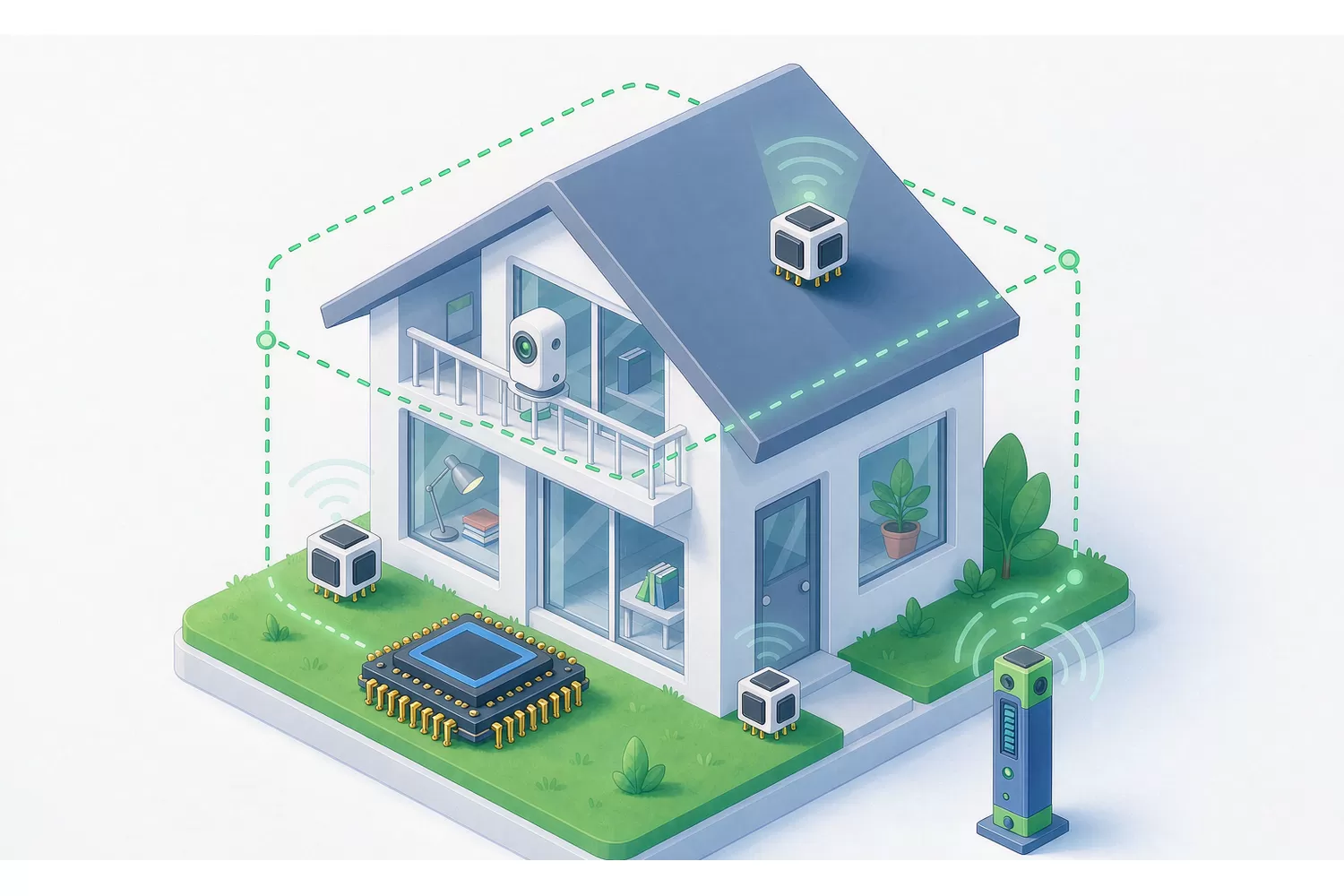
The smart-home and IoT market is where 32-bit microcontrollers earn their keep: a node has to sense, sometimes connect, and almost always sleep. AT32's spread - from the ultra-low-power L021 through the mainstream F421/F425 to the wireless WB415 - covers most of what an end-node designer needs without jumping to a more expensive part.

A reference node, by function
| Function | Suggested AT32 | Why |
|---|---|---|
| Low-power sensor hub | AT32L021 | Minimal static current, tiny package |
| Mainstream node MCU | AT32F421 | Good peripheral mix, low cost |
| Feature-rich node | AT32F425 | More memory and peripherals |
| Wireless node | AT32WB415 | Integrated Bluetooth LE |
Design priorities for nodes
- Sleep first. Pick the lowest power mode that still meets your wake-up latency, and wake on interrupt, not polling.
- Budget the radio. If you use the integrated Bluetooth LE of the AT32WB415, validate range and current draw on real hardware, not in the datasheet alone.
- Design for recovery. A missed packet or a watchdog reset must not become a field return; build clean re-entry.
- Qualify the lot. Source from a traceable channel and keep a per-lot record so any failure is traceable.
Sourcing for volume
We stock the AT32 families used in nodes and can quote the AT32F421, AT32F425, AT32L021 and AT32WB415 with date codes for your build. We are an independent distributor, not an authorised representative of Artery; part names are used to help you identify the components discussed. See the microcontroller range and send your BOM for a quote.
Frequently asked questions
Which AT32 part fits a battery-powered sensor node?
For a small, low-power node the AT32L021 low-power family is the natural starting point, with the AT32F421 or F425 as the next step up when you need more peripherals or a faster core. Both are available in small packages suited to compact end devices.
How do I add wireless connectivity?
The AT32WB415 integrates Bluetooth LE, removing the need for a separate radio and its associated RF layout. For designs that need a different radio, the AT32 can sit alongside an external module while still handling sensing, control and the application protocol.
What should I watch on the software side?
IoT nodes live or die on power management and robustness. Use the sleep modes aggressively, wake on interrupt rather than polling, and design the firmware so a missed packet or a watchdog reset recovers cleanly without a field return.
Are these parts suitable for volume IoT production?
Yes, provided you qualify the specific device and lot. The AT32 families used in consumer and industrial nodes are widely adopted; the usual advice applies - start with samples, validate the radio and power budget, and keep a per-lot record.
About us & trademarks: JTDZ Tech (Shenzhen Jingteng Electronics Technology Co., Ltd.) is an independent distributor of electronic components. We are not an authorised distributor or representative of the manufacturers named in this article. Manufacturer and part names are used for indicative purposes only, to help identify the components discussed; all trademarks remain the property of their respective owners. Always verify specifications against the manufacturer's datasheet before design-in or purchase.
Recommended next steps
If you are sourcing any of the parts mentioned in this guide, we can help you confirm stock, pricing, and lead times quickly.
- Upload your BOM — send your full parts list and receive a consolidated quote within 2 business hours.
- Browse related in-stock lines: Sensors / Optoelectronic Devices.
- Contact our team for hard-to-find or end-of-life components.
