
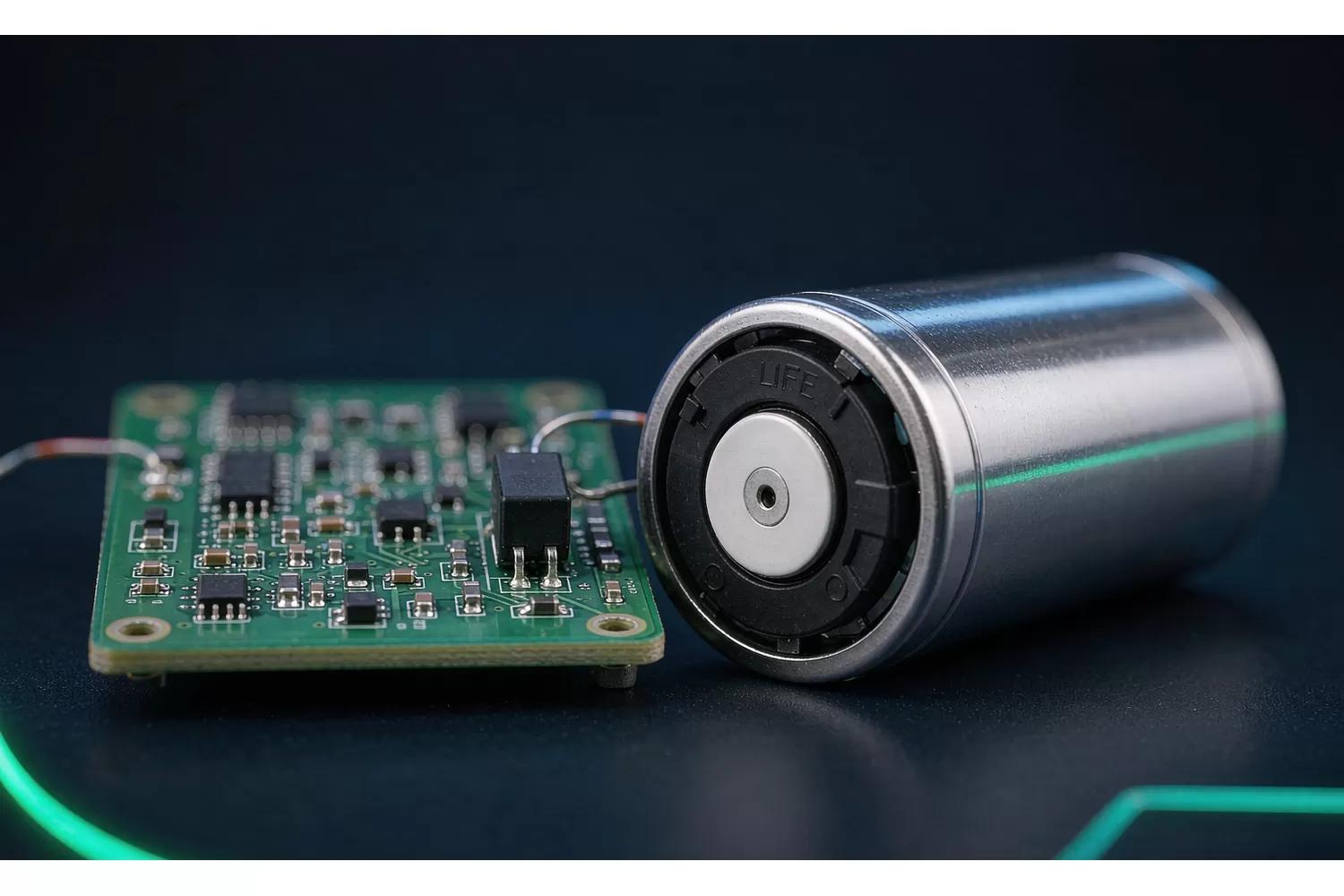
A battery-powered product is judged by runtime, and runtime is decided almost entirely by the power path. Unlike a wall-powered box, a portable device cannot afford to waste current — so the converters, the LDOs and the sensing parts are all chosen for the lowest possible standby draw while still delivering when the load wakes up.

The converter chain in a typical device
A single cell or a small pack feeds a boost such as the TPS61080 to create a system rail, while a buck such as the TPS54331 steps the pack down for the core. A low-quiescent LDO like the TPS73601 keeps the always-on and noise-sensitive sections alive at micro-amp levels. The art is balancing active efficiency against sleep current across the whole chain.
Seeing the current
You cannot manage battery life without measuring it. A current-sense amplifier such as the INA240 sits in the charge and discharge path so the firmware can gauge the cell and protect it. Combined with fuel-gauge logic, that is what turns a raw cell into a product that reports "23% left" honestly. For designs that also watch temperature, the sensor range covers the supporting devices.
Protection is not optional
Battery faults are unforgiving. Over-current, over-voltage and reverse-polarity protection parts sit between the cell and the rest of the board, and they are the difference between a fault and a fire. We supply these from traceable channels and we flag any line that is single-sourced in your bill of materials.
Sourcing for a long-lived supply chain
Send us the converter, the LDO, the sense amplifier and the protection parts from your schematic. We quote availability, date code and inspection options so a battery product does not stall on an allocated regulator or a scarce protection device.
Frequently asked questions
What makes battery-powered power design different?
Battery systems live or die on efficiency and quiescent current. Every milliamp wasted shortens runtime, and the power path must handle charge, discharge, protection and fuel gauging. The converter topology, the passives and the protection parts all have to be chosen for low standby draw.
Which converters suit battery systems?
Boost converters for stepping a cell up to a system rail, buck converters for stepping a pack down, and buck-boost for rails that cross the battery line. Low-quiescent LDOs handle the always-on and noise-sensitive sections. Current-sense amplifiers monitor charge and discharge.
What protection and sensing parts do I need?
Over-current, over-voltage and reverse-polarity protection, a battery fuel-gauge or coulomb counter, and a current-sense amplifier such as the INA240 family for charge/discharge monitoring. Protection parts are what keep a fault from turning into a fire.
Can you supply battery-system power parts?
Yes. We stock boost/buck/buck-boost regulators, low-Iq LDOs, current-sense amplifiers and protection devices commonly referenced in battery-powered designs. Send the exact part numbers and quantity for a quote.
About us & trademarks: JTDZ Tech (Shenzhen Jingteng Electronics Technology Co., Ltd.) is an independent distributor of electronic components. We are not an authorised distributor or representative of the manufacturers named in this article. Manufacturer and part names are used for indicative purposes only, to help identify the components discussed; all trademarks remain the property of their respective owners. Always verify specifications against the manufacturer's datasheet before design-in or purchase.
