
Check the toolchain before you check the datasheet
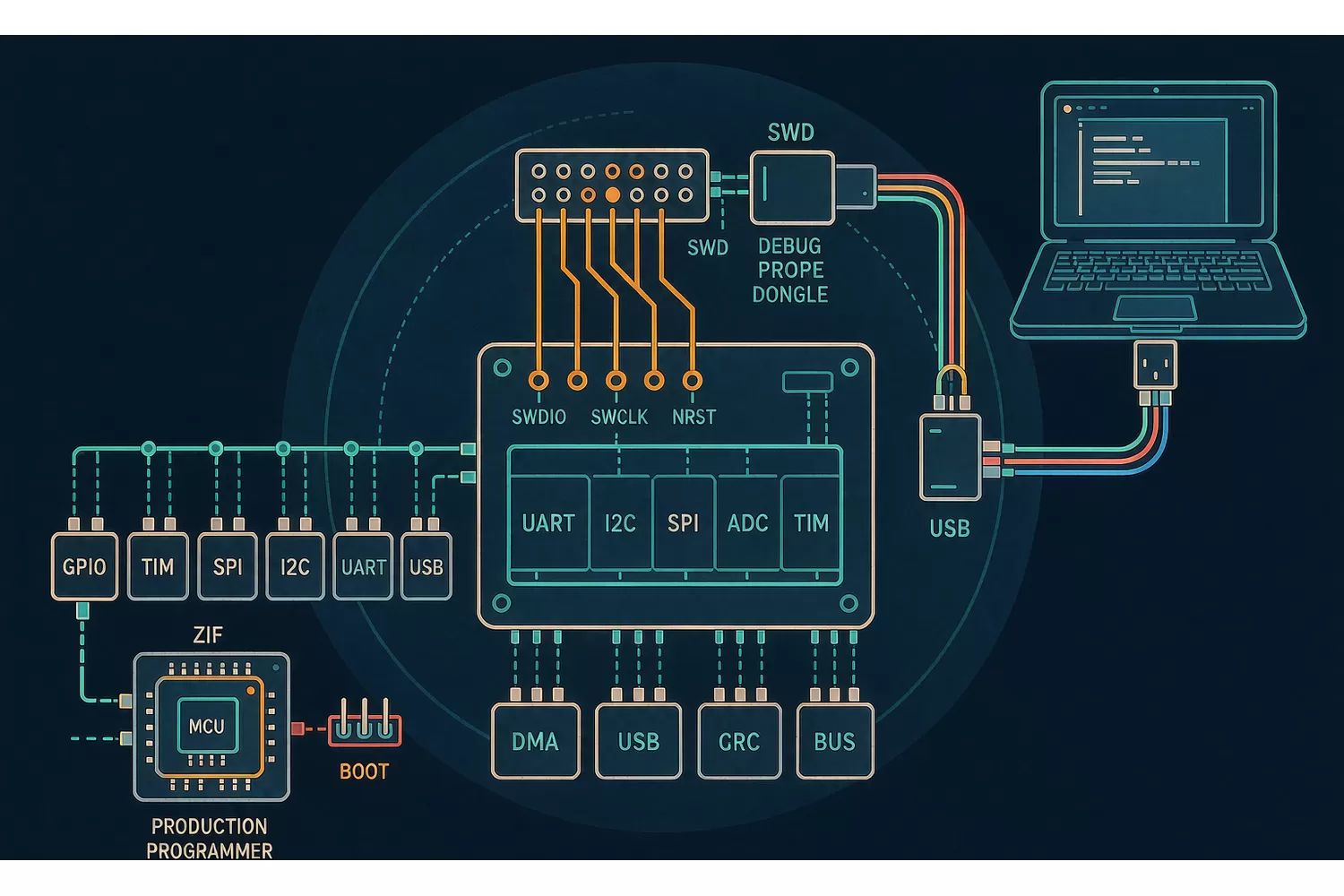
An MCU replacement that cannot be debugged is not a replacement. The good news is that the Cortex-M debug interface is standardised, so the SWD connection, the probe and the general flow usually carry over. The friction sits in device support: whether your specific IDE version lists the part, and whether your production programmer has it in its device database.

The debug path
| Layer | What usually transfers | What to verify |
|---|---|---|
| Two-wire SWD | Pin functions SWDIO and SWCLK | Which package pins carry them, and whether they are shared |
| Probe hardware | Generic CMSIS-DAP and J-Link class probes | Device selection in the probe software |
| IDE and toolchain | Same compiler family | Device support package for the exact part number |
| Flash algorithm | Provided by the support package | Whether your IDE version ships it already |
| Production programmer | Same socket and interface | Device entry in the programmer's own database |
Pin sharing on small packages
On QFN and small LQFP parts the SWD pins often double as general-purpose I/O. Firmware that configures those pins as outputs early in startup will lose the debug connection — sometimes permanently, until a boot-mode entry is used to recover. Check this before you flash a design onto a board you cannot easily rework.
Reset pin as debug control
Some debug adapters use the reset line to force a connect under reset. If your board removed the external reset network, that connection method may behave differently. Keep the option to drive reset available on the debug header.
The programming path
- System bootloader. Many parts ship with a factory bootloader that loads firmware over a serial or USB interface. Confirm it is present on the order code you buy, and confirm the entry condition, because production fixtures depend on it.
- Read protection. Once enabled, recovery usually requires a full erase. Decide in advance which products ship locked, and document the recovery procedure for the line.
- Mass production. Offline programmers, gang programmers and in-circuit fixtures each have their own device support. Confirm at least one path supports the new part before you commit to the switch.
A one-day checklist that prevents a one-week delay
- Confirm your IDE version lists the new part number; update if not.
- Plug the probe into a development board and get a connect, before touching your own PCB.
- Flash a minimal program and verify the debug connection survives a reset.
- Enable and then remove read protection once, deliberately, to learn the recovery path.
- Confirm your production programmer recognises the part.
Where this affects the schedule
None of these items is technically difficult, and all of them are cheap to check. The cost appears when a production line is stopped because the programmer does not know the part, and that delay is measured in days rather than hours. Checking the toolchain first converts a schedule risk into a checklist.
Parts commonly used for toolchain bring-up: AT32F403ARCT7, AT32F407VGT7 and AT32F435CGT7. The full line is listed under Microcontrollers / MCUs.
Verify before you commit: pinout, peripheral mapping and electrical limits differ between part numbers and between silicon revisions. Always confirm against the current official datasheet and errata for the exact order code you intend to use.
Questions & Answers
Will my existing ST-Link or J-Link work with AT32 parts?
Generic SWD probes of the CMSIS-DAP and J-Link classes normally work because the debug interface is standardised. You still need device support in the probe software, so update it and select the new part number.
Do I need a different IDE?
Usually the same IDE works once its device support package includes the part. Confirm your installed version lists the exact order code before you start the port.
What is the risk of read protection during a swap?
If protection is enabled and you lose the key, recovery normally means a full erase. Decide deliberately which builds ship locked and document the recovery procedure so the production line is not blocked.
Which pin issue breaks debug connections most often?
SWD pins that double as general-purpose I/O on small packages. If startup code reconfigures them early, the debugger loses the connection and recovery may need a boot-mode entry.
Recommended next steps
If you are sourcing any of the parts mentioned in this guide, we can help you confirm stock, pricing, and lead times quickly.
- Upload your BOM — send your full parts list and receive a consolidated quote within 2 business hours.
- Browse related in-stock lines: Microcontrollers / MCUs.
- Contact our team for hard-to-find or end-of-life components.
About us & trademarks: Jingteng Electronics (Shenzhen Jingteng Electronics Technology Co., Ltd.) is an independent distributor of electronic components. We are not an authorised distributor, agent or representative of any manufacturer named in this article. Manufacturer names, part numbers and trademarks are used for identification and technical compatibility only and belong to their respective owners.
