
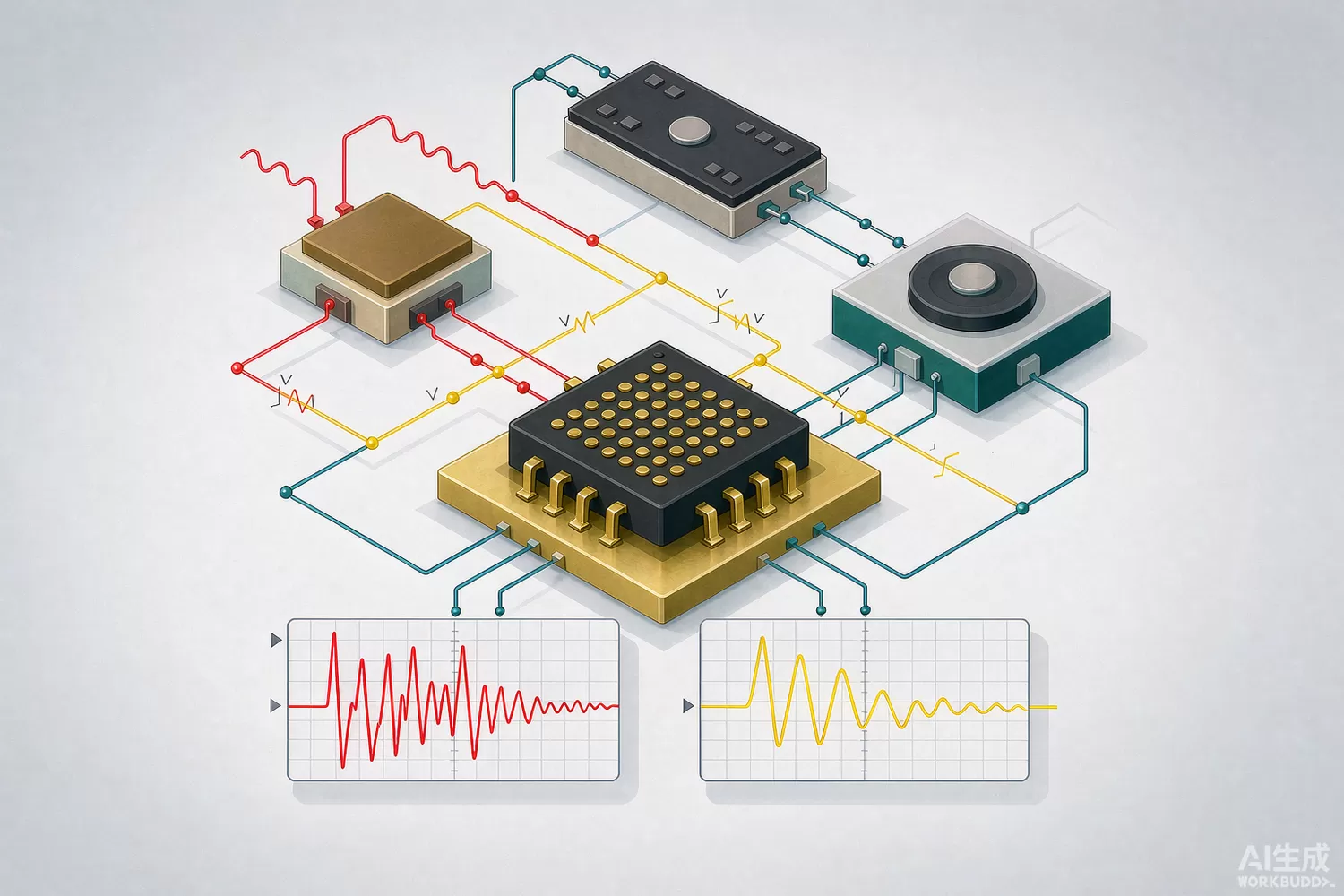
Nothing converts a mediocre supply into a mediocre radio faster than the voltage-controlled elements inside an RF chain. VCO push, reference-oscillator sensitivity and PA bias modulation all translate millivolts of rail noise into hertz of frequency error and dBc of spurious energy. A low-noise low-dropout regulator is therefore not a generic power part in RF design — it is a signal-integrity component, and its noise and PSRR belong on the RF schematic page, not the power page. This article covers selection logic, the latest architecture trends, and domestic options that cut rail cost dramatically.

Application logic: which rails actually matter
Grade your rails by how directly they modulate RF. Tier one: VCO and PLL varactor or tuning supplies, reference oscillators and DDS analog supplies — these need the quietest parts available, typically 4–25 µV RMS of integrated noise (10 Hz–100 kHz) and high PSRR at low offset frequencies. Tier two: LNA and mixer bias — noise here modulates gain and can leak as AM spurs. Tier three: digital, memory and interface rails — ordinary LDOs or switchers with good filtering suffice. The classic mistake is budgeting tier-one performance with a generic 1117-class regulator; the classic fix is one dedicated low-noise LDO per sensitive rail, decoupled close to the pin.
Switching regulators stay in the design for efficiency, but they feed the LDO, not the RF pin: the LDO's PSRR does the attenuation, which is why PSRR at the switcher's ripple frequency (hundreds of kilohertz to megahertz) matters as much as the headline noise figure.
Datasheet parameters that decide success
- Output noise, integrated 10 Hz–100 kHz in µV RMS — the defining spec for tier-one rails (4.7 µV RMS for the TPS7A4700 class).
- PSRR at 10 kHz–1 MHz, which sets how much switching ripple survives.
- Dropout voltage and headroom: an LDO starved of headroom loses PSRR dramatically.
- Load and line transient response, relevant when a PA bursts change the shared battery rail.
- Stability with your ceramic output capacitors and any reference-bypass capacitor the architecture uses.
New technology in low-noise regulation
The visible trend is reference filtering and noise-reduction pins: modern parts move their internal reference into a filtered domain (an external capacitor sets the noise corner), trading a bit of startup time for an order of magnitude of noise. Also visible: PSRR held up into the megahertz range so LDOs can sit right behind fast switchers; programmable soft-start and sequencing for multi-rail RF boards; and power-good plus tracking features that make cold-start sequencing of VCO, PLL and PA rails deterministic. Ultra-low-noise parts once lived only at the top of the price list; the architecture has now moved into mid-price silicon, which is exactly where domestic vendors compete.
Domestic alternatives: families and indicative cost
Three domestic tracks are visible on our own shelves. Hexin (HEXIN) HX2001 is a small SOT-23-5 LDO stocked as HX2001-EB and aimed at the quiet-rail role at commodity pricing. COSINE's COS29xxx family cross-references the MIC291xx/293xx/295xx/297xx 1.5–3 A low-dropout parts: COS29302WU, COS29502WU and COS29152WU cover adjustable-output, higher-current rails for PA bias and mixed-signal boards. Joulwatt covers the switching tier with parts such as the JW5060T buck that cross-references the MP1584EN. Import anchors remain the reference designs of record: the TPS7A4700RGWR (4.7 µV RMS programmable-output LDO) and the TPS73601DBVR (capacitor-free, noise-reduction architecture).
Price figures below are indicative public-market reference ranges for moderate volumes, compiled from publicly observable listings. They fluctuate with the spot market, package option, grade (industrial, automotive, screened) and order quantity, and must not be read as a quotation. Ask us for a firm price on your exact part numbers and quantities.
| Function (imported anchor) | Example import part | Indicative import price (USD) | Domestic candidate | Indicative domestic price (USD) |
|---|---|---|---|---|
| Ultra-low-noise analog rail (4–7 µV RMS class) | TPS7A4700RGWR (TI) | 2.00 – 3.50 | HX2001-EB LDO (Hexin) | 0.20 – 0.50 |
| Adjustable quiet rail, capacitor-free architecture | TPS73601DBVR (TI) | 0.60 – 1.20 | COS29xxx family, low-current members | 0.15 – 0.40 |
| 1.5–3 A low-dropout rail for PA / mixed-signal bias | MIC29302WU / MIC29502WU (Micrel-class) | 1.20 – 2.50 | COS29302WU / COS29502WU (COSINE) | 0.30 – 0.80 |
| General low-power digital / housekeeping rails | XC6206 / ME6211-class imports | 0.05 – 0.15 | XC6206P332MR / ME6211C33M5G domestic stock | 0.02 – 0.06 |
| Efficient front-end buck feeding the LDO | MP1584EN (MPS) | 0.40 – 0.90 | JW5060T (Joulwatt) | 0.08 – 0.25 |
On tier-one rails the imported ultra-low-noise parts still set the reference for noise and PSRR figures; on tier-two and housekeeping rails, domestic parts routinely deliver 60–90% cost reduction for equivalent electrical function. Validate noise on your board with a proper low-noise measurement setup — datasheet numbers assume reference-grade test conditions.
Qualification flow
Measure integrated noise with a low-noise preamp into a spectrum analyser (or rent the vendor's eval kit), check PSRR by injecting a known ripple through an injection transformer, and listen at the RF output: compare VCO phase noise at 1 kHz offset with the battery rail versus the final regulator tree. Then swap in domestic candidates on the same PCB — dropout, stability and transient behaviour are where generic LDOs quietly disappoint, not noise.
Frequently asked questions
Why not just use a switcher with an RC filter?
You can, but the RC filter attenuates proportionally to frequency, while switching ripple sits at a specific frequency where its fundamental survives. A low-noise LDO's PSRR attacks exactly that band, and its output impedance stays low at DC where filtering cannot help.
How much headroom does a low-noise LDO need?
More than the datasheet dropout: PSRR degrades as the device approaches dropout. Budget 0.5–1 V above dropout for demanding rails.
Do domestic LDOs really reach 4–7 µV RMS noise?
Family-level public data shows domestic vendors quoting competitive noise figures on their flagship parts. For tier-one rails, request the measured noise spectrum plot, not just the headline number, and verify on your board.
One big LDO or several small ones?
Several small ones. Star-regulating each sensitive rail isolates load transients — a PA burst on a shared 3 A rail will modulate every circuit that shares it.
About us & trademarks: JTDZ Tech (Shenzhen Jingteng Electronics Technology Co., Ltd.) is an independent distributor of electronic components. We are not an authorised distributor or representative of the imported manufacturers named in this article. Manufacturer, brand and part names are used for identification purposes only; all trademarks remain the property of their respective owners. Cross-reference information in this article is based on publicly available sources, is subject to change, and is not a substitute for your own engineering validation. Always verify specifications against the manufacturer's datasheet before design-in or purchase.
