
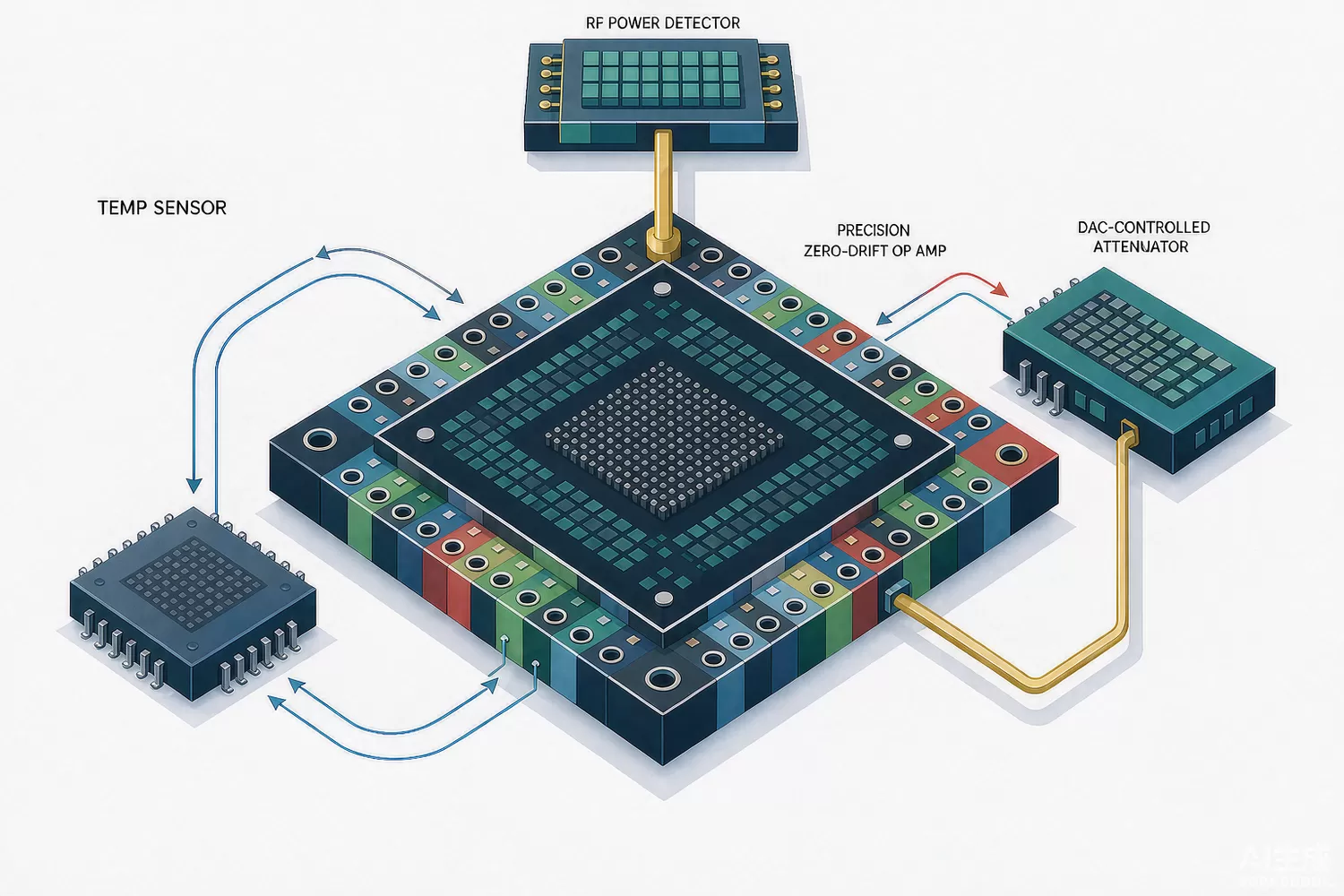
Behind every well-behaved RF chain stands a set of very slow, very precise operational amplifiers. They integrate the detector voltage that closes an automatic gain control loop, they servo the bias current of a power amplifier against temperature, they drive the DAC-referenced tuning voltage of a varactor filter, and they amplify the microvolt-level signals of power and temperature sensors. The RF engineer never sees them on a block diagram, but when they drift, the radio drifts. This article covers the selection logic for zero-drift and precision op amps in those roles, the technology trends, and the domestic COSINE parts that now cross-reference the classic Analog Devices and TI anchors.

Application logic: why zero-drift in RF systems
An RF power-control loop is a DC instrument in disguise: the detector diode's output (or a log detector's RSSI voltage) must be amplified and compared to a setpoint with an error that stays below a fraction of a dB over years and temperature swings. A conventional precision op amp with 5–50 µV/°C of offset drift turns a 30°C swing into tens of microvolts of error — directly into loop setpoint error. Zero-drift (chopper-stabilised or auto-zero) architectures null offset continuously and specify drift in the tens of nanovolts per degree, moving the error budget to noise and linearity instead. The same logic applies to TEC and oven servo loops (temperature setpoint accuracy is RF frequency accuracy, as our reference-oscillator article explains) and to precision current sensing in PA supply monitoring.
Datasheet parameters that matter here
- Offset and offset drift (zero-drift parts: 1–20 µV and below 0.1 µV/°C).
- Voltage noise density — chopping adds noise near the chop frequency; check the noise-versus-frequency plot, not just the 1 kHz headline.
- Offset current and bias current with your detector impedance.
- Rail-to-rail input/output behaviour if the loop must approach the supply rails (log detectors sit near ground).
- Chop-frequency residue: chopper parts put tiny artifacts at the chopping clock and its harmonics — relevant if your RF chain can demodulate them.
New technology
Zero-drift has migrated from exotic to mainstream: modern parts combine chopper stabilisation with rail-to-rail operation at commodity prices, and several vendors ship zero-drift plus EM hardened clock schemes that suppress chopping artifacts at the pins. Package integration is also moving — dual and quad zero-drift channels in one small package fit the multi-loop reality of radio control boards (AGC, PA bias, thermal servo) without spending board area. Noise floors of the newest auto-zero parts now approach chopper-free precision bipolar parts over much of the band, removing the old excuse for staying with conventional parts in low-noise roles.
Domestic alternatives: families and indicative cost
COSINE's precision line is the clearest domestic story in this batch because our stocked parts carry explicit cross-references to the import anchors: COS2387SRA against the OPA2387 zero-drift dual, COS2335SRA against the OPA2335 36 V zero-drift dual, and the AD855x-referenced COS8554SR and COS8552SR for single-supply auto-zero roles, with COS8552MR stocked as original COSINE parts. Import anchors: OPA2387-class (5 µV, 0.03 µV/°C-class drift), OPA2335 (2 µV, 36 V operation) and AD8554-class single-supply auto-zero parts.
Price figures below are indicative public-market reference ranges for moderate volumes, compiled from publicly observable listings. They fluctuate with the spot market, package option, grade (industrial, automotive, screened) and order quantity, and must not be read as a quotation. Ask us for a firm price on your exact part numbers and quantities.
| Function (imported anchor) | Example import part | Indicative import price (USD) | Domestic candidate | Indicative domestic price (USD) |
|---|---|---|---|---|
| Zero-drift dual, general RF control loops | OPA2387 (Analog Devices) | 2.20 – 4.00 | COS2387SRA (COSINE) | 0.40 – 1.00 |
| Zero-drift dual, wide-supply (36 V) servo and sensor | OPA2335 (Analog Devices) | 2.50 – 4.50 | COS2335SRA (COSINE) | 0.50 – 1.20 |
| Single-supply auto-zero, detector / ADC buffer | AD8554ARZ / AD8552ARZ (Analog Devices) | 1.80 – 3.80 | COS8554SR / COS8552SR | 0.35 – 0.90 |
| Detector front-end amplification (Schottky / log) | Discrete detector chains (see our article) | — | COSINE precision singles and duals | 0.15 – 0.60 |
Cost gaps of 70–85% are routine in this category. The engineering work is confirmation on your loop: verify offset drift and chopping artifacts on the real board, because detector impedance and layout can dominate the outcome.
Qualification flow
Bench-check three units over your temperature range (a thermoelectric stage or a simple hotbox suffices), log loop setpoint error versus temperature with the detector attached, and scan the output with a spectrum analyser for chop-frequency residue. Then run the loop's worst case: minimum detector drive, maximum gain — that is where offset and noise actually bite.
Frequently asked questions
Chopper noise versus offset drift — which wins for an AGC integrator?
For a true DC integrator, offset drift wins: chopping artifacts land at the chop frequency where the integrator has gain, but the loop bandwidth is far below it. Check that your loop bandwidth sits well under the chop clock.
Do domestic zero-drift parts really match OPA2387-class specs?
Public cross-reference documentation matches the headline offset and drift figures. Validate the noise spectrum and chopping residue on your own fixture before approving the second source.
Why did my detector loop oscillate after swapping op amps?
Different parts have different output-stage drive and phase behaviour against your integrator capacitor. Re-check compensation with the actual part, especially with cable or filter capacitance on the output.
Can a conventional precision op amp still be the right choice?
Yes — where AC noise at audio-and-above frequencies matters more than DC drift (for example IF buffering), a low-noise bipolar part can outperform a chopper. Match the part to the dominant error source.
About us & trademarks: JTDZ Tech (Shenzhen Jingteng Electronics Technology Co., Ltd.) is an independent distributor of electronic components. We are not an authorised distributor or representative of the imported manufacturers named in this article. Manufacturer, brand and part names are used for identification purposes only; all trademarks remain the property of their respective owners. Cross-reference information in this article is based on publicly available sources, is subject to change, and is not a substitute for your own engineering validation. Always verify specifications against the manufacturer's datasheet before design-in or purchase.
