
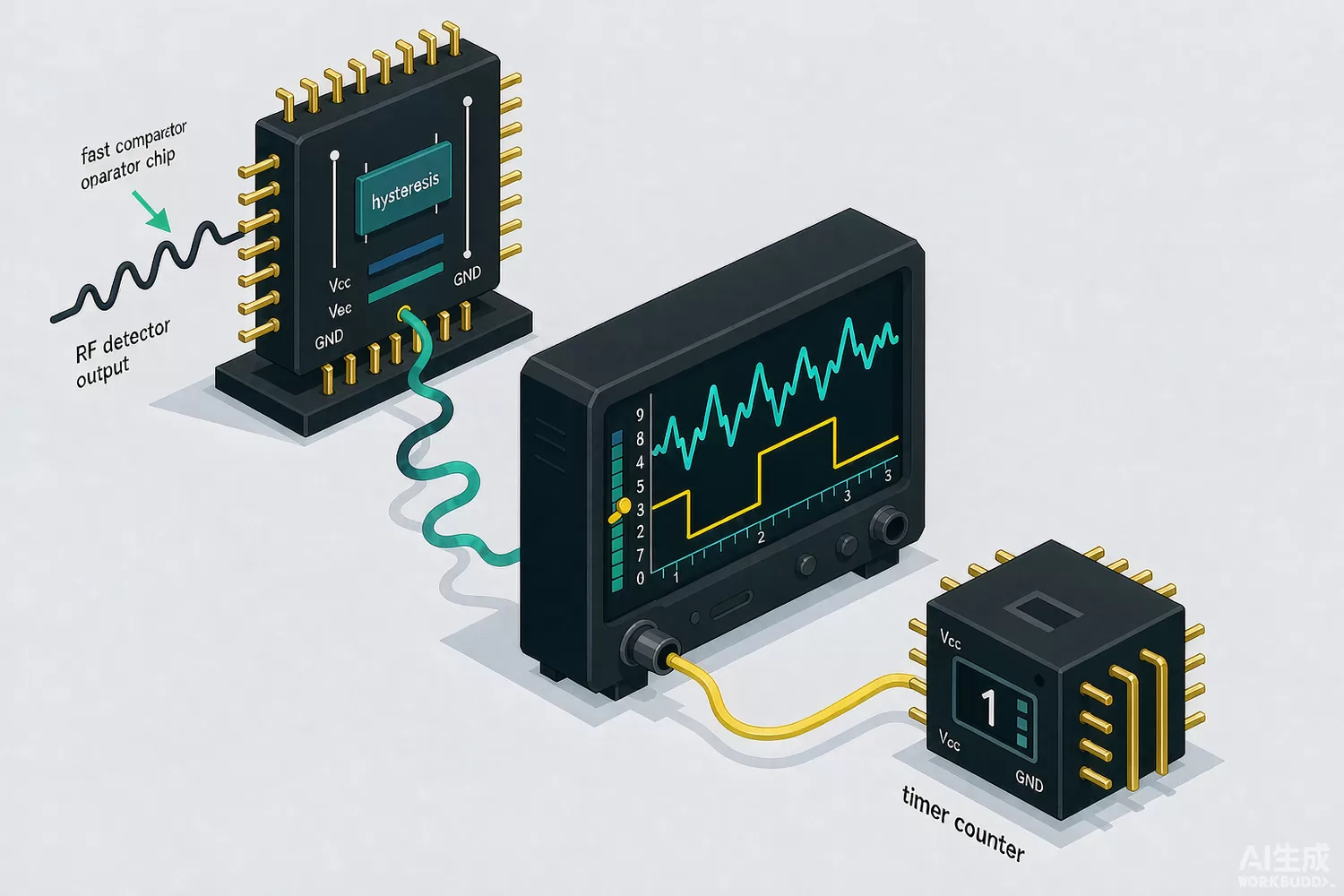
A comparator is the cheapest RF-adjacent decision device you own: it converts an analog waveform — a detector output, a limited IF envelope, a clock sinewave, a pulse edge — into a clean logic level. In radio and test hardware, comparators zero-cross square up reference sinewaves for counters, regenerate the video output of limiters and discriminators, trigger on pulse edges for time-of-flight and LIDAR-style timing, and watchdog alarm levels in power-control loops. Speed is the whole point: a general-purpose part like the LM393 settles in a microsecond, while a fast part decides in single-digit nanoseconds. This article covers the selection logic, technology trends and the domestic COSINE comparators now stocked against the classic TI anchors.

Application logic: matching comparator class to task
Three classes cover nearly every radio-system job. Class one, general-purpose (LM393/LM339-class, our stocked LM393SR and LM339SR): power supervision, slow alarms, level monitoring — propagation of 0.3–1.3 µs is fine. Class two, fast (TLV3201/3202-class, stocked as COS3201TR and COS3202SR): 40–50 ns propagation for pulse gates, discriminator regeneration and clock squaring up to tens of megahertz. Class three, very fast (TLV3501/3502-class, stocked as COS3502SR): 4.5 ns propagation for counter front ends, coincidence timing and fast triggers. Choosing one class too slow corrupts timing jitter; one class too fast wastes noise margin and power.
Datasheet parameters that decide success
- Propagation delay and its dispersion (delay spread between events is your timing jitter floor).
- Input offset and hysteresis options — built-in hysteresis beats an external positive-feedback network for speed.
- Input common-mode range versus your signal swing (rail-to-rail input parts handle detector outputs near ground).
- Output type: push-pull CMOS for clean logic, open-drain for level shifting; some fast families offer LVDS/PECL outputs for GHz-class timing.
- Power versus speed: the 4.5 ns class draws several milliamps; the 40 ns class microamps. Sleep pins matter in battery instruments.
New technology
The fast end has moved toward peaking-enabled inputs (a bandwidth-boosting trick in the TLV3501 class that trades supply current for nanosecond edges), LVDS and PECL output options that hand timing signals straight to FPGA counters without a translation stage, and integrated reference ladders that remove one external precision part. At the system level, FPGA-internal comparators (via differential IO) increasingly handle very-fast threshold decisions, leaving standalone parts for the analog-side jobs where board-level convenience and supply discipline win. Equivalent-time techniques in instruments also push timing precision below part propagation numbers — delay-line interpolation between a comparator trigger and the counter clock recovers picosecond-class resolution.
Domestic alternatives: families and indicative cost
COSINE's comparator line cross-references the import anchors directly: the fast class COS3201TR (TLV3201AIDBVR reference), COS3202SR (TLV3202 reference) and the very fast COS3502SR (TLV3502 reference), plus the general-purpose LM393SR and LM339SR for the LM193/LM139 heritage parts. These sit naturally with our wider COSINE precision range used in RF control loops.
Price figures below are indicative public-market reference ranges for moderate volumes, compiled from publicly observable listings. They fluctuate with the spot market, package option, grade (industrial, automotive, screened) and order quantity, and must not be read as a quotation. Ask us for a firm price on your exact part numbers and quantities.
| Function (imported anchor) | Example import part | Indicative import price (USD) | Domestic candidate | Indicative domestic price (USD) |
|---|---|---|---|---|
| Very fast comparator, 4.5 ns class | TLV3502 (TI) | 1.20 – 2.50 | COS3502SR (COSINE) | 0.30 – 0.70 |
| Fast comparator, 40–50 ns class, rail-to-rail | TLV3201 / TLV3202 (TI) | 0.50 – 1.20 | COS3201TR / COS3202SR | 0.10 – 0.35 |
| General-purpose dual comparator | LM393 / LM193 heritage | 0.08 – 0.25 | LM393SR (COSINE) | 0.02 – 0.08 |
| General-purpose quad comparator | LM339 / LM139 heritage | 0.10 – 0.30 | LM339SR (COSINE) | 0.03 – 0.10 |
| Counter front end behind the comparator | Clock/reference chain (see our article) | — | GD32F303CBT6 timer capture | 0.30 – 0.80 |
For the general-purpose and fast classes the domestic gap is essentially price, not performance; for the very fast class, request propagation-delay dispersion data at your overdrive level and confirm jitter on a real pulse source.
Qualification flow
Feed the candidate a realistic signal — real amplitude, real rise time, real common-mode — and measure propagation delay dispersion on an oscilloscope with persistence, then threshold sweep across temperature for the alarm roles. Hysteresis behaviour deserves a deliberate look: a comparator with insufficient hysteresis on a noisy detector output will chatter exactly at the decision point, and the symptom looks like firmware trouble.
Frequently asked questions
Why does my comparator double-trigger on a slow input?
Insufficient hysteresis plus input noise crossing the threshold repeatedly. Add the built-in or external hysteresis band, slow the input with a small RC, and keep the decision point away from the noisy region.
Comparator or FPGA IO for threshold detection?
FPGA differential IO works for clean, fast, logic-level signals; a dedicated comparator wins where the input is analog, near-ground or slowly moving, and where precise hysteresis and supply discipline matter.
Do domestic fast comparators match TLV3502-class timing?
Public cross-reference data matches the headline propagation numbers. Request delay-dispersion measurements at your overdrive and confirm timing jitter in-circuit.
What supply hygiene does a fast comparator need?
Ground bounce couples directly into decisions: solid ground plane, local decoupling, and keep high-current output returns away from the input network.
About us & trademarks: JTDZ Tech (Shenzhen Jingteng Electronics Technology Co., Ltd.) is an independent distributor of electronic components. We are not an authorised distributor or representative of the imported manufacturers named in this article. Manufacturer, brand and part names are used for identification purposes only; all trademarks remain the property of their respective owners. Cross-reference information in this article is based on publicly available sources, is subject to change, and is not a substitute for your own engineering validation. Always verify specifications against the manufacturer's datasheet before design-in or purchase.
