
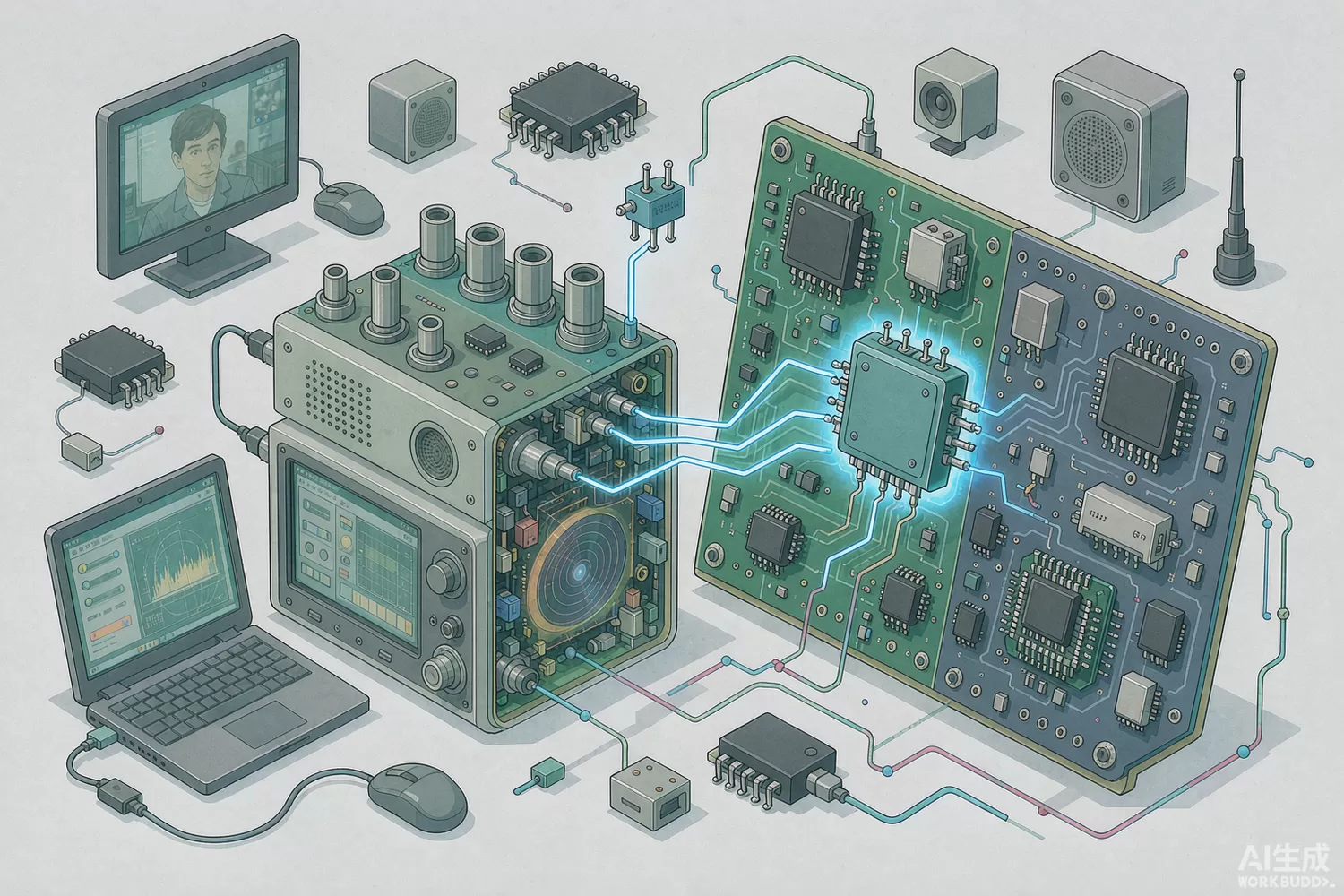
A surprising fraction of RF-platform BOMs is timing silicon: one crystal per frequency, fixed PLLs for DAC and ADC clocks, VCXOs for retiming. Any-frequency clock generator ICs collapse that assortment into one I2C-configurable chip that synthesises multiple independent outputs from a single 25 or 27 MHz crystal. The Skyworks (formerly Silicon Labs) Si5351 family made the category mainstream; domestic vendors now offer same-footprint, register-compatible alternatives. This article covers where these devices fit, their real limits, and how the domestic options compare.

Application logic: one chip, many clocks
The architecture is a pair of fractional-N PLLs feeding a bank of output dividers and drivers. From one crystal reference, an Si5351A drives three outputs (2.5 kHz to 200 MHz each), while the Si5351B adds an internal VCXO for fine frequency trim against a remote reference, and the Si5351C accepts an external reference clock instead. Typical digital-RF loads: DAC/ADC sample clocks in SDR transceivers, clocking for microcontroller-controlled RF front ends, spread-spectrum clocks for EMI relief in digital sections, and replacement of obsolete custom oscillators in service equipment. In low-cost SDR receivers, one Si5351 provides both the LO clock and the sampler clock from a single crystal — the reason the part has a cult following among radio amateurs.
Specification checklist
- Output frequency range and per-output divider resolution: Si5351-class parts cover 2.5 kHz–200 MHz with fractional dividers.
- Period jitter, quoted for your actual frequency plan (a 3-output plan and an 8-output plan jitter differently on the same device).
- Crystal interface: series-resonant 25/27 MHz crystals with defined load capacitance; the B-variant's internal VCXO pull range for retiming.
- Output format: CMOS swings into 50-ohm systems need proper AC coupling and impedance care.
- I2C configuration and NVM: some variants burn the frequency plan into EEPROM for standalone power-up.
For clocking beyond this class — PCIe generation clocks and low-jitter distribution — dedicated devices take over: Skyworks' Si52147 serves PCIe-generation clocking, Renesas/IDT buffer families such as the ICS85411 handle fan-out distribution, and TI's CDCP1803 provides PCIe-class buffering. Those roles sit adjacent to the any-frequency generators; the synthesiser-vs-buffer split follows signal integrity budgets. For an RF-chain view of clock-driven sampling, see our RF-sampling data converter article.
New technology: lower jitter, more outputs, spread spectrum
The category keeps moving on three axes. Jitter: successive silicon revisions and domestic competitors now document period jitter in the 35–70 ps typical class for realistic frequency plans, enough for 16-bit audio converters and mid-range radio samplers. Flexibility: glitchless on-the-fly frequency switching and per-output rise-time control reduce the need for external filtering. And EMI management: centre and down spread-spectrum profiles are now standard in the domestic alternatives, matching the mixed-signal reality of most boards.
Domestic alternatives: documented, register-compatible families
This is one of the few component categories where the domestic side is documented at part-number level, not just family level, and the compatibility claims are specific:
- Shenzhen Jiadexing (Godsend) Electronics — GDS5351A/B/C: I2C-programmable, 2.5 kHz–200 MHz, 3- and 8-output variants in MSOP-10/QFN-20, published as same-footprint and register-map-compatible with the Si5351 family; documented period jitter of 60 ps typ / 135 ps max (pk-pk) for full-output plans.
- Shengjin Microelectronics — SMC5351A-GT / B-GM / C-GM1: mapped one-for-one onto the Si5351A/B/C suffixes, with equivalent I2C command set and lower unit cost.
- Hangzhou Ruimeng Technology — MS5351M: three-channel 2.5 kHz–200 MHz generator documented as fully compatible with the Si5351 command set, with phase-adjustable and glitchless-switching outputs and HCSL/PCIe-Gen1 format support.
Compatibility claims still require the five-step verification the migrating vendors themselves recommend: pin-map comparison, land-pattern check, register-map verification against the application notes, frequency-plan review, and same-condition jitter measurement. Publicly documented jitter parity makes that exercise quick for these parts.
Price figures below are indicative public-market reference ranges for moderate volumes, compiled from publicly observable listings. They fluctuate with the spot market, package option, grade (industrial, automotive, screened) and order quantity, and must not be read as a quotation. Ask us for a firm price on your exact part numbers and quantities.
| Function (imported anchor) | Example import part | Indicative import price (USD) | Domestic candidate | Indicative domestic price (USD) |
|---|---|---|---|---|
| 3-output any-frequency generator | Si5351A (Skyworks/SiLabs) | 0.60 – 1.60 | GDS5351A / SMC5351A-GT / MS5351M | 0.20 – 0.60 |
| 3-output + internal VCXO | Si5351B (Skyworks/SiLabs) | 0.90 – 2.20 | GDS5351B / SMC5351B-GM | 0.35 – 0.90 |
| 3-output, external reference input | Si5351C (Skyworks/SiLabs) | 0.80 – 2.00 | GDS5351C / SMC5351C-GM1 | 0.30 – 0.85 |
| PCIe-generation clock, low jitter | Si52147 (Skyworks) | 0.50 – 1.50 | Domestic PCIe clock families (vendor level) | 0.30 – 0.90 |
| Clock buffer / distribution | ICS85411 (Renesas/IDT) / CDCP1803 (TI) | 1.50 – 5.00 | Domestic buffer families (vendor level) | 0.80 – 2.50 |
The domestic price advantage here (roughly 60–70% on the generator sockets) is unusually clean because the parts document register-level compatibility. The remaining risk sits in jitter over your exact frequency plan — measure, do not trust the table.
Qualification checklist
Configure both devices with the identical frequency plan and measure period jitter on the same scope with the same probes; verify frequency accuracy against a GPS-disciplined counter at power-up from NVM; exercise a glitchless frequency switch if your application needs one; and check crystal start-up margin with your actual load capacitors — start-up failures are the classic field issue in cloned timing parts.
Frequently asked questions
Is a domestic Si5351-class replacement safe for production?
With verification, yes: GDS5351, SMC5351 and MS5351M document register-level compatibility and jitter figures. Run the five-step check (pins, land pattern, registers, frequency plan, jitter) before releasing the second source.
Can one clock generator feed both the LO and the ADC?
Often, yes, up to 200 MHz outputs — but check crosstalk between outputs in your plan, and prefer separate PLL paths on multi-PLL devices so the LO does not modulate the sampler clock.
Why does my Si5351 output look square, not sinusoidal?
These are CMOS-output generators. Into 50-ohm RF stages, AC-couple and filter, or use a balun and a band-pass filter to clean the harmonics before injecting an LO port.
When do I still need a discrete PLL synthesiser instead?
Above 200 MHz, for sub-Hz step sizes, or for phase-noise figures that fractional-N CMOS clocking cannot reach — see our RF PLL synthesiser article for that class of part.
About us & trademarks: JTDZ Tech (Shenzhen Jingteng Electronics Technology Co., Ltd.) is an independent distributor of electronic components. We are not an authorised distributor or representative of the imported manufacturers named in this article. Manufacturer, brand and part names are used for identification purposes only; all trademarks remain the property of their respective owners. Cross-reference information in this article is based on publicly available sources, is subject to change, and is not a substitute for your own engineering validation. Always verify specifications against the manufacturer's datasheet before design-in or purchase.
