
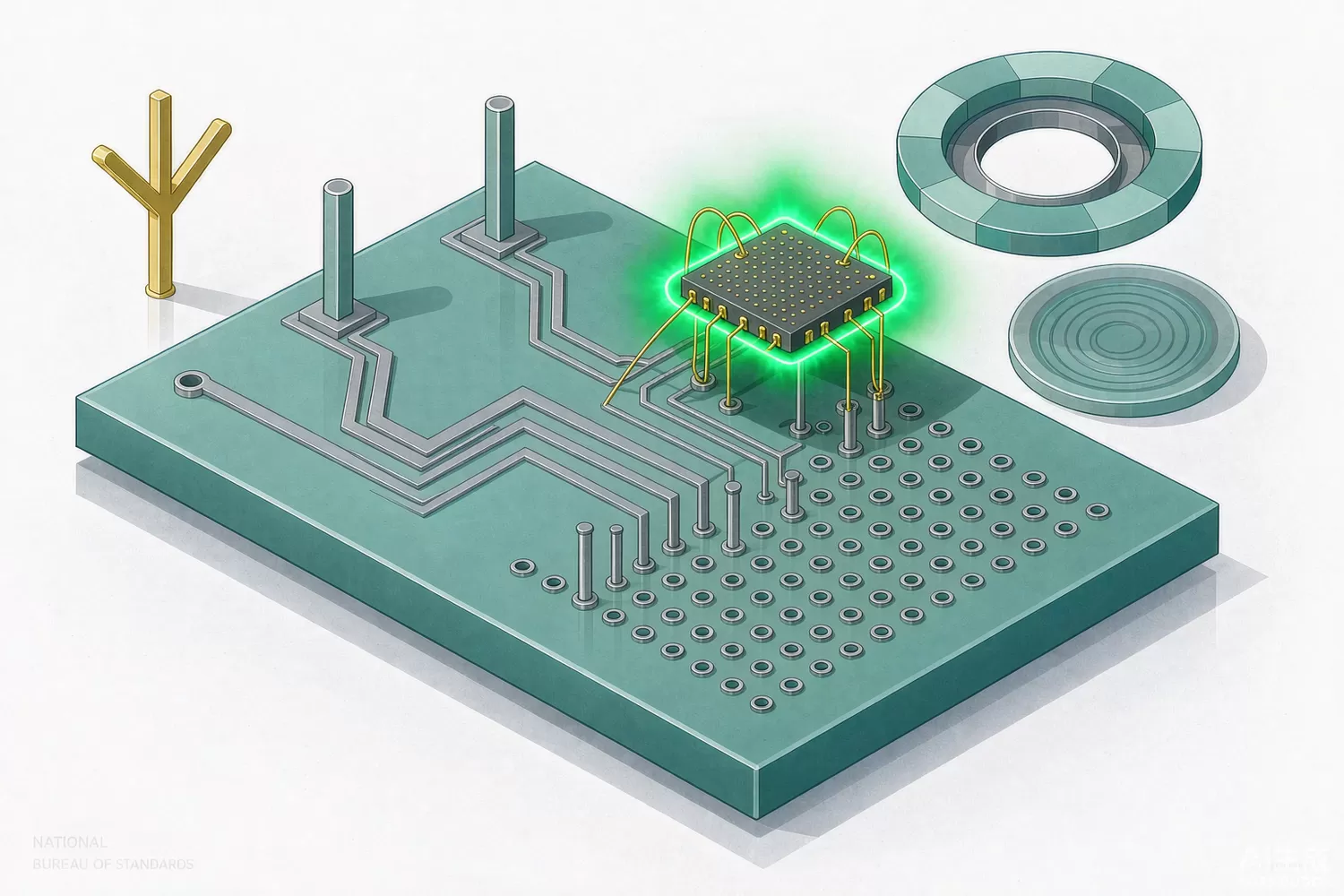
Most modern receivers use packaged LNA MMICs — they are fast to design in. But when noise figure must be squeezed below what a 50-ohm-matched module offers, or when the front end must be optimised to a non-50-ohm source such as an electrically small antenna, designers still reach for discrete GaAs pHEMT and HEMT transistors and build the match themselves. This article explains when the discrete approach wins, how to design with these devices, and which domestic families are the current benchmark.

Application logic: when a bare transistor beats a module
A packaged LNA MMIC is noise-matched to 50 ohms at one band. A bare device lets you noise-match to whatever impedance your source actually presents — critical for satellite LNAs behind a waveguide probe, for LNAs in front of a fixed filter whose passband is narrower than the device's optimum, and for cryogenic or ultra-low-NF designs where every 0.1 dB counts. Devices in this article's anchor list cover the classic sources: Broadcom/Avago E-pHEMT parts (ATF-54143, ATF-55143), Renesas/NEC's HJ-FET NE32584C famous in satellite LNBF front ends, Fujitsu's FHX35 family (FHX35X, FHX35LG), and Mitsubishi's MGF49x line (MGF4934BM, MGF4965BM, MGF4964BL).
Design flow in five steps
- Pick the device for NF and associated gain at your frequency from the datasheet's constant-NF contours (e.g. 0.5 dB class NF at 2 GHz for E-pHEMT parts; sub-0.5 dB class at 12 GHz for HJ-FETs).
- Place the bias point: pHEMTs want 2–3 V drain and 20–60 mA; the E-pHEMT variants accept single positive supply because the threshold is near +0.6 V.
- Synthesise the input match onto the constant-NF contour (simultaneous conjugate match is deliberately NOT used — the source impedance moves toward Gamma-opt).
- Stabilise: add series resistive feedback or shunt RC until K-factor exceeds 1 across the band, before finalising the match.
- Lay out with via-grounded source leads and short gate traces; source inductance converts into degraded NF and gain peaking faster than any other layout error.
If the system-level view is what you need — sensitivities, cascaded noise budgets, filtering ahead of the LNA — start with our LNA receive front-end article, which covers packaged MMIC choices; this article is the device-level companion.
New technology: enhancement-mode and higher-frequency processes
The modern discrete landscape is shaped by two process shifts. Enhancement-mode pHEMT (the ATF-54143/55143 class) removed the negative gate supply that made depletion-mode designs fragile: one 3 V rail now biases the whole front end, and gate-bias networks shrank from a charge-pump to a resistor divider. Pushed-up fT processes from the Japanese HEMT lines moved sub-0.5 dB noise from 12 GHz down to Ka-band, which is why MGF and FHX families keep appearing in new VSAT and radio-astronomy builds. Current-generation devices also document noise parameters across temperature, acknowledging that LNAs rarely work at +25°C in the field.
Domestic alternatives: families and indicative cost
Domestic discrete microwave-transistor capability is publicly documented at family level: China Electronics Technology Group Corporation research institutes (CETC-13 in Shijiazhuang, with supporting GaAs lines at CETC-55) publish GaAs pHEMT and HEMT device families spanning 0.5–20 GHz with noise figures in the 0.4–0.8 dB class at their design bands, offered as die and in SMT packages. Open data sheets typically include NF contours and S-parameters for packaged variants; die-level data is shared through controlled channels. For LNA MMIC alternatives (the packaged route), see the domestic families listed in our front-end article.
Price figures below are indicative public-market reference ranges for moderate volumes, compiled from publicly observable listings. They fluctuate with the spot market, package option, grade (industrial, automotive, screened) and order quantity, and must not be read as a quotation. Ask us for a firm price on your exact part numbers and quantities.
| Function (imported anchor) | Example import part | Indicative import price (USD) | Domestic candidate (family level) | Indicative domestic price (USD) |
|---|---|---|---|---|
| E-pHEMT LNA transistor, SOT-343 | ATF-54143 (Broadcom) | 0.60 – 1.60 | CETC-13 pHEMT device families | 0.40 – 1.20 |
| Higher-frequency E-pHEMT transistor | ATF-55143 (Broadcom) | 0.80 – 2.00 | CETC-13 pHEMT device families | 0.50 – 1.50 |
| HJ-FET for 12 GHz LNAs | NE32584C (Renesas/NEC) | 2.00 – 6.00 | CETC-13 HEMT families | 1.50 – 4.50 |
| HEMT die for hybrid LNAs | FHX35X / FHX35LG (Fujitsu) | 3.00 – 9.00 | CETC-13/55 HEMT die families | 2.00 – 6.00 |
| Low-noise HEMT, packaged | MGF4934BM / MGF4965BM (Mitsubishi) | 3.00 – 10.00 | CETC-13 packaged HEMT families | 2.00 – 7.00 |
Device-level price differences are modest; the meaningful gap is application support — noise-parameter files, bond-pad models and wafer-lot repeatability data. Ask for all three when qualifying a domestic device against an ATF/NE/FHX/MGF incumbent.
Qualification checklist
Build the LNA on your final stack-up, sweep noise figure across the band at both temperature extremes, record input return loss against the antenna (not a tuner), and verify stability with a worst-case source pull. Re-measure after 500 hours of bias soak: gate current drift is the classic failure signature of marginal processes.
Frequently asked questions
Why choose a bare pHEMT over a 50-ohm LNA MMIC?
When the source is not 50 ohms (antennas, waveguide probes, filter interfaces), when you need the last 0.2 dB of noise figure, or when the bias architecture must be customised. Otherwise the MMIC is faster to build.
What kills discrete-HEMT designs most often?
Insufficient stabilisation (oscillation at band edges), source-lead inductance from layout, and gate-bias networks that cannot absorb Schottky gate-current drift over temperature.
Are domestic pHEMT devices available in the same packages?
Family-level documentation covers SMT and die formats comparable to ATF/FHX packaging. Confirm bond-pad geometry and reference-ground arrangement before reusing a board layout unchanged.
Can I mix discrete devices with packaged MMIC stages?
Yes, and it is common: a discrete first stage noise-matched to the antenna, followed by a 50-ohm MMIC for the remaining gain, gives most of the NF benefit with half the design effort.
About us & trademarks: JTDZ Tech (Shenzhen Jingteng Electronics Technology Co., Ltd.) is an independent distributor of electronic components. We are not an authorised distributor or representative of the imported manufacturers named in this article. Manufacturer, brand and part names are used for identification purposes only; all trademarks remain the property of their respective owners. Cross-reference information in this article is based on publicly available sources, is subject to change, and is not a substitute for your own engineering validation. Always verify specifications against the manufacturer's datasheet before design-in or purchase.
