
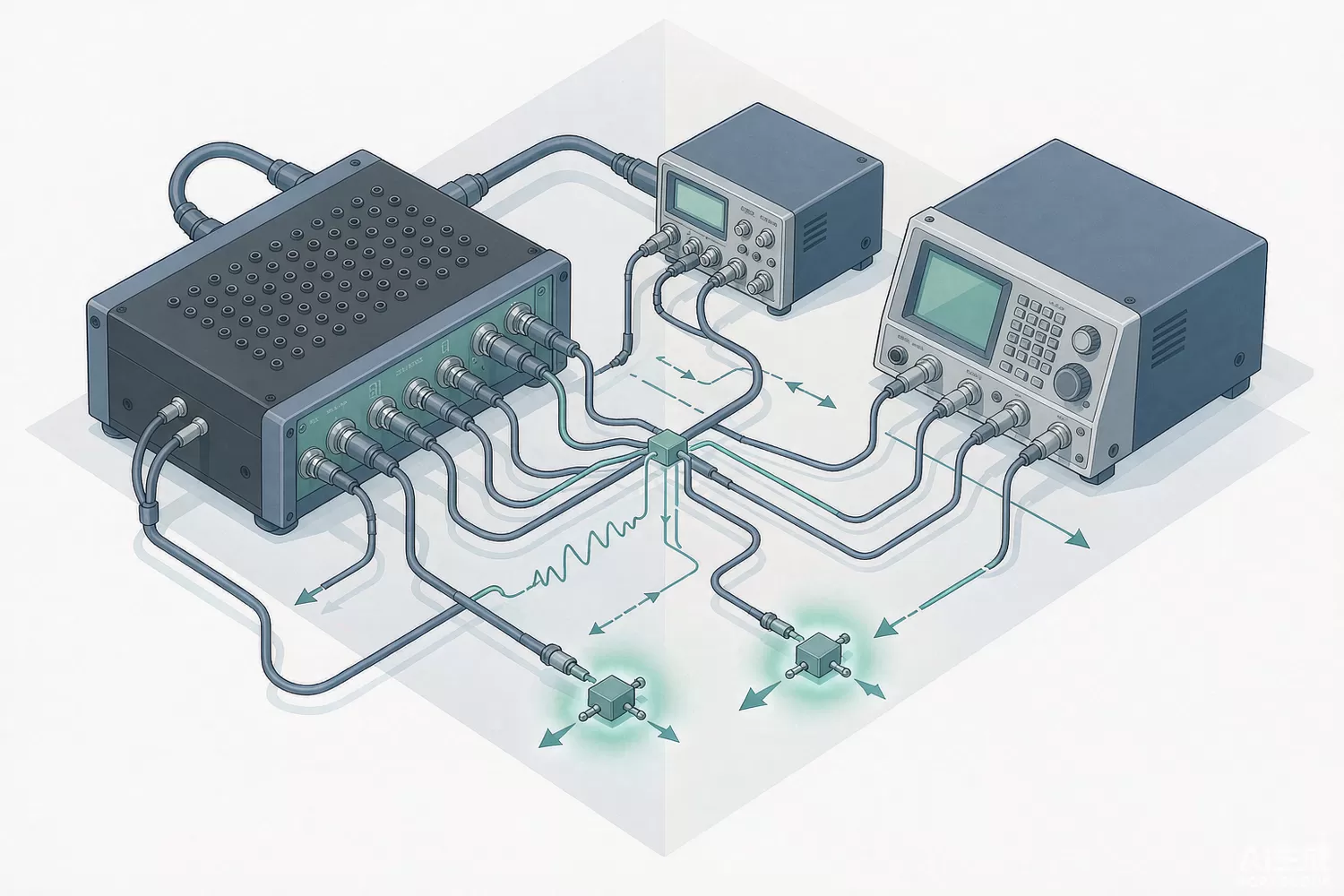
The cheapest component that fixes the most RF problems is a 50-ohm termination. An unterminated port reflects the entire incident wave back into the circuit, converting a well-behaved switch, coupler or mixer into an unpredictable one. Terminations — from 0603 chip loads to 100 W coaxial loads — are the hygiene layer of every RF system. This article covers where they matter, how to specify them, and the domestic sourcing picture.

Application logic: the four places a load must be
- Unused switch positions: an RF relay or switch matrix port left open reflects energy into the common port and wrecks the isolation you paid for. Terminate every unused throw.
- Coupler isolated ports: a directional coupler's isolated port is only isolated if it sees 50 ohms; an open isolated port degrades directivity by 6 dB or more and corrupts every power measurement downstream.
- Mixer IF and unused LO ports: mixer conversion loss and port isolation are specified with proper terminations on all ports; floating ports generate spurious responses.
- Test-system inputs: a spectrum analyser input or power sensor waiting for its turn in a multiplexed fixture must look like 50 ohms while idle.
Board-level loads come in chip formats; the anchors in our stock are EMC Technology SMT terminations: the SMT2010TALNF, SMT2010F and SMT2010ALNF 2 W-class loads in 2010-format packages, and the higher-power TS0310W3F 3 W part. The same vendor families extend upward through coaxial loads to kilowatt dry loads — the chip parts are where sourcing decisions concentrate.
Specifying a chip termination that does not surprise you
- Power with derating: a 2 W rating at 25 C case temperature may be 0.5 W inside a sealed enclosure; derate by enclosure ambient, not by datasheet notes.
- Frequency band: chip terminations are flat to several GHz with a defined VSWR limit beyond; check the curve, not the marketing line.
- VSWR over temperature: resistive films drift slightly; good parts hold 1.15:1-class VSWR from -55 to +125 C.
- Substrate and attachment: alumina-chip parts with gold metallisation suit wire-bond hybrid assembly; organic-terminated parts suit reflow. Mixing the two attachment styles is a common field failure.
- DC blocking: some loads are DC-shorted, some are DC-open; verify which one your bias scheme expects.
New technology: high-power-density chip loads
The current generation pushes power density upward on smaller footprints: thick-film and thin-film resistive elements on beryllium-oxide or aluminium-nitride substrates now deliver 2–5 W from packages that once handled 0.5 W, which matters because board area in multi-channel switch matrices is scarcer than budget. Laser-trimmed film also tightens the resistance tolerance, holding input match closer to ideal 50 ohms across the lot. At system level, instrument makers increasingly integrate switch-and-terminate front ends so that every internal port is automatically loaded — a design pattern worth copying in custom test fixtures.
Domestic alternatives: families and indicative cost
Domestic capability here is well established and documented at product-family level. Shenzhen Yantel publishes fixed chip attenuators and high-power load families (ceramic-chip formats, DC to 26.5 GHz class, multiple power grades) with laser-trimmed tolerance; Fujian Millimeter Electronics manufactures microwave resistive components including loads with military reliability grading; and Chengdu Hongke Electronics offers comparable passive families. For test-house procurement, domestic chip loads are the first place to look for cost reduction without re-qualification risk, provided VSWR and derating are verified on your board.
Price figures below are indicative public-market reference ranges for moderate volumes, compiled from publicly observable listings. They fluctuate with the spot market, package option, grade (industrial, automotive, screened) and order quantity, and must not be read as a quotation. Ask us for a firm price on your exact part numbers and quantities.
| Function (imported anchor) | Example import part | Indicative import price (USD) | Domestic candidate | Indicative domestic price (USD) |
|---|---|---|---|---|
| 2 W-class chip termination, 2010 format | SMT2010TALNF (EMC Technology) | 0.60 – 1.80 | Yantel / Chengdu Hongke chip loads | 0.25 – 0.90 |
| 2 W-class chip termination, alternate termination finish | SMT2010F / SMT2010ALNF (EMC Technology) | 0.60 – 1.80 | Yantel chip-load family | 0.25 – 0.90 |
| 3 W power chip termination | TS0310W3F (EMC Technology) | 0.80 – 2.20 | Yantel / Fujian Millimeter power chips | 0.35 – 1.20 |
| Companion thermopad (drift compensation) | TVA0500N03W3 (EMC Technology) | 2.50 – 7.00 | Yantel TC-attenuator family | 0.80 – 2.50 |
Chip terminations are the closest thing RF sourcing has to a commodity: the domestic price advantage is large, qualification is a single afternoon of VSWR sweeps, and the failure modes (cracked terminations from thermal cycling) are visible under X-ray. There is little reason to pay import prices for test-fixture loads.
Qualification checklist
Sweep VSWR across your band on the real PCB; run a thermal-cycling soak with power applied at 50% of the derated rating; verify DC-isolation behaviour matches the bias plan; and photograph the termination under X-ray after the soak — substrate microcracks show up before the VSWR does. For the temperature-compensating cousin of this component family, see our RF attenuators and front-end protection guide.
Frequently asked questions
Do I really need a termination on a port that is switched off?
Yes. Switched-off is not isolated: the open port reflects energy and degrades the isolation of the switch, and in duplexers it can pull the transmit band's load impedance out of spec.
Chip termination versus connectorised load?
Chip loads win on cost and board area up to a few watts; connectorised coaxial loads win on power handling, measurement confidence and reusability across fixtures. Use chips in the product, connectors in the lab.
What kills chip terminations in the field?
Thermal cycling cracks the substrate-to-solder interface, and over-power events film-burn the resistive element. Both are visible in X-ray screening, which we offer before volume shipment.
Are domestic chip loads equivalent for test fixtures?
For fixture use, yes, after a VSWR and power-derating check on your board; vendors such as Yantel document comparable bands and power grades at a substantially lower price.
About us & trademarks: JTDZ Tech (Shenzhen Jingteng Electronics Technology Co., Ltd.) is an independent distributor of electronic components. We are not an authorised distributor or representative of the imported manufacturers named in this article. Manufacturer, brand and part names are used for identification purposes only; all trademarks remain the property of their respective owners. Cross-reference information in this article is based on publicly available sources, is subject to change, and is not a substitute for your own engineering validation. Always verify specifications against the manufacturer's datasheet before design-in or purchase.
