
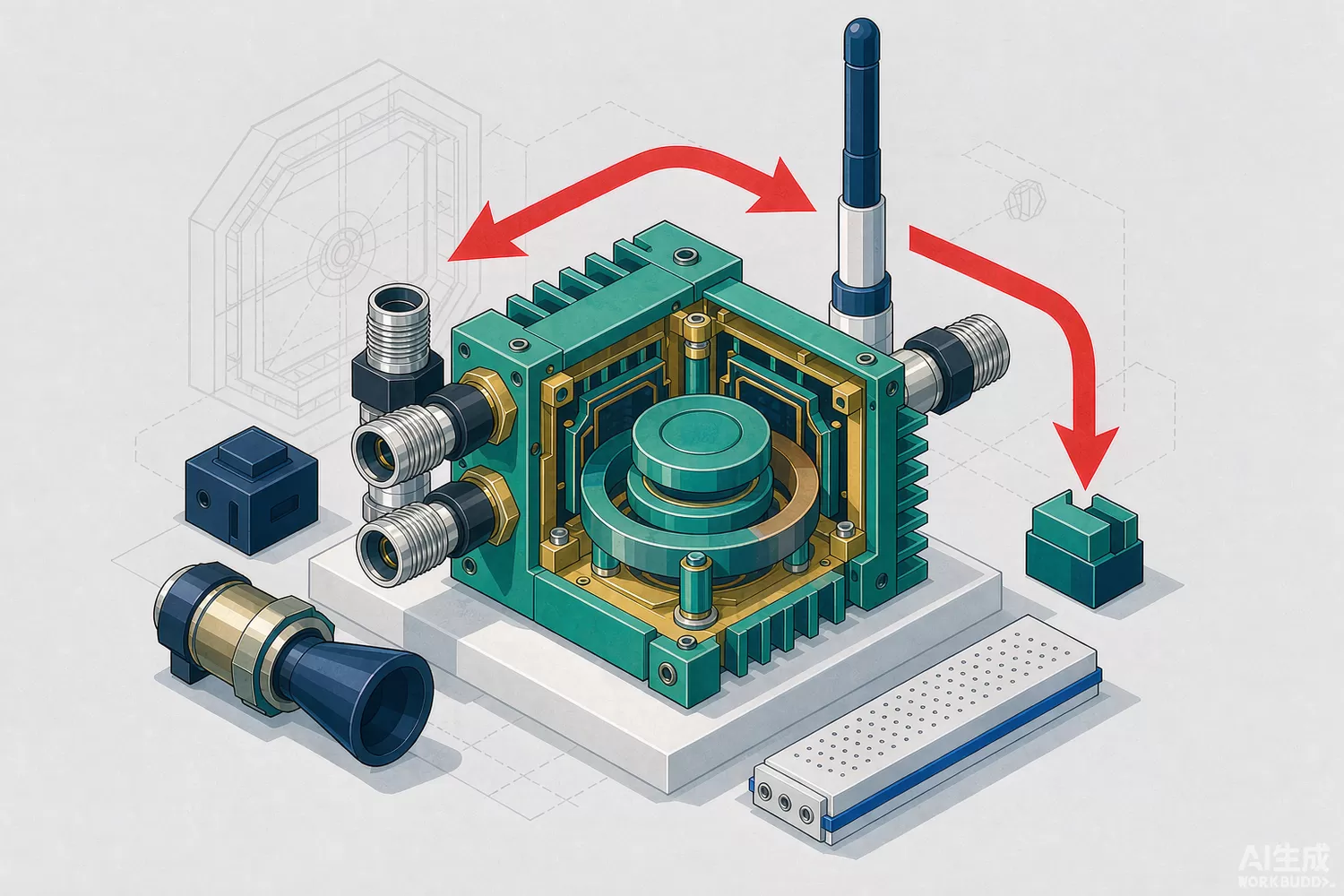
Ferrite circulators are the only common three-port components that genuinely break reciprocity: energy entering port 1 exits port 2, port 2 exits port 3, and almost nothing propagates backwards. Terminate the third port and the two-port becomes an isolator — a one-way valve for RF. Every serious transmitter relies on one: the power amplifier's output sees a clean 50-ohm load even when the antenna is mismatched, and reflected power is absorbed in a termination instead of cooking the transistor. This article covers the application logic, packaging trends, and the unusually strong domestic supply picture.

Application logic: where circulators earn their place
The classic placement is directly after a power amplifier, before the antenna switch or duplexer: the isolator absorbs antenna reflection so the PA never sees a swinging load, which protects both the die and the linearity budget. On receive, an isolator ahead of a mixer or LNA improves isolation and directivity where switch isolation is insufficient. In radar T/R front ends the circulator is the duplexer itself for monostatic operation. In instrumentation, isolators on sources and on DUT interfaces stop reflections from pulling oscillator frequency. Pair this article with our coverage of the watt-class driver amplifiers and the gain-drift thermopads those transmitters also use.
Specifying the junction: the numbers to agree on
Specification is straightforward once you accept the physics: insertion loss (typically 0.2–0.5 dB), isolation (18–25 dB per junction), bandwidth (usually 5–15% fractional per junction), power handling for forward and reflected paths, and the temperature coefficient of the magnet bias. High-power designs derate for heat because the absorbed load dissipates the reflected wattage.
New technology in ferrite devices
- Solder-in and SMT packaging: sizes have shrunk toward 6–12 mm footprints with stripline construction, letting high-volume radios replace coaxial units with reflow-mountable parts.
- Higher-power density through better ferrite materials and thermal design — commercial parts now absorb hundreds of watts, and VHF designs reach the kilowatt class.
- Temperature-stabilised bias structures keep isolation flat across −40 to +85 °C, important for outdoor units.
- Multi-junction and dual-band assemblies cover wide bands in one part for multiband transmitters.
Domestic alternatives: families and indicative cost
Domestic supply here is exceptionally mature — Sichuan has hosted ferrite-device industry for decades. Tianyatong Technology (TianYaTong, brand RFTYT) in Mianyang publishes coaxial circulators and isolators from 10 MHz to 26.5 GHz with power ratings up to 2000 W: its TH2025BS-1 covers 2.4–2.5 GHz with 0.25 dB insertion loss and 25 dB isolation in an SMA package rated −40 to +85 °C, and the TG-series coaxial isolators list per-band forward and reflected power ratings. Uiy (UIY, uiy.com.cn), also in Mianyang, publishes the UIYCC coaxial circulator family — for example a 2300–2500 MHz unit with 0.3 dB loss, 23 dB isolation and 100 W handling — plus an 800 W VHF-class 175–210 MHz circulator and stripline (solder-in) styles. Imported equivalents (US ferrite vendors serving radar and test markets) remain relevant where screened space-grade units are specified.
Price figures below are indicative public-market reference ranges for moderate volumes, compiled from publicly observable listings. They fluctuate with the spot market, package option, grade (industrial, automotive, screened) and order quantity, and must not be read as a quotation. Ask us for a firm price on your exact part numbers and quantities.
| Function (imported anchor) | Example import class | Indicative import price (USD) | Domestic candidate | Indicative domestic price (USD) |
|---|---|---|---|---|
| 2.3–2.5 GHz coaxial circulator, 100 W | US coaxial circulator families | 40.00 – 120.00 | RFTYT TH2025BS-1; UIY UIYCC2528A-class | 8.00 – 25.00 |
| Sub-6 GHz coaxial isolator | Import coaxial isolator families | 30.00 – 90.00 | RFTYT / UIY coaxial isolators, same band | 6.00 – 20.00 |
| VHF/UHF high-power isolator | Import high-power units | 150.00 – 500.00 | UIY 800 W-class VHF circulator; TianYaTong TG-series to 2 kW | 30.00 – 120.00 |
| Solder-in stripline circulator for modules | Import solder-in families | 15.00 – 40.00 | UIY / RFTYT stripline (solder-in) series | 4.00 – 15.00 |
| PA protected by the isolator | RFPA3800TR13, QPQ1297TR7 (Qorvo PA) | 8.00 – 20.00 | SZM-3166Z / QPQ1285TR7 PA line | 5.00 – 15.00 |
Domestic ferrite parts typically price at a third to half of import equivalents with genuinely competitive specifications — this is one of the most favourable substitution categories in the whole RF passive shelf. Verify band edges, power derating curves and magnet stability under vibration before volume adoption.
Validation flow
Measure insertion loss, isolation and return loss across your full band at temperature extremes; run the reflected-power soak at your worst antenna VSWR to confirm the load temperature stabilises; and vibrate-test magnetically sensitive units for outdoor use. Then compare directly against the import part on the same fixture — ferrite vendors differ more in screening discipline than in basic physics.
Frequently asked questions
What happens if I omit the isolator after a PA?
The PA output sees an antenna-dependent load. Mismatch reflects power back into the die, stresses it thermally, and detunes output matching — efficiency, linearity and lifetime all degrade. Most PA field failures trace to unprotected load swings.
How much isolation do I need?
Enough to keep reflected power within the PA's safe-operating area at your worst antenna VSWR. 20 dB of isolation turns a 3:1 VSWR reflection into a mild ripple at the amplifier; 25 dB is common for high-power designs.
Can one circulator cover a very wide band?
Only with multiple junctions. A single ferrite junction is inherently a fractional-bandwidth device; cascaded or dual-junction assemblies cover wider ranges at higher loss and cost.
Do domestic circulators handle defence-grade environments?
Vendors such as TianYaTong and UIY advertise military-standard-aligned production (for example GJB quality systems) and custom band and power builds. Request the power derating and vibration test data for your band before volume commits.
About us & trademarks: JTDZ Tech (Shenzhen Jingteng Electronics Technology Co., Ltd.) is an independent distributor of electronic components. We are not an authorised distributor or representative of the imported manufacturers named in this article. Manufacturer, brand and part names are used for identification purposes only; all trademarks remain the property of their respective owners. Cross-reference information in this article is based on publicly available sources, is subject to change, and is not a substitute for your own engineering validation. Always verify specifications against the manufacturer's datasheet before design-in or purchase.
