
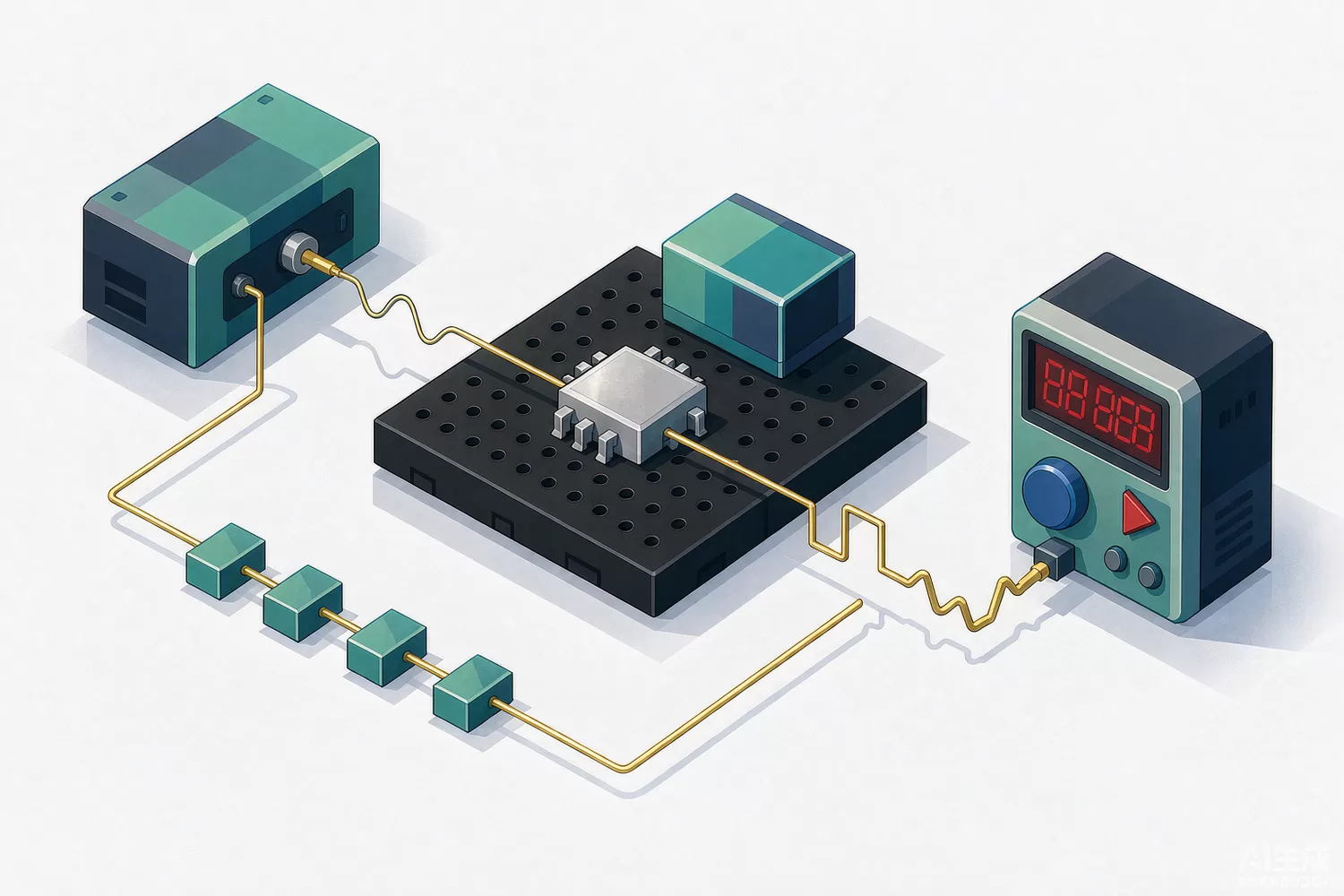
A prescaler is a small, often forgotten block that divides a very fast periodic signal by a fixed ratio so that slower, cheaper and quieter circuits can handle it. It sits between a microwave VCO and the phase-frequency detector of a PLL, between a 10 GHz oscillator and a frequency counter, and between a clock tree and its monitoring logic. Because it processes the full-speed signal, its input sensitivity, additive noise and divide accuracy set real system limits. This article covers selection logic, technology directions and the domestic supply picture.

Application logic: why divide at all
Three jobs dominate. First, PLL feedback division: a 10 GHz VCO cannot feed a PFD directly; a fixed or dual-modulus prescaler (divide by 4, 8, 16, or dual 128/129) brings it into the few-hundred-megahertz range where CMOS synthesisers operate — the trade is that prescaler division multiplies any divider error by the ratio, and its additive noise adds to loop phase noise. Second, measurement: counters top out at a few gigahertz; a prescaler front end extends them to Ka-band. Third, clock monitoring and distribution: dividing a fast clock lets an MCU or a supervisor watch a microwave source with a slow, reliable input. For the source side of this chain see our PLL synthesizer article.
Datasheet parameters that matter
- Input frequency range at your drive level — ECL and SiGe parts specify sensitivity in dBm versus frequency, and a weak VCO output near band edge is the classic failure.
- Divide ratio and modulus (fixed, dual-modulus, programmable) versus your synthesizer architecture.
- Additive SSB phase noise floor, quoted at an offset such as 100 kHz — this adds directly to your loop's noise.
- Output swing and compatibility (ECL/PECL, CMOS) with what follows.
- Supply current, since high-speed divider blocks can draw tens of milliamps at 3–5 V.
New technology
SiGe and CMOS process scaling keep pushing prescaler inputs upward: modern parts divide 20 GHz-class inputs in standard packages, and synthesisers increasingly integrate the prescaler on-chip, leaving discrete dividers for standalone measurement fronts, low-noise fixed-ratio division and high-voltage or wide-temperature niches. Regenerative (Miller) divider circuits remain attractive for very high frequencies at low divide ratios because their additive noise is lower than static flip-flop chains, and domestic standards work now covers the class formally: national standard GB/T 20870.2-2023, drafted under China Electronics Technology Group Corporation leadership, defines test methods for microwave integrated-circuit prescalers — a sign the domestic supply chain is consolidating around testable, specified parts.
Domestic alternatives: families and indicative cost
Domestic capability is anchored by the CETC ecosystem. Hebei Xinhua North Integrated Circuit (Hebei Xinhua North, the industrial arm of CETC-13) is a leading drafter of the prescaler standard and mass-produces microwave RFIC families including limiters, low-noise amplifiers, mixers and switches. CETC's listed chip platform (600877) has publicly announced series-production 30 GHz frequency-synthesizer and divider circuits alongside 20 GHz integrated-VCO synthesis families. Nanjing Meichen Microelectronics (Nanjing Meichen, under the CETC Guorui group) supplies high-end RF analogue ICs for radar and instrumentation. Import anchors include the Onsemi MC12080-class fixed dividers (around 1 GHz input in ECL) and Analog Devices' ADF500x family that extends division into the 18 GHz region for PLL loops.
Price figures below are indicative public-market reference ranges for moderate volumes, compiled from publicly observable listings. They fluctuate with the spot market, package option, grade (industrial, automotive, screened) and order quantity, and must not be read as a quotation. Ask us for a firm price on your exact part numbers and quantities.
| Function (imported anchor) | Example import part | Indicative import price (USD) | Domestic candidate (family level) | Indicative domestic price (USD) |
|---|---|---|---|---|
| Fixed divide-by-2/4 prescaler to ~1 GHz | MC12080-class (Onsemi) | 1.50 – 4.00 | CETC-13 / Hebei Xinhua North divider families | 0.80 – 2.50 |
| High-frequency PLL prescaler to 18 GHz | ADF5007-class (Analog Devices) | 6.00 – 15.00 | CETC 600877 divider / synthesizer series (family level) | 3.00 – 10.00 |
| Counter front-end division for instruments | GHz-class ECL divider blocks | 3.00 – 10.00 | Nanjing Meichen RF IC families (family level) | 2.00 – 6.00 |
| Reference and monitor side of the divider chain | SI5351A-B-GMR (Skyworks clock) | 0.60 – 1.20 | GD32F303CBT6 MCU counter + COS3201 comparator | 0.30 – 0.90 |
| Quiet rail for divider and PFD circuits | TPS73601DBVR (TI) | 0.60 – 1.20 | HX2001 LDO (Hexin) | 0.20 – 0.50 |
Because prescalers are specified through standards now, the cleanest domestic evaluation is to request GB/T 20870.2-2023-style test data (sensitivity curves, additive phase noise) rather than relying on marketing comparisons.
Validation flow
Drive the candidate with a synthesiser set to your worst-case VCO power at band edges and confirm division holds across temperature; measure residual phase noise by comparing two identical divider chains driven coherently; and verify output compatibility with your PFD or counter at temperature extremes. Keep the input matched and the supply decoupled — divider circuits misbehaving from a marginal input look exactly like PLL unlock errors.
Frequently asked questions
Why does my PLL occasionally unlock only at high temperature?
Frequently the prescaler input loses sensitivity margin at band edge as transistor gain falls with temperature. Re-measure divider input sensitivity at temperature extremes before blaming the phase detector.
Does the prescaler affect phase noise?
Yes — its additive noise floor appears inside the loop bandwidth. Regenerative dividers and high-speed SiGe parts add less noise than slow static divider chains.
What is dual-modulus division for?
It lets a synthesizer synthesise arbitrary channel steps: the dual-modulus block divides by A or A+1 while low-speed counters swallow pulses, giving fractional-like step control without a fully fractional-N architecture.
Are domestic prescalers comparable to import parts?
At family level, CETC-linked vendors publish serious microwave divider capability backed by a national test standard. Request sensitivity and residual-noise test data at your frequency and compare on your loop.
About us & trademarks: JTDZ Tech (Shenzhen Jingteng Electronics Technology Co., Ltd.) is an independent distributor of electronic components. We are not an authorised distributor or representative of the imported manufacturers named in this article. Manufacturer, brand and part names are used for identification purposes only; all trademarks remain the property of their respective owners. Cross-reference information in this article is based on publicly available sources, is subject to change, and is not a substitute for your own engineering validation. Always verify specifications against the manufacturer's datasheet before design-in or purchase.
