
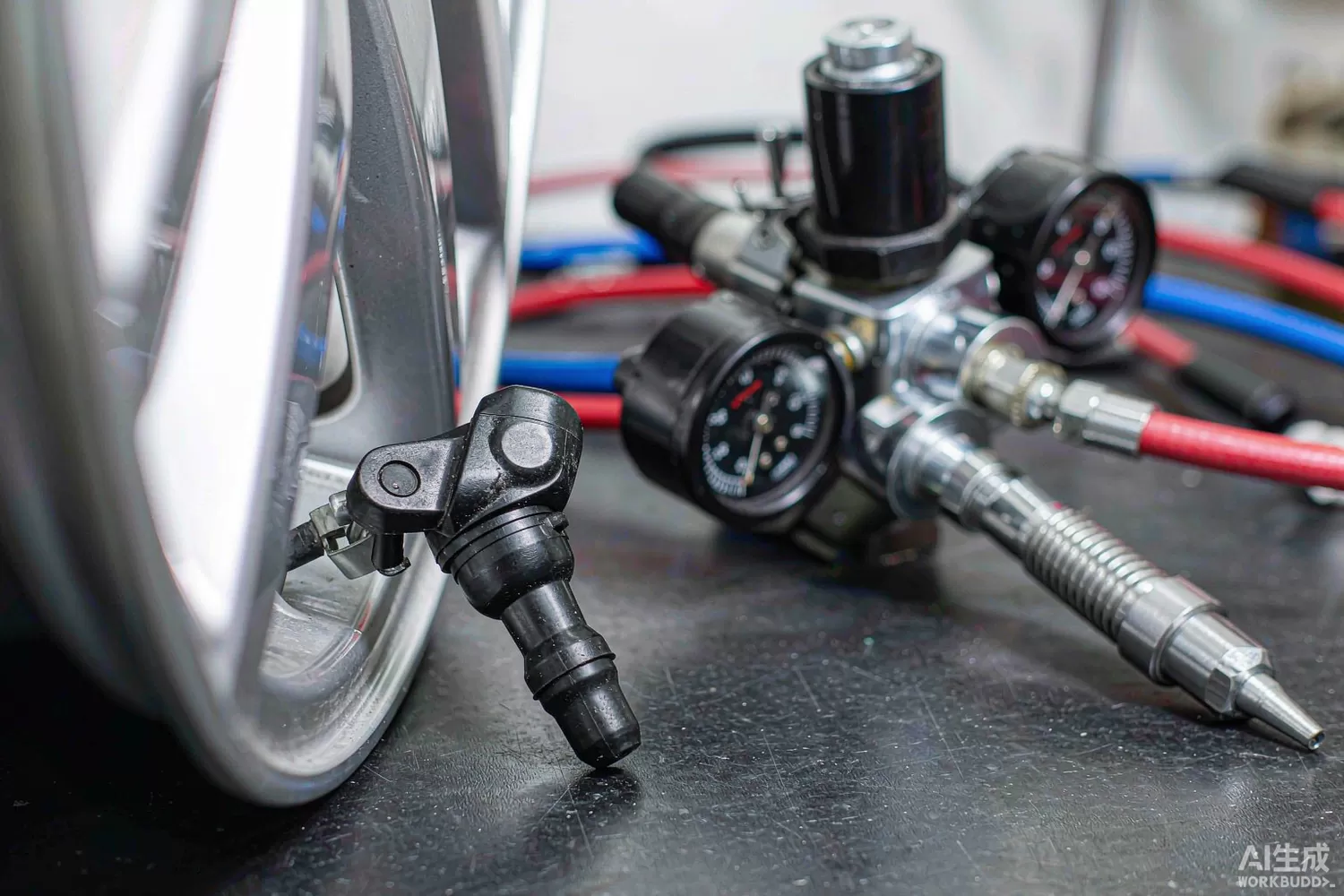
The tire-pressure monitoring sensor (TPMS) is one of the harshest chip environments in a passenger car: mounted on the wheel rim, it experiences 0–125 °C swings, hundreds of g of centripetal acceleration, pressure pulses from every tire revolution, and must do all of its work for a decade on a lithium coin cell nobody services. The TPMS SoC — pressure and temperature sensing, a small MCU, a low-frequency wake receiver and a 315/433 MHz transmitter on one die or in one package — is therefore engineered less like a radio product and more like a power-budget problem wearing a radio. This article explains the application logic, the parameters that separate a reliable design from a warranty problem, the technology shifts now in production, and domestic candidates with public part numbers. For the underlying radio link, see our RKE chip article.

Application logic: measure, decide, transmit — rarely
A TPMS wheel unit wakes once or twice per minute, measures, decides whether anything is worth saying, and transmits only then. The discipline follows from the battery arithmetic:
- Wake by wheel motion, not by clock — an accelerometer inside the SoC detects the centripetal signature of the wheel starting to spin; above roughly 20–40 km/h the unit enters periodic mode, below it sleeps at a few hundred nanoamperes. A clock-driven design would drain the battery during weeks of parking.
- Pressure, temperature and voltage every cycle — pressure is corrected against temperature (a tire heats up tens of degrees at speed and its pressure follows), and the battery voltage is reported so the receiver can warn before the cell dies rather than after.
- Transmit on change or on schedule — a fast-leak alarm triggers immediate high-rate transmission; slow state changes are broadcast every 30–120 seconds. The fastest leaks transmit most, which is exactly when the remaining battery matters least.
- Learn-me protocols — after rotation or replacement, the receiver must map each wheel unit to a corner: by transmission order during an auto-learn sequence, by LF trigger from a tool held at each wheel, or by explicit ID programming.
- LF wake for workshop functions — a 125 kHz field wakes and reconfigures a specific wheel unit at centimetre range: force a transmission, change the address, enter shipping mode. The LF receiver is the service interface.
- Alarm thresholds by regulation — a 25 % pressure loss must alarm within minutes (US FMVSS 138 and analogous regimes); the decision logic and its latency live in firmware the supplier certifies.
Parameters that decide warranty survival
- Sleep and average current — sub-300 nA sleep plus duty-cycled measurement must average below roughly 2–4 µA to reach ten years from a 200–550 mAh cell with margin; this single number eliminates most candidates.
- Pressure accuracy after temperature compensation — ±7–10 kPa over the full temperature range, because a 25 % alarm threshold is useless if the zero point drifts by more than the alarm margin.
- Accelerometer threshold behaviour — the motion-wake must discriminate wheel rotation from road shock, curbs and tire-slap; false wakes at parking speed quietly murder the battery budget.
- RF output and antenna detuning — 5–10 dBm into a wheel-rim antenna whose impedance shifts with tire, brake dust and water; the transmit chain needs margin, not a datasheet maximum.
- Reliability screening — AEC-Q100 grade, 100 % burn-in in many production flows, and demonstrated field-failure rates, because a wheel unit replacement costs far more than the chip.
- Package and valve integration — the SoC ships in a sensor module bonded to the valve stem; mechanical qualification (vibration, salt fog, overpressure) is inseparable from the electrical datasheet.
- Receivers in the car — four wheel units share one or two body-mounted receivers; dense-transmission behaviour and protocol discipline matter as much as any single link.
What is changing in TPMS technology
Three shifts define the current generation. First, the BLE upgrade path: newer wheel units broadcast over Bluetooth Low Energy in addition to or instead of the legacy 315/433 MHz frame, letting the driver's phone or an aftermarket app read pressures directly — and letting the same chip serve the replacement market without vehicle-side receivers. Second, higher integration and lower sleep current: each SoC generation folds the accelerometer, LF receiver, pressure die and transmitter closer together, pushing sleep below a quarter of a microampere and adding self-diagnostics (plugged valve, sensor fault) that the receiver can display. Third, regulatory spread: TPMS mandates have propagated from the US and EU through China, Korea and increasingly into commercial-vehicle and two-wheel segments, multiplying addressable volume and pulling the price floor down — which is exactly the environment where domestic suppliers built their share. China's market also pushes direct-replacement aftermarket modules for vehicles that shipped with indirect systems, a segment with its own cost logic. For battery-management context across a vehicle, see our battery-management front-end article.
Domestic alternatives: suppliers and indicative cost
Domestic supply here has crossed from emerging to established. SENASIC (Jingjie Electronics, Nanjing) shipped China's first production TPMS SoC (the SNP70X series) in 2017–2018 and has since become a volume incumbent: the SNP739D integrates pressure, radial acceleration, temperature and voltage sensing with an 8-bit MCU, 315/433 MHz transmitter and LF receiver, carries AEC-Q100 qualification, sleeps at about 0.25 µA and is publicly benchmarked by the vendor against the Infineon SP40 with front-installation across multiple Tier-1 platforms; the SNP746 adds single-chip BLE TPMS. Additional domestic sensor-SoC vendors serve the aftermarket segment at family level. Imported anchors — Infineon's SP40 platform and NXP's FXTH87-class integrated wheel modules — remain the qualification baselines in export programmes. Where only family-level information is public, the table says so; verify the exact part against your valve module and protocol.
A validation bench is quick to assemble from catalogue stock: a pressure-calibration rig controlled by an Artery AT32F403ACGT7, a Cosine COS128U instrumentation amplifier reading a reference bridge, a Cosine COS2991S LDO emulating end-of-life battery voltage, a Titan Micro TS2502PN on the test-fixture ports, and a MACOM SW-456TR-3000 switching four wheel-position antennas into one receiver.
Price figures below are indicative public-market reference ranges for moderate volumes, compiled from publicly observable listings. They fluctuate with the spot market, package option, grade (industrial, automotive, screened) and order quantity, and must not be read as a quotation. Ask us for a firm price on your exact part numbers and quantities.
| Function (imported anchor) | Example import part / class | Indicative import price (USD) | Domestic candidate | Indicative domestic price (USD) |
|---|---|---|---|---|
| Integrated TPMS SoC | Infineon SP40 platform | 2.5 – 5.0 | SENASIC SNP739D (AEC-Q100, vendor-benchmarked against SP40) | 1.2 – 3.0 |
| First-generation wheel SoC | Legacy discrete sensor + MCU + TX stacks | 3.0 – 6.0 | SENASIC SNP70X series | 1.0 – 2.5 |
| BLE TPMS wheel SoC | Emerging import BLE wheel classes | 3.0 – 6.0 | SENASIC SNP746 (single-chip BLE TPMS, family level) | 1.5 – 3.5 |
| Aftermarket cap/strap sensor | Import aftermarket module brands | 4.0 – 10.0 | Domestic aftermarket module families (family level) | 2.0 – 5.0 |
| LF wake/service tool coil driver | Specialist LF tool ICs | 1.0 – 2.5 | Generic MCU + H-bridge implementation | 0.3 – 0.8 |
| Body receiver module | Vehicle RKE receiver classes | 1.5 – 4.0 | HOPERF CMT receiver family + SAW | 0.5 – 1.5 |
| Reference instrumentation for the rig | INA128/AD620-class in-amps | 2.0 – 5.0 | COS128U (Cosine) | 0.5 – 1.5 |
Read the table as a screening tool, not a quotation. The structural point: TPMS is one of the few automotive chip categories where a domestic supplier already holds roughly a quarter of the Chinese wireless-SoC market by revenue, with cumulative shipments measured in hundreds of millions of units — so the domestic candidates here are not opportunistic cross-references but production incumbents, and the price advantage narrows to the honest range shown rather than the factor-of-ten gaps of earlier decades. Differentiation has moved to the mechanical module, the firmware certification trail and OEM platform approvals.
Validation flow before you commit
Qualify a wheel unit as a system, not a chip. Run pressure accuracy across the full temperature sweep on a calibrated rig, then repeat after thermal cycling with the sensor bonded exactly as production will bond it. Characterise motion-wake on a spinning-wheel rig at the boundary speeds where false wakes and missed wakes live, and log average current over a simulated month of urban driving. Radiated-validate the transmission through a mounted wheel — the rim is the antenna — across tire brands, water spray and brake-dust contamination. Exercise every learn-me path a technician will ever use, including LF reconfiguration at maximum tool distance. Finally, demand the supplier's field-return statistics and burn-in flow: in this category, shipped history is the specification that matters most.
Frequently asked questions
Why do TPMS sensors need an accelerometer at all?
Because a clock-driven measurement schedule would drain the battery during weeks of parking. The centripetal signature of wheel rotation is a free wake-up signal that correlates perfectly with when measurements are actually meaningful.
Direct or indirect TPMS - why does the chip market care?
Indirect systems infer pressure from wheel speed and need no wheel chips; direct systems broadcast real measurements. Regulation increasingly mandates direct-style accuracy, which is what created the volume market these SoCs serve.
Can domestic TPMS SoCs replace imported parts in a running design?
At the chip level the flagship domestic part is AEC-Q100 qualified and vendor-benchmarked against the leading imported platform, but a wheel-module redesign must requalify the mechanical assembly, firmware protocol and learn-me procedures regardless of chip origin.
What actually kills TPMS sensors in the field?
Battery exhaustion accelerated by false wake-ups, corrosion of the valve assembly, and mechanical damage from mounting - in roughly that order. Firmware quality in the motion-wake logic is the biggest controllable factor.
About us & trademarks: JTDZ Tech (Shenzhen Jingteng Electronics Technology Co., Ltd.) is an independent distributor of electronic components. We are not an authorised distributor or representative of the imported manufacturers named in this article. Manufacturer, brand and part names are used for identification purposes only; all trademarks remain the property of their respective owners. Cross-reference information in this article is based on publicly available sources, is subject to change, and is not a substitute for your own engineering validation. Always verify specifications against the manufacturer's datasheet before design-in or purchase.
