
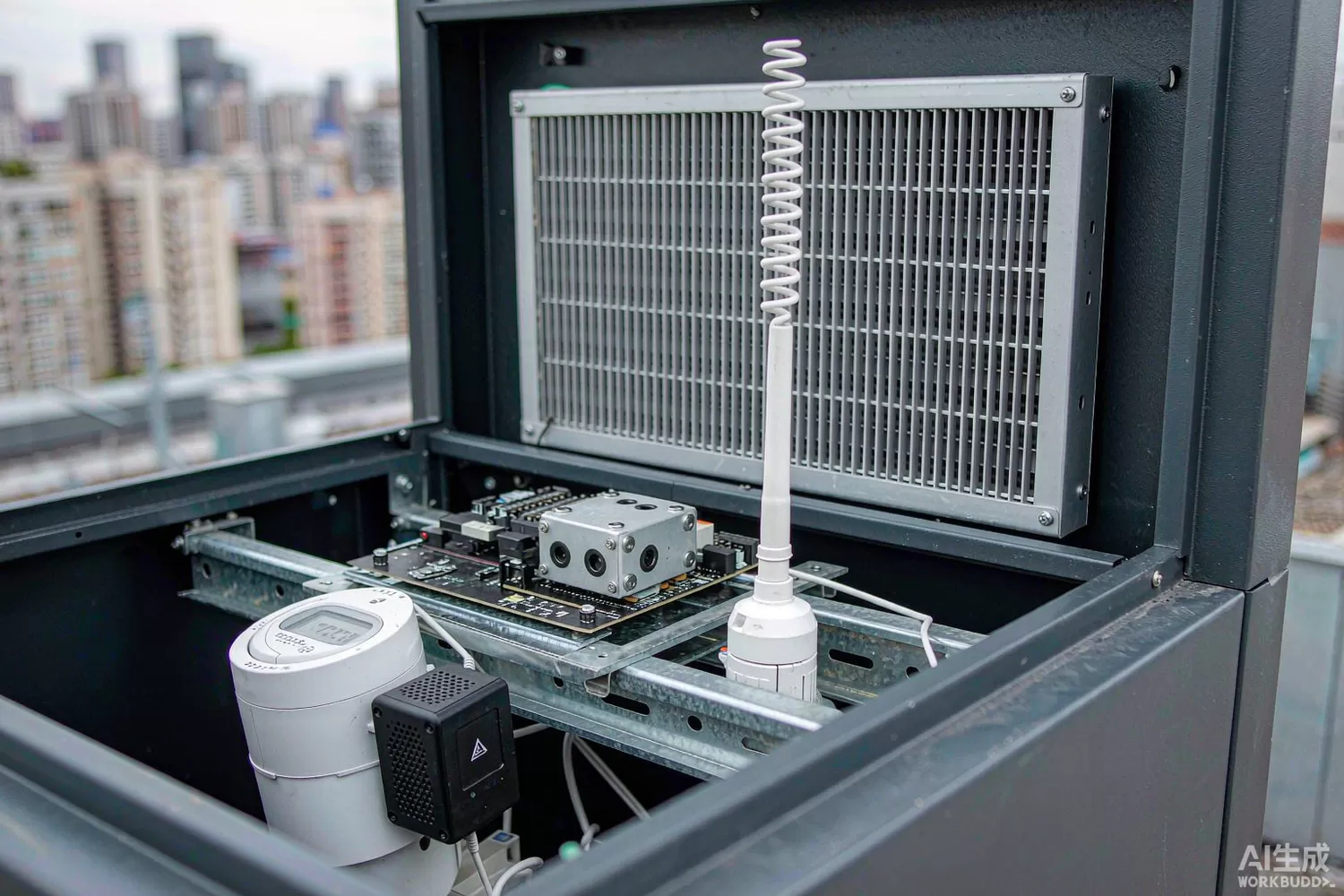
LoRa-class chirp spread-spectrum (CSS) radios redefined what a battery-powered device can reach: kilometres of range from tens of milliwatts, a decade of life from two AA cells, and a network architecture simple enough for a city metering programme to run without a telecom operator. The chip behind it is a Sub-GHz transceiver whose modulation — linear frequency chirps spanning the whole channel — trades data rate for processing gain in a way FSK never could. This article explains the application logic of CSS links, the parameters that decide whether a deployment meets its range promise, the technology shifts in the silicon, and the domestic supply picture with concrete part numbers. For the FSK/OOK counterpart in the same bands, see our Sub-1 GHz transceiver article.

Application logic: buying range with spreading factor
A CSS transmitter sweeps a chirp across the channel for every symbol; the receiver correlates against the same chirp and gains a processing advantage equal to the ratio of chirp bandwidth to symbol rate — the spreading factor, SF7 through SF12. Each step up doubles the symbol time, adds roughly 2.5 dB of link budget and halves the useful data rate. The whole design discipline follows from that trade:
- Adaptive data rate is a network discipline, not a datasheet — end devices walk their spreading factor up when links degrade and down when the gateway hears them loudly; getting ADR right decides both battery life and network capacity.
- Link budget in decibels, not kilometres — a typical CSS link carries 150–160 dB of path budget; whether that is 2 km or 15 km depends on terrain, antenna height and noise floor, so plan with measurements, not marketing maps.
- Duty-cycle and dwell-time regulation — sub-GHz bands restrict transmit time; spreading factor choice must respect airtime limits, which is why SF12 heartbeats and SF7 firmware updates obey different economics.
- Star-of-stars architecture — end devices talk only to gateways, gateways to a network server that deduplicates and schedules downlinks; no mesh routing means no mesh energy cost, and a multichannel concentrator serves thousands of nodes.
- Receiver-side discipline — downlink windows open only briefly after each uplink; a device that misses its RX window silently degrades to retransmission, so crystal tolerance and wake timing are protocol parameters, not implementation details.
- Coexistence with FSK neighbours — chirp correlation rejects narrowband interferers by its processing gain, but a crowd of SF12 devices on one channel still saturates a concentrator; capacity planning is part of RF planning.
Parameters that decide whether the link meets the promise
- Sensitivity at the spreading factor you will actually use — −137 to −148 dBm figures belong to specific SF/bandwidth pairs; a deployment dominated by SF9 on 250 kHz should be evaluated there, not at the headline SF12 number.
- Maximum output power and PA efficiency — +22 dBm parts reach farther, but the PA current during SF12 uplinks sets the peak battery load; efficiency at your duty cycle matters more than the maximum number.
- Sleep and duty-cycled receive current — class-A devices sleep at under a microampere and wake only for their windows; the wake-and-listen overhead decides real-world battery life more than transmit current does.
- Frequency error and AFC range — chirp correlation tolerates some crystal error, but cheap crystals at 470–510 MHz still cost decibels; parts with wider tracking forgive worse BOMs.
- Concentrator channel count and capacity — gateway silicon demodulates multiple simultaneous chirp streams on multiple channels; the number of simultaneous SF12 demodulations, not the channel count alone, sets dense-network behaviour.
- Integrated MCU and memory — SoCs that fold a Cortex-M0+-class core and flash onto the radio die remove a chip, a boot decision and a board layer; the LoRaWAN stack must fit with your application.
- Certification and regional band plans — EU868, US915, CN470 and AS923 differ in channel grids and dwell rules; a part certified for your target band with reference designs saves a compliance cycle.
What is changing in CSS LPWAN silicon
Three movements matter to buyers. First, single-chip SoC integration: the current generation embeds the MCU, flash and radio in one package — a SiP architecture that removes the external controller from the bill of materials and, more importantly, removes one firmware boundary; this is the same integration wave that swept the BLE category, now mature in LPWAN. Second, concentrators move down-market: multichannel gateway silicon that once lived only in $200 base stations is now affordable enough for building-level gateways, pushing CSS networks into buildings, campuses and factories where a single operator-owned tower never made sense. Third, adjacent-mode expansion: the same CSS PHY now carries long-range frequency-hopping variants and 2.4 GHz CSS for global shipping trackers, and LR-FHSS-style waveforms add interference resilience for uplink-dense networks. The consequence for sourcing is that the interesting competition has shifted from “does the PHY work” — it demonstrably does — to integration level, tooling and supply-chain terms, which is where domestic vendors compete hardest. For gateway-side receive-chain components, our LNA front-end article applies directly.
Domestic alternatives: suppliers and indicative cost
Domestic coverage is concrete and production-proven. ASR Micro (ASR, stock code 688388) licensed the CSS PHY and ships the ASR6501 — an SiP pairing an SX1262-class radio with a Cortex-M0+ core, covering 150–960 MHz with up to +22 dBm, −138 dBm sensitivity at SF12 and a footprint smaller than the discrete two-chip solution; the ASR6502 adds peripherals and the ASR6505 pairs the radio with an 8-bit core for cost-optimised transparent-transmission applications, and the newer ASR6601 continues the line. These parts have shipped in tens of millions through Chinese metering, agriculture and asset-tracking programmes, with module ecosystems built by numerous Shenzhen vendors. Imported anchors — Semtech's SX1262/SX1276 transceivers and SX1302-class concentrators — remain the PHY reference points and dominate the export gateway market. Where only family-level information is public, the table says so; verify the exact part against your band plan and stack version.
A link-budget bench is quick to assemble from catalogue stock: a Mini-Circuits PHA-13LN+ as the gateway reference LNA, a Mini-Circuits LFCG-2600+ cleaning the transmit spectrum, a Titan Micro TS2502PN guarding the antenna port, a Cosine COS2991S LDO for battery-representative supply rails, and an Artery AT32F403ACGT7 driving the test harness and ADR state machine.
Price figures below are indicative public-market reference ranges for moderate volumes, compiled from publicly observable listings. They fluctuate with the spot market, package option, grade (industrial, automotive, screened) and order quantity, and must not be read as a quotation. Ask us for a firm price on your exact part numbers and quantities.
| Function (imported anchor) | Example import part / class | Indicative import price (USD) | Domestic candidate | Indicative domestic price (USD) |
|---|---|---|---|---|
| CSS transceiver (discrete) | Semtech SX1262-class | 2.5 – 4.5 | ASR6505 (radio + 8-bit core SiP) | 1.0 – 2.0 |
| CSS SoC with MCU core | Semtech radio + external Cortex-M0+ | 3.5 – 6.5 | ASR6501 / ASR6601 (integrated M0+ SiP) | 1.2 – 2.2 |
| Gateway concentrator | Semtech SX1302-class multichannel | 15 – 28 | Domestic gateway families (family level) | 8 – 18 |
| Module with antenna | Import module brands | 4 – 9 | Shenzhen CSS module ecosystem (family level) | 1.8 – 4.0 |
| Gateway tip LNA | Mini-Circuits PHA-13LN+ class | 1.2 – 3.5 | Vanchip / Maxscend LNA families (family level) | 0.4 – 1.5 |
| 470 MHz band SAW filter | Murata / Taiyo Yuden SAW | 0.25 – 0.9 | Tai-Saw SAW (site stock: TA0224A, TB0614A) | 0.08 – 0.3 |
| Node MCU (where discrete) | STM32-class general purpose | 1.2 – 3.0 | AT32F403ACGT7 (Artery) | 0.4 – 0.9 |
Read the table as a screening tool, not a quotation. The practical reality: at the node tier the domestic SoCs undercut the imported discrete stack by roughly half while delivering the same PHY and a smaller board area, and the Chinese metering sector — the largest CSS deployment on earth — has already normalised them. The remaining import advantage concentrates in the concentrator tier and in the export-facing certification paperwork. One design caution: the CSS PHY in the domestic SiPs is licensed technology; stack versions and certification kits follow the licensor's release cadence, so pin your stack version before you commit a fleet.
Validation flow before you commit
Validate the network, not the node. Bench-characterise sensitivity at your exact spreading-factor and bandwidth combination, then run a live range campaign on your real deployment geometry — urban CSS behaviour is dominated by fading and noise rise, not by datasheet numbers. Exercise ADR across the full SF range and confirm the device converges without oscillation at cell edges. Measure battery-representative current through a complete wake-measure-transmit-sleep cycle with an averaging meter, including the downlink windows. Stress the concentrator with a fleet simulator at your target node density before committing a city-scale gateway plan. Finally, verify regional certification paths (CN470, EU868, US915) for the exact module revision — band-plan firmware differs between regional SKUs and is a common silent mismatch.
Frequently asked questions
What does the spreading factor actually cost me?
Each SF step up adds roughly 2.5 dB of link budget and doubles airtime, which halves effective capacity per channel and multiplies battery cost per byte. Use the lowest SF your link geometry allows and let ADR manage the rest.
Can domestic LoRa-class SoCs replace imported transceivers?
The licensed-PHY domestic SiPs match the imported PHY at roughly half the two-chip cost and have shipped in tens of millions. Pin the stack version and certification kit before committing; the imported concentrator still dominates export gateways.
Why do CSS links outperform FSK at the same power?
Chirp correlation gains processing advantage proportional to chirp bandwidth over symbol rate - up to about 20 dB at SF12 - which is link budget FSK cannot buy at the same current.
What fails first in CSS deployments?
Capacity at the gateway: dense SF12 fleets saturate concentrators, and devices at cell edges oscillate between spreading factors when ADR is mistuned. Plan channels and ADR margins before scaling.
About us & trademarks: JTDZ Tech (Shenzhen Jingteng Electronics Technology Co., Ltd.) is an independent distributor of electronic components. We are not an authorised distributor or representative of the imported manufacturers named in this article. Manufacturer, brand and part names are used for identification purposes only; all trademarks remain the property of their respective owners. Cross-reference information in this article is based on publicly available sources, is subject to change, and is not a substitute for your own engineering validation. Always verify specifications against the manufacturer's datasheet before design-in or purchase.
