
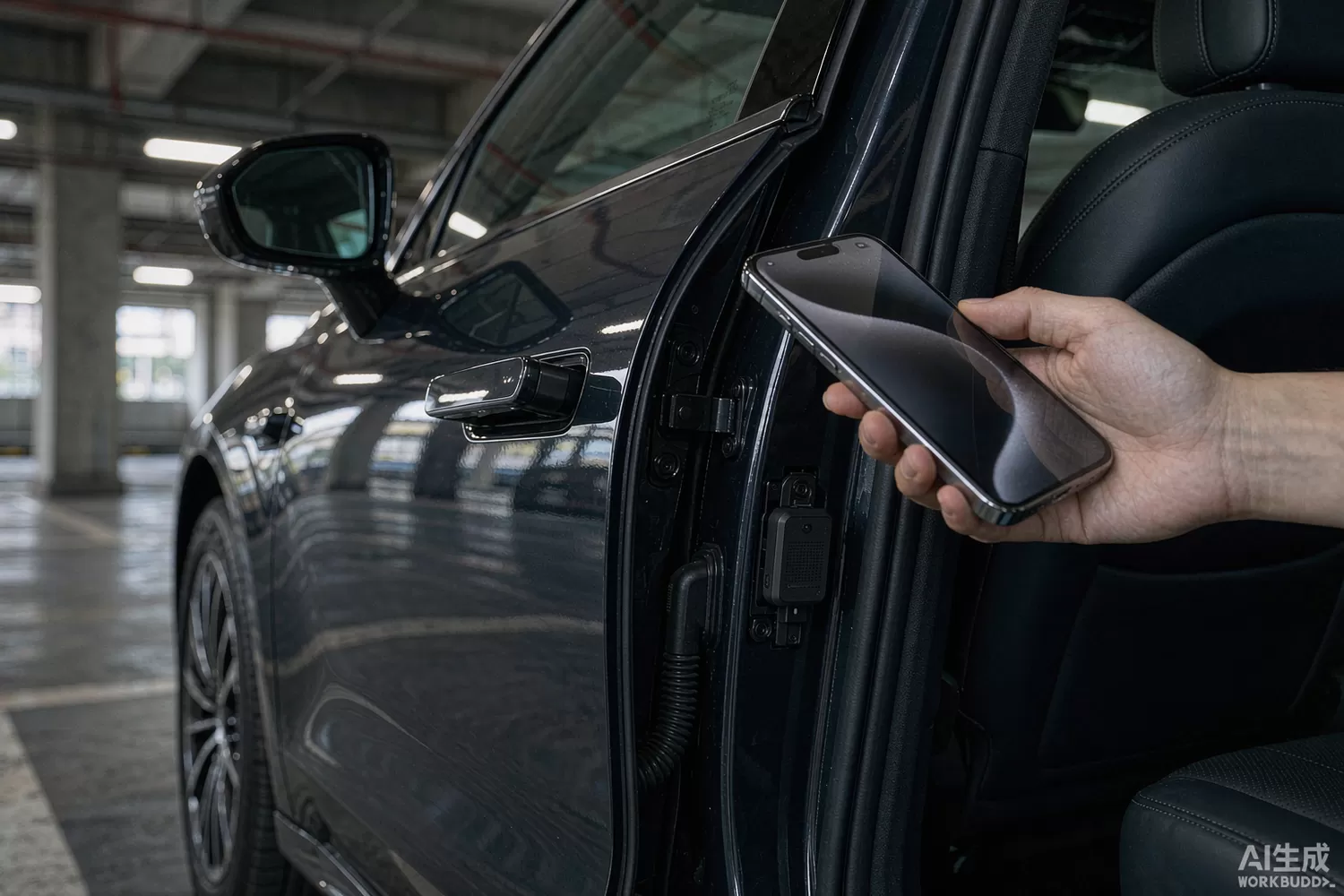
The key fob survived for decades because it was simple: a radio transmitter, a rolling code, a receiver in the door module. Phone-as-key broke that simplicity. A phone cannot be trusted to hold a secret the way a sealed fob can, it cannot be assumed to be in the owner’s hand, and it is exactly the kind of device an attacker can relay from across a car park. The industry’s answer was to stop trusting signal strength and start measuring time of flight: ultra-wideband ranging with distance bounding, orchestrated by Bluetooth. This article explains how the chain works, what the newest digital-key specifications demand, and where domestic UWB and security silicon stand. For the underlying ranging technology, see our UWB ranging article; for the classic fob, our remote keyless entry article.

Application logic: two radios with different jobs
- BLE is the doorman — a low-power Bluetooth link advertises the vehicle, discovers the phone, and runs the authenticated handshake that proves the phone holds the key credential. It is cheap, ubiquitous and energy-efficient, and it is deliberately not trusted for distance.
- UWB is the ruler — once the credential is proven, the two sides exchange ultra-wideband pulses and measure time of flight with sub-nanosecond resolution. Because the timestamp is bound into the ranging exchange, a relay cannot simply amplify the signal: it would have to answer within the time window, which is physically impossible at distance.
- Anchors inside the car — three to five UWB anchors around the cabin and bumpers trilaterate the phone. Placement is the design: an anchor layout that cannot distinguish inside from outside lets a phone in the driveway unlock a car in the garage.
- Secure element and provisioning — the vehicle holds a secure element that stores key material and runs the digital-key applet; the phone holds a matching credential in its secure world. Provisioning, sharing and revocation are protocol problems solved by the specification, not by the radio.
- Low-power wake — the vehicle must notice an approaching phone without draining the 12 V battery. A sub-milliamp wake receiver or a duty-cycled BLE scan is the usual answer, with the UWB radio powered only for the ranging burst.
- Fallbacks — NFC in the door handle and a mechanical blade remain in the design, because a phone battery dies at the worst possible moment and no amount of protocol design fixes that.
The parameters that decide a key you can trust
- Ranging accuracy and stability — centimetre-level accuracy is not the goal; consistent accuracy at the decision boundary is. What matters is whether the system reliably distinguishes 1.5 m from 3 m, in rain, with a body between phone and anchor.
- Distance-bound latency — the cryptographic distance bounding must complete inside a window measured in nanoseconds. Any added processing in the ranging path weakens the relay defence, which is why the timestamping lives in hardware.
- Anchor geometry and antenna behaviour — the cabin is a metal box with seats, glass and a human. Anchor placement, polarisation and the vehicle body’s effect on the pulse shape decide real-world accuracy far more than the chip’s datasheet.
- Current per anchor — five anchors on a vehicle that may sit for two weeks need microamp-level sleep and fast wake. The system budget is what constrains the anchor count.
- Automotive qualification — AEC-Q100 grade and a documented functional-safety argument are entry requirements, not differentiators. A consumer UWB SoC with a perfect datasheet is not eligible.
- Security certification — the digital-key ecosystem audits both the vehicle and the phone side. The secure element’s certification and the key-provisioning process are part of the product, not an accessory.
What is changing: specification maturity and sensor reuse
Three shifts are visible. First, the specification consolidated: the cross-industry digital-key framework now covers UWB ranging with BLE initiation, which means a compliant implementation can be built from multiple silicon vendors instead of one vertically integrated stack. Second, UWB became a sensor: the same anchors that measure the key’s distance can detect a child left in the cabin or a person approaching the boot, so the hardware cost is amortised across safety and convenience features. Third, phone-side support widened: more handsets expose UWB to third-party applets, which is what makes the feature a mass-market expectation rather than a flagship curiosity. The practical consequence for a tier-one or an OEM is that the antenna and anchor layout must be designed once for ranging and for in-cabin sensing, and that the secure element must support credential updates over the air for a decade.
Domestic alternatives: suppliers and indicative cost
The imported anchors are NXP’s automotive UWB ranging family, widely used in production digital-key programmes, together with established secure elements from the large European and Japanese suppliers. Domestic UWB is real but younger: MKSemi (Hangzhou) has published UWB SoC families aimed at ranging and radar applications, and domestic module and solution houses build anchors around them; BLE companion functions are available from Tailing Micro and similar suppliers, and automotive security elements from Fudan Microelectronics and Nationz are used in domestic vehicle programmes. The honest assessment: the domestic chain can build a working digital key, but the qualification evidence, the automotive-grade documentation and the ecosystem certification path are the hard parts — not the radio. Start any substitution by asking for AEC-Q100 reports and the functional-safety package, not for a price.
A realistic anchor-node BOM: an Artery automotive-grade AT32A423RCT7 as the node controller, a Cosine COS1042T on the vehicle CAN link, a COS29302WU for the always-on rail, a GD25Q64CSIG for firmware and calibration data, and a TS2502PN on the harness-facing pins.
Price figures below are indicative public-market reference ranges for moderate volumes, compiled from publicly observable listings. They fluctuate with the spot market, package option, grade (industrial, automotive, screened) and order quantity, and must not be read as a quotation. Ask us for a firm price on your exact part numbers and quantities.
| Function (imported anchor) | Example import part / class | Indicative import price (USD) | Domestic candidate | Indicative domestic price (USD) |
|---|---|---|---|---|
| Automotive UWB ranging SoC | NXP automotive UWB class | 3.5 – 6.5 | MKSemi UWB SoC families (automotive qualification to confirm) | 1.50 – 3.20 |
| BLE companion SoC | Imported automotive BLE SoC | 1.80 – 3.50 | Tailing Micro TLSR families (family level) | 0.80 – 1.80 |
| Secure element (key storage) | Certified imported automotive SE | 1.50 – 4.00 | Fudan Micro / Nationz automotive SE (certification-dependent) | 0.60 – 1.80 |
| Anchor node controller MCU | Imported automotive Cortex-M | 2.50 – 5.00 | AT32A423RCT7 (Artery, AEC-Q100) | 1.10 – 2.60 |
| CAN transceiver | TJA1042 class | 0.60 – 1.40 | COS1042T (Cosine) | 0.15 – 0.45 |
| Always-on rail LDO | Imported automotive LDO | 0.35 – 0.90 | COS29302WU (Cosine) | 0.10 – 0.30 |
| Harness-pin ESD protection | Imported automotive TVS | 0.10 – 0.35 | TS2502PN (Titan Micro) | 0.03 – 0.12 |
Where the cost difference actually comes from
The radio is not the expensive part of a digital key; the qualification and the software are. A production programme spends far more on the security audit, the anchor calibration for each vehicle model and the field-failure analysis than on five UWB SoCs. That is why a domestic UWB part at half the imported price changes the BOM by a few dollars while the certification effort is unchanged, and why OEMs are cautious: a ten-year credential lifecycle is a commitment that a young supplier must prove it can keep. The commercially sensible angle for domestic silicon is not the flagship model but the volume platform — a shared architecture across several models where the anchor hardware is common, the calibration is done once, and the per-unit saving multiplies. There, a domestic chain with documented change notification and a second-source plan is a defensible choice.
Validation flow before you commit
Start with the relay test, not the convenience test: a two-person relay setup at increasing distance, repeated in rain and with the phone in a bag, is the evidence an assessor will ask for. Then test the inside/outside decision at the boundaries that matter — seated in the driver’s seat, standing at the boot, walking past the car in a car park — and log false unlocks. Verify anchor-to-anchor consistency across temperature, because a phase shift in one anchor moves the position estimate. Finally, run a quiescent-current measurement over two weeks with the vehicle parked, since the wake path is where digital-key systems quietly drain batteries and generate warranty claims.
Frequently asked questions
Why does a digital key need UWB if BLE already authenticates?
Authentication proves who is asking; it says nothing about where they are. Without a distance measurement, a relay can forward the authenticated exchange and open the car.
Is Bluetooth Channel Sounding an alternative to UWB for keys?
It is being evaluated for that role, and it improves on signal-strength methods, but the centimetre-level stability and the hardware timestamping that distance bounding needs are still UWB’s advantage.
How many anchors does a car need?
Three is the practical minimum for a position estimate; four or five are common once inside/outside discrimination and boot access are required.
Can a domestic UWB SoC go into a production vehicle?
Possibly, but the entry ticket is AEC-Q100 documentation plus a functional-safety and security package. Ask for those before discussing price.
About us & trademarks: JTDZ Tech (Shenzhen Jingteng Electronics Technology Co., Ltd.) is an independent distributor of electronic components. We are not an authorised distributor or representative of the imported manufacturers named in this article. Manufacturer, brand and part names are used for identification purposes only; all trademarks remain the property of their respective owners. Cross-reference information in this article is based on publicly available sources, is subject to change, and is not a substitute for your own engineering validation. Always verify specifications against the manufacturer's datasheet before design-in or purchase.
