
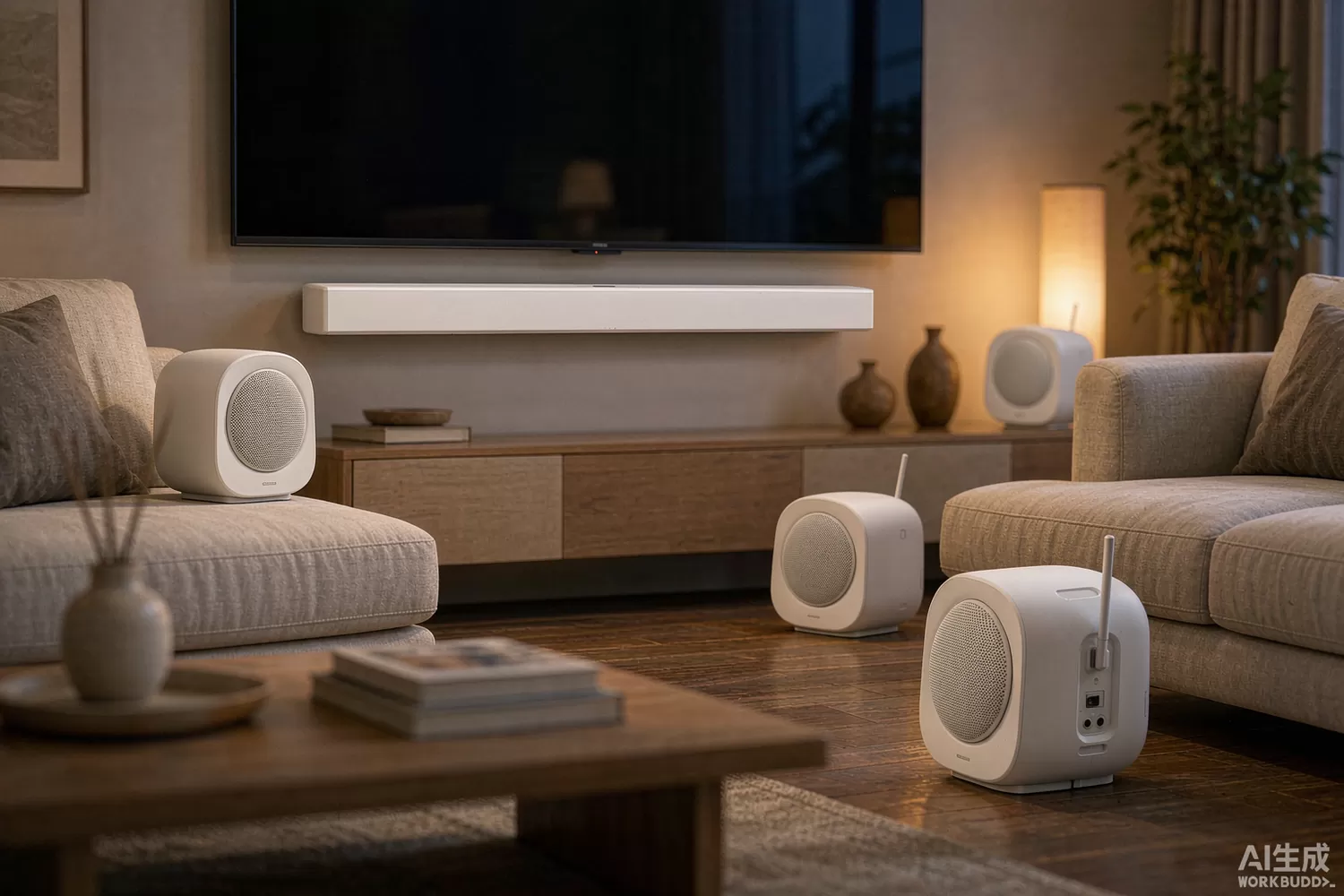
Wireless audio looks like a solved problem until someone watches a film. Then the twenty-millisecond gap between lip and voice becomes the only thing the room notices, and a product that measured well on a bench becomes a return. Latency, not bandwidth, is the governing constraint in multi-speaker audio, and it explains almost every architectural choice in the category: why manufacturers keep proprietary 2.4 GHz links alongside Bluetooth, why broadcast modes matter more than point-to-point, and why clock synchronisation between speakers is a hardware problem before it is a software one. This article walks the latency budget, compares the link options, and screens domestic audio SoCs against the imported parts that dominate premium designs. For the SoC cost view, see our Bluetooth audio SoC article.

Application logic: one budget, several deadlines
- Audio-visual sync — a viewer tolerates roughly 20 to 25 ms of audio lag behind video, and rather less of audio lead. Above that, the brain stops integrating and starts noticing.
- Instrument and game use — a musician or a gamer needs under 10 ms end to end, which rules out buffered Bluetooth codecs and pushes designs to proprietary 2.4 GHz links with short frames.
- Multi-speaker synchronisation — two speakers in stereo must stay within a few microseconds of each other or the image collapses. This is a clock-distribution problem, and it is why a broadcast link with a shared timing reference beats two independent point-to-point links.
- Codec choice — LC3 at low complexity gives good quality at 160 to 320 kbps with a frame length of 7.5 or 10 ms; SBC and older codecs need larger buffers, which is exactly the latency the product cannot afford.
- Jitter buffer — every link needs one, and its depth is a direct latency cost. A design that adapts buffer depth to measured jitter can hold a lower average latency than one with a fixed conservative buffer.
- Coexistence — the 2.4 GHz band is shared with Wi-Fi, and a home-theatre system in a living room with a mesh network is the normal case, not the corner case.
The parameters that decide whether the room sounds in sync
- End-to-end latency, measured — from analogue input to analogue output, including codec, buffer and radio. Vendors quote the radio; the product ships the total.
- Packet loss concealment — a link that drops a frame must hide it, not repeat it. Concealment quality at 1 to 3 percent loss separates a usable product from a crackling one.
- Clock drift between speakers — crystals differ by tens of ppm; over an hour that is audible as drift unless the link carries a timing reference or the receiver periodically resynchronises.
- Channel plan and antenna diversity — a proprietary link can hop away from Wi-Fi if it knows where Wi-Fi is. Antenna diversity at the receiver is cheap insurance against a body blocking the path.
- Current consumption — battery speakers must stream for ten hours; the radio’s average current in a low-duty broadcast scheme is often lower than in a request-response scheme, which is a hidden advantage of broadcast modes.
- Multi-room scale — adding speakers should not multiply latency or bandwidth. A broadcast topology handles eight receivers as easily as one; eight point-to-point links do not.
What is changing: broadcast, multichannel and the return of 5 GHz
Three shifts are reshaping the category. First, LE Audio and Auracast broadcast turned Bluetooth from a pairing protocol into a one-to-many distribution scheme, which is precisely what multi-speaker products needed: one transmitter, many receivers, shared timing. Second, multichannel home theatre over wireless moved from proprietary 5.8 GHz links to hybrid designs that use a dedicated high-rate link for the surround channels and a standard link for control and setup. Third, low-latency gaming modes pushed proprietary links back into the spotlight, because a 20 ms broadcast is still too slow for competitive play. The silicon consequence is convergence: audio SoCs now integrate the codec, the radio, the power management and often the amplifier, and the differentiation moved to the link layer and to the tuning.
Domestic alternatives: suppliers and indicative cost
The imported anchors are Qualcomm’s QCC-series audio SoCs for Bluetooth and Nordic’s nRF5340-class parts for LE Audio designs. Domestic supply is very strong in this category: Bestechnic’s BES-series audio SoCs are used across domestic earbuds and speakers, Bluetrum’s AB53xx family serves cost-sensitive products, Actions’ ATS-series covers portable audio, and JieLi’s AC-series covers high-volume consumer designs. For proprietary 2.4 GHz links, domestic SoCs with integrated radios and audio codecs are available, though the RF link layer and its latency tuning remain the integrator’s work. The realistic caution: the gap between domestic and imported parts here is less about audio quality than about stack maturity — LE Audio broadcast implementations differ in how they handle late joiners, clock recovery and multi-sink scheduling, and those details decide whether eight speakers stay in sync.
A realistic transmitter BOM for a broadcast speaker hub: a Nordic nRF52832 as a comparison platform for the LE Audio path, an Artery AT32F421C8T7 handling system control and display, a COS29152WU for the analog rail, a GD25Q32CSIG for prompts and configuration, and a TS2502PN on the USB-C port. If the product includes a wireless microphone input, our UHF microphone front-end article covers that chain.
Price figures below are indicative public-market reference ranges for moderate volumes, compiled from publicly observable listings. They fluctuate with the spot market, package option, grade (industrial, automotive, screened) and order quantity, and must not be read as a quotation. Ask us for a firm price on your exact part numbers and quantities.
| Function (imported anchor) | Example import part / class | Indicative import price (USD) | Domestic candidate | Indicative domestic price (USD) |
|---|---|---|---|---|
| Bluetooth audio SoC (premium) | Qualcomm QCC30xx class | 2.5 – 5.0 | Bestechnic BES2700 class | 1.50 – 3.00 |
| LE Audio SoC | Nordic nRF5340 class | 5.0 – 9.0 | Bestechnic / Actions LE Audio families (family level) | 1.80 – 3.60 |
| Cost-focused audio SoC | Imported entry audio SoC | 1.20 – 2.50 | Bluetrum AB53xx family | 0.60 – 1.40 |
| Portable audio SoC | Imported portable audio SoC | 1.50 – 3.00 | Actions ATS series (family level) | 0.80 – 1.80 |
| System control MCU | STM32-class Cortex-M0+ | 0.80 – 2.00 | AT32F421C8T7 (Artery) | 0.25 – 0.70 |
| Analog-rail LDO | Imported low-noise LDO | 0.20 – 0.55 | COS29152WU (Cosine) | 0.04 – 0.14 |
| Configuration NOR flash | 32 Mbit serial NOR | 0.35 – 0.80 | GD25Q32CSIG (GigaDevice) | 0.10 – 0.30 |
Where the cost difference actually comes from
In a speaker, the audio SoC plus its amplifier and power stage is the dominant electronics cost, so domestic silicon genuinely changes the price of the product — which is why the mid-market moved almost entirely to domestic parts. The imported premium buys two things: a mature LE Audio implementation with tested broadcast scheduling, and an ecosystem of reference designs that shortens development by months. Those two things are worth real money on a first product and progressively less on the fifth, when your own link-layer tuning has been debugged. The hidden cost on the domestic side is the amplifier and the acoustic tuning, not the SoC: a cheaper SoC that forces a different clock tree or a noisier supply can cost more in acoustic engineering than it saves in BOM. Budget an acoustic and EMC iteration before you commit.
Validation flow before you commit
Measure latency end to end with a pulse into the analogue input and an oscilloscope on the amplifier output — not with a vendor tool that measures the radio only. Then test synchronisation with the real speaker count: eight units in a room, playing for an hour, with a microphone recording each and a cross-correlation check for drift. Run a coexistence test with a Wi-Fi mesh node streaming video in the same room and log concealed frames. Finally, test the join and leave behaviour that customers actually perform: power on a speaker mid-film, move it to another room, and confirm it rejoins in sync without restarting the stream.
Frequently asked questions
Is Bluetooth now low-latency enough for home theatre?
For dialogue and music, usually yes with LC3 and a short buffer. For lip-sync-critical film playback and for multi-speaker synchronisation, a broadcast link with a shared timing reference or a proprietary 2.4 GHz design still does better.
Why do so many soundbars ship with a proprietary link?
Because it gives control over frame length, buffering and channel plan, which is exactly where latency and robustness are decided. Standard protocols trade that control for interoperability.
Does higher bandwidth reduce latency?
Not directly. Latency is set by frame length, buffering and scheduling; bandwidth only decides how much audio fits in each frame.
How do I keep eight speakers in sync?
Distribute one timing reference and let every receiver lock to it, rather than letting each link negotiate independently. Periodically resynchronise to absorb crystal drift.
About us & trademarks: JTDZ Tech (Shenzhen Jingteng Electronics Technology Co., Ltd.) is an independent distributor of electronic components. We are not an authorised distributor or representative of the imported manufacturers named in this article. Manufacturer, brand and part names are used for identification purposes only; all trademarks remain the property of their respective owners. Cross-reference information in this article is based on publicly available sources, is subject to change, and is not a substitute for your own engineering validation. Always verify specifications against the manufacturer's datasheet before design-in or purchase.
