
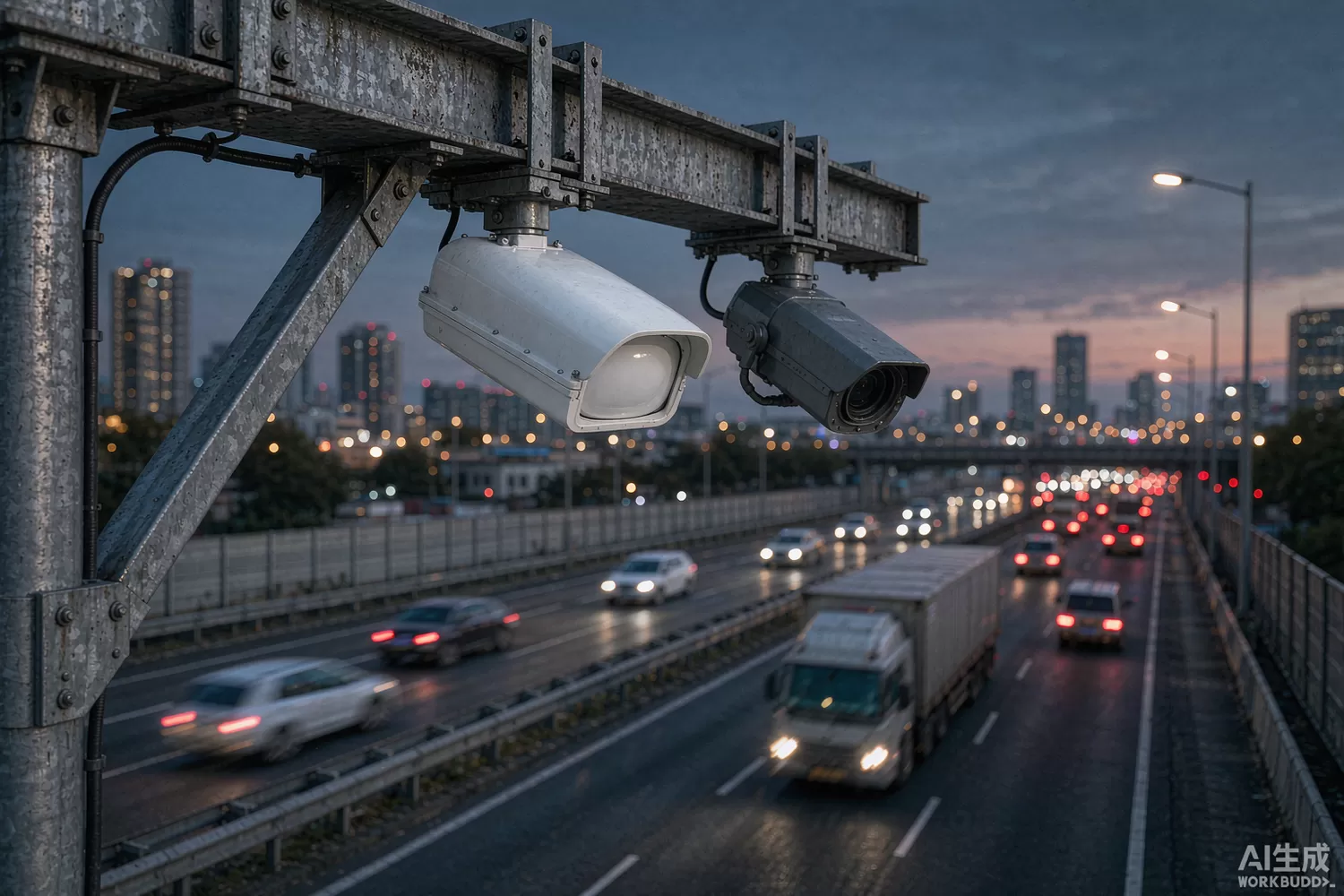
A traffic radar bolted to a gantry has a harder job than the radar in a car. It must work for a decade in rain, salt and 60 °C, measure speed to a legal standard, decide which lane a vehicle is in, and trigger a camera within milliseconds — all without a human to clean the radome. It also has to be defendable: a speeding ticket that a court rejects because the sensor misread a passing lorry is a procurement problem, not a technical one. This article explains how fixed traffic radar works, why its design priorities differ from in-vehicle ADAS radar, and where domestic front ends and modules now compete. In-vehicle radar was covered in our automotive radar article; the sensing physics of short-range bands appear in our 24 GHz K-band sensor article.

Application logic: measure speed, then decide what to photograph
- Speed by Doppler — a continuous-wave or FMCW radar measures the frequency shift of the return, which maps directly to radial velocity. This is the legally recognised measurement, and it is why traffic radar is a Doppler instrument first and an imaging device second.
- Range and lane by FMCW — adding a chirp gives range, and a narrow beam or a multi-channel array gives angle. Together they let the system associate a speed with a lane, which is the difference between a valid enforcement and a dispute.
- Trigger logic — the radar asserts a hardware trigger to the camera with a timestamp. Latency from detection to trigger, and the timestamp’s alignment with the camera exposure, decide whether the photograph shows the vehicle the radar measured.
- Presence detection — at intersections and pedestrian crossings the same hardware runs a different mode: slow-moving targets, stop-bar occupancy and queue length. This mode values sensitivity and false-alarm control over speed accuracy.
- Environmental rejection — rain, snow, foliage, guardrails and bridge expansion joints all generate returns. The radar’s ability to reject static clutter and non-vehicle targets is a design requirement, not a tuning detail.
- Field serviceability — alignment drift after a gantry is hit, radome contamination and lightning damage dominate the total cost of ownership. Self-diagnosis and remote alignment checks matter to the buyer as much as accuracy.
The parameters that decide a defensible measurement
- Speed accuracy and update rate — legal tolerances are tight, and the measurement must be stable over several seconds of tracking rather than a single snapshot. Averaging hides noise but slows the response to a braking vehicle.
- Beamwidth and side-lobe level — a narrow beam keeps adjacent-lane vehicles out, but a narrow beam is harder to align. Side lobes are worse than a wide beam, because they silently measure the wrong lane.
- Angular resolution — multi-channel arrays resolve lanes at distance; a single-channel design relies on beamwidth alone and struggles beyond two lanes.
- Clutter rejection and tracking — the tracker, not the radio, decides whether a guardrail is a vehicle. Range-Doppler clustering plus a plausibility model is where most of the field reliability comes from.
- Environmental sealing and thermal — a radome that absorbs water changes the beam; a housing that cooks the front end shifts the frequency. Both are mechanical requirements that the RF design inherits.
- Power and backhaul — solar-powered installations force milliwatt-level average consumption, which pushes duty-cycled operation and a low-power wake path into the design.
What is changing: 4D sensing, radar-camera fusion and edge processing
Three shifts stand out. First, 77 GHz moved into roadside products: the wider bandwidth gives finer range resolution, which separates vehicles from trailers and reduces the classic ambiguity of a lorry towing a trailer being read as two targets. Second, radar-camera fusion became normal: the radar detects and measures, the camera classifies and identifies, and the fusion layer decides whether the pair constitutes an enforcement event. That architecture puts a timestamping and synchronisation requirement on the radar that older standalone designs did not have. Third, edge processing moved the tracker and the event logic into the sensor, so the roadside unit sends events rather than raw detections — which reduces backhaul and makes solar-powered installations practical. On the component side, integrated 24 GHz and 77 GHz front-end modules with on-chip chirp generation cut the RF design effort dramatically, and that is precisely where domestic suppliers are gaining ground.
Domestic alternatives: suppliers and indicative cost
The imported anchors are European sensor houses such as InnoSenT and smartmicro, whose traffic modules are widely specified in enforcement and intersection programmes. Domestic supply has matured quickly: Calterah’s 77 GHz CMOS radar SoCs are used in both automotive and roadside designs, and domestic traffic-radar integrators build enforcement and intersection products around domestic front ends, with 24 GHz modules available from several module houses at aggressive prices. The honest distinction: domestic front ends are competitive on price and increasingly on performance, while the legal-metrology approval and the field reliability record are still where imported modules carry a premium. For an enforcement product, the approval path must be planned with the metrology authority from the start, because the sensor choice constrains it.
A realistic roadside unit control BOM: an Artery AT32F435CGT7 as the tracker and event controller, a COS1042T for the camera and backhaul CAN link, a COS29302WU for the always-on rail, a LM393SR comparator pair for threshold and trigger conditioning, and a TS2502PN on the surge-exposed interface.
Price figures below are indicative public-market reference ranges for moderate volumes, compiled from publicly observable listings. They fluctuate with the spot market, package option, grade (industrial, automotive, screened) and order quantity, and must not be read as a quotation. Ask us for a firm price on your exact part numbers and quantities.
| Function (imported anchor) | Example import part / class | Indicative import price (USD) | Domestic candidate | Indicative domestic price (USD) |
|---|---|---|---|---|
| 24 GHz traffic radar module | InnoSenT traffic module class | 300 – 900 | Domestic 24 GHz radar modules (family level) | 80 – 300 |
| 77 GHz radar front-end module | European 77 GHz traffic module class | 900 – 2500 | Calterah 77 GHz CMOS radar SoC based module (family level) | 300 – 900 |
| Radar SoC (77 GHz, single chip) | Imported 77 GHz radar SoC | 12.0 – 25.0 | Calterah Andes/Alps family (family level) | 4.0 – 9.0 |
| Tracker / event controller MCU | Imported Cortex-M4/M7 | 3.0 – 7.0 | AT32F435CGT7 (Artery) | 1.20 – 2.60 |
| Camera / backhaul CAN transceiver | TJA1042 class | 0.60 – 1.40 | COS1042T (Cosine) | 0.15 – 0.45 |
| Always-on rail LDO | Imported 3 A LDO | 0.90 – 1.90 | COS29302WU (Cosine) | 0.25 – 0.70 |
| Trigger threshold comparator | Imported dual comparator | 0.12 – 0.35 | LM393SR (Cosine) | 0.03 – 0.10 |
| Surge-port ESD protection | Imported surge-rated TVS | 0.20 – 0.60 | TS2502PN (Titan Micro) | 0.03 – 0.12 |
Where the cost difference actually comes from
The radar front end dominates a roadside unit’s electronics cost, so a domestic module genuinely halves the electronics BOM — but electronics is often less than half of an installed enforcement site. The gantry, the power and lightning protection, the camera, the civil works and the metrology approval together dwarf the sensor. That has two consequences. First, a cheaper sensor is only a real saving if it does not add installation or approval cost; a module that needs re-alignment twice a year costs more than it saved. Second, the economic case for domestic radar is strongest in volume presence and traffic-flow applications — intersection occupancy, queue measurement, counting — where legal metrology is not involved, and weakest in certified speed enforcement, where the approval history is the product.
Validation flow before you commit
Test against a reference instrument on a closed track: multiple vehicle types, including a lorry with a trailer and a motorcycle, at several speeds and angles, and compare not just the mean error but the spread and the drop-outs. Then run a 72-hour static clutter test on a live gantry, logging false detections per hour, because that number decides the operational cost of the site. Verify trigger latency and timestamp alignment by filming a vehicle with a high-speed camera and comparing the recorded frame with the radar event. Finally, subject the unit to the environmental sequence it will actually see — thermal cycling, salt spray, vibration — and re-measure beam alignment afterwards, since alignment drift is the failure mode that quietly invalidates a year of good data.
Frequently asked questions
Why not just use a camera for speed enforcement?
Cameras need a speed measurement from another sensor, and radar provides it independent of lighting and weather. Radar-camera fusion combines the two, with the radar supplying the legal measurement.
Is 24 GHz obsolete now that 77 GHz exists?
No. At short range and in presence-detection roles, 24 GHz is cheaper and entirely adequate; 77 GHz earns its price where range resolution and lane discrimination matter.
What limits lane discrimination?
Antenna beamwidth, side-lobe level and the number of receive channels. A narrow beam helps but is fragile to alignment, which is why multi-channel arrays are preferred.
Do domestic modules have metrology approval?
Approval is granted per product and per jurisdiction, not per chip. A domestic front end can be approved, but the process must be planned early with the authority responsible for the site.
About us & trademarks: JTDZ Tech (Shenzhen Jingteng Electronics Technology Co., Ltd.) is an independent distributor of electronic components. We are not an authorised distributor or representative of the imported manufacturers named in this article. Manufacturer, brand and part names are used for identification purposes only; all trademarks remain the property of their respective owners. Cross-reference information in this article is based on publicly available sources, is subject to change, and is not a substitute for your own engineering validation. Always verify specifications against the manufacturer's datasheet before design-in or purchase.
