
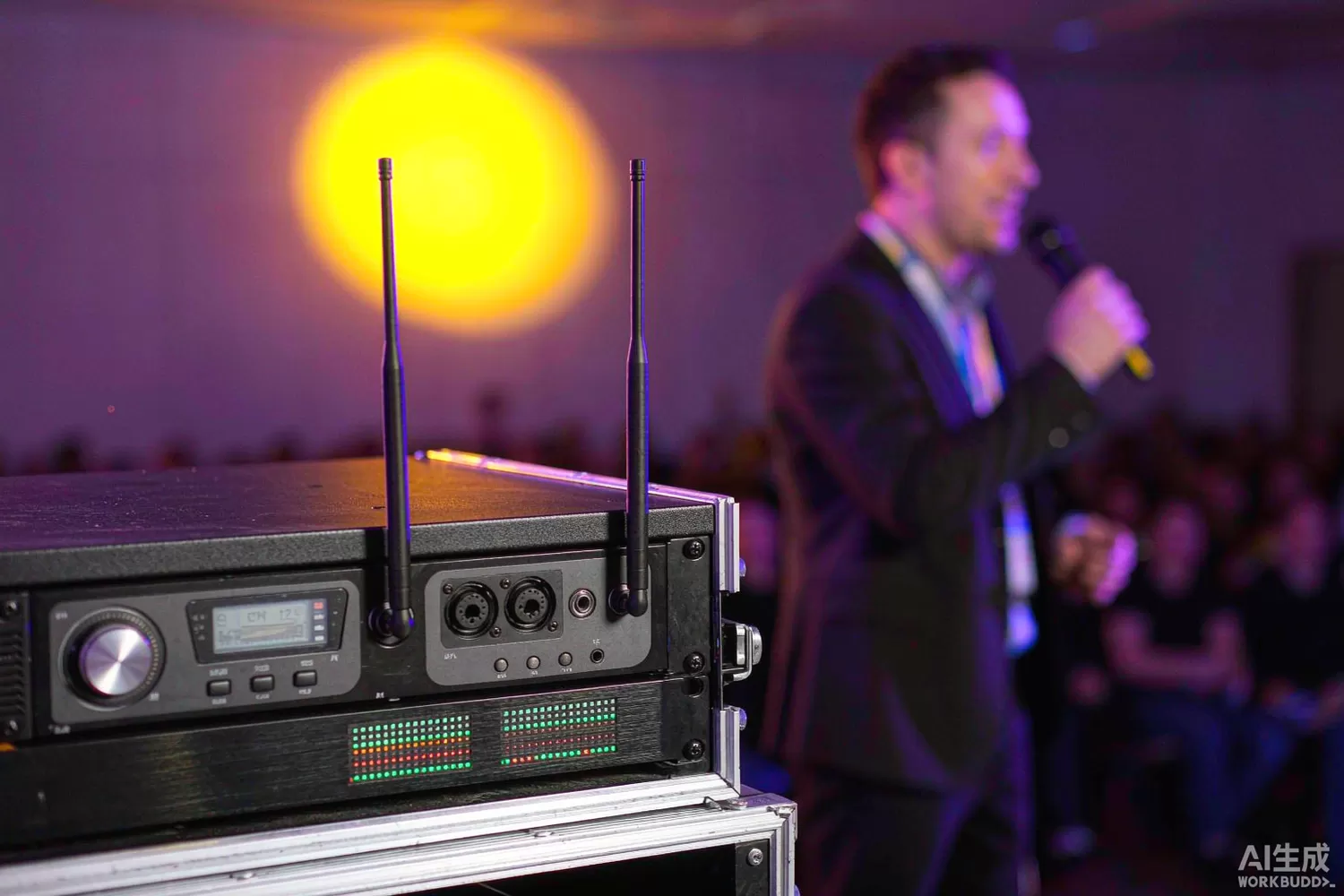
A wireless microphone is an RF system with an unforgiving contract. It must deliver a live vocal with no perceptible latency, no dropouts under multipath, no audible compression artifacts, inside a venue whose spectrum is shared with broadcast television, in-ear monitors, intercoms and whatever the neighbouring production brought. And it must do this on two AA batteries for eight hours. The RF front end that meets this contract — a frequency-agile synthesiser, a clean transmitter PA, a low-noise diversity receiver — is a miniature masterclass in practical RF design. This article covers the system as a chip-level choice: application logic at both ends of the link, the specifications that decide range and reliability, the digital-transition trends, and the domestic supply picture. For the sub-GHz transceiver families that small-scale systems borrow from, see our sub-1 GHz transceiver article.

Application logic: the transmitter end
The transmitter is a constrained system: RF power capped at 10–50 mW in most regulatory regimes (UHF wireless mics operate under licence-exempt or lightly-licensed rules in the 470–698 MHz range, depending on market), battery supply 2–3 V, and audio quality expectations from studio work. The application logic flows from three constraints:
- Frequency agility — venues are coordinate-changed nightly; the synthesiser must cover the whole local band (tens of megahertz minimum) with clean, fast hops and hold its phase noise while doing it. A fractional-N PLL with a low-noise VCO is the norm; phase noise at 10–100 kHz offset decides how far away the receiver can work.
- Efficiency at low voltage — the PA runs from two cells; a 10 mW carrier from 2.4 V demands an efficient final stage and a bias network that does not leak the battery away in standby (our PA bias and sequencing article covers that support tier).
- Antenna physics in a handheld — the mic body detunes the antenna with every hand position; the transmit chain must tolerate 4:1 VSWR without drifting or distorting, because the user's grip is not a design parameter you control.
Analog transmitters add companding (the compressor–expander pair that hides the modest channel SNR), pilot tones for squelch, and tone-key signalling to keep receivers muted when the carrier is noise. Digital transmitters instead digitise audio and ship a constant-envelope or low-PAPR modulation — typically 2-FSK/GFSK variants at a few hundred kilobits per second — trading spectrum efficiency for a link that either delivers bit-perfect audio or mutes, with the mitigation burden moved to error correction and diversity.
Application logic: the receiver end
The receiver is where the engineering concentrates, and diversity is the heart of it. Two antennas, spaced or orthogonal, feed two complete front ends; the system selects or combines whichever branch is hearing the transmitter cleanly, converting the multipath nulls of a moving performer from dropouts into brief fades. Around that, the front-end logic is standard but tight:
- Low-noise first stage — receiver noise figure of 3–5 dB decides usable range at the 10–50 mW transmit power; every extra decibel is range the compander cannot recover.
- Blocking tolerance — the venue next door runs a television transmitter at megawatts; front-end filters and mixer linearity decide whether the mic link survives, and SAW filtering after the LNA is universal.
- Fast, quiet synthesis — the receiver's PLL must hop with the transmitter and re-lock inside the mute window; spurious outputs land in the audio as noise if the loop design is lazy.
- Audio-chain timing — analog companding adds a few milliseconds; digital systems add codec and FEC delay. The total must stay under roughly 10 ms or performers start fighting their own monitoring.
What is new in wireless-microphone RF
Three shifts define the current generation. First, the digital transition: flagship systems have moved to digital transmission with AD/DA at both ends, which removes companding artifacts and makes the link's audio quality independent of RF SNR above threshold — the trade is latency discipline and a harder noise floor at threshold, where digital mutes and analog merely degrades. Second, spectrum pressure: as broadcasters vacate UHF and regulators repack the band, frequency-coordination software and fast-scanning receivers have become as important as the RF hardware; modern receivers sweep the band continuously and steer the whole rack away from interference automatically. Third, 2.4 GHz digital systems: for camera-hop and presentation use, licence-free 2.4 GHz digital mics (built from the same BLE-adjacent silicon families covered in our Bluetooth SoC article) now deliver near-professional latency, squeezing the middle market — leaving the UHF tier for touring, broadcast and installed sound where range, density and spectrum rights matter.
Domestic alternatives: families and indicative cost
Domestic coverage here is a consumer-volume story moving upmarket. Beken (Beken, stock code 603068) supplies UHF wireless-audio and walkie-talkie transceiver families that anchor the domestic value segment, including the widely used BK4819-class transceiver ICs; Telink (Telink, 688591) and Bluetrum (Bluetrum, 688332) cover the 2.4 GHz digital tier at consumer prices; and several Shenzhen design houses build complete UHF analog systems on discrete PLL-plus-PA architectures. Imported anchors are the Analog Devices ADF435x PLL families and TI/Skyworks front-end parts in professional receivers, the NXP/Infineon synthesiser lineage in legacy systems, and the professional brands' ASICs that never reach open sale. The honest summary: domestic silicon owns the value segment outright, is credible through the prosumer tier, and the professional touring tier still largely builds on imported PLLs and front ends — a gap that is commercial distribution as much as silicon.
Supporting parts for either tier are catalogue stock: Tai-Saw TB0614A and TA0224A SAW filters for front-end band definition, a Qorvo SGA5589Z gain block or Mini-Circuits PHA-13LN+ LNA in the receiver front end, a Qorvo AH225-S8G PA for the transmit side, and an Artery AT32F403ACGT7 MCU for frequency management and display.
Price figures below are indicative public-market reference ranges for moderate volumes, compiled from publicly observable listings. They fluctuate with the spot market, package option, grade (industrial, automotive, screened) and order quantity, and must not be read as a quotation. Ask us for a firm price on your exact part numbers and quantities.
| Function (imported anchor) | Example import part / class | Indicative import price (USD) | Domestic candidate | Indicative domestic price (USD) |
|---|---|---|---|---|
| UHF wireless-audio transceiver / speech IC | ADI / professional-brand ASICs (not openly sold) | n/a (system level) | Beken BK4819-class transceiver families (family level) | 0.5 – 2.0 |
| Fractional-N PLL + VCO, low phase noise | ADI ADF435x family | 4 – 12 | Domestic PLL families (family level); in-stock import class for pro tier | 1.5 – 6 |
| Receiver LNA / gain block, 400–900 MHz | Mini-Circuits PHA-13LN+; Qorvo SGA5589Z; site stock | 0.8 – 2.5 | Vanchip / Maxscend small-signal families | 0.25 – 1.0 |
| Transmit PA, 10–50 mW class, UHF | Qorvo AH225-S8G class; site stock | 0.8 – 2.5 | Vanchip / domestic PA families (family level) | 0.25 – 1.0 |
| SAW filter, UHF front end | Murata / Taiyo Yuden SAW | 0.2 – 0.7 | Tai-Saw TB/TA series; site stock | 0.06 – 0.25 |
| 2.4 GHz digital-audio SoC (presentation tier) | Imported 2.4 GHz audio SoCs | 1.5 – 4.0 | Telink TLSR-class; Bluetrum families | 0.4 – 1.5 |
| System-control MCU | STM32F103-class | 1.2 – 3.0 | AT32F403ACGT7 (Artery) | 0.4 – 0.9 |
| Audio codec / compander | TI / Cirrus codec families | 0.8 – 2.5 | COS6112 class audio parts (COSINE) | 0.15 – 0.8 |
Read the table as a screening tool, not a quotation. The engineering summary: the value tier — presentation, education, small venues — is fully addressable with domestic silicon today, and the quality ceiling of that tier has risen far enough that “domestic” no longer implies “compromised” there. The professional touring tier is a different risk calculation: channel density, coordination tools and long-term firmware support matter as much as phase noise, and professional brands' integrated systems hold that ground for now. For a manufacturer entering this market, the pragmatic split is domestic BOM below the pro tier, imported PLL/front-end silicon in the flagship, and a qualification plan that measures phase noise, blocking and range in a real venue — not just on the bench.
Validation flow before you commit
Test the link where it will live. Walk a real venue with the transmitter moving, antennas at performer height, and log dropouts against receiver branch selection — diversity that only works at bench geometry is decoration. Measure phase noise delivered to the antenna port, because it sets range more honestly than transmit power does. Sweep blocking with a strong adjacent carrier at broadcast levels and confirm the SAW-filtered front end holds. Measure end-to-end latency through the audio chain and confirm it is stable under frequency changes. Then run the battery model: eight hours of continuous transmit from two cells, including the synthesiser's hopping overhead — synthesiser current, not PA current, is usually the surprise.
Frequently asked questions
Digital or analog for a new wireless-mic design?
Digital wins on audio quality above threshold and removes companding artifacts; it costs latency discipline and a harder threshold behaviour. Analog survives in the value tier and in retrofit markets. New professional designs are digital; new value designs can be either.
Why do professional receivers still use two complete front ends?
True diversity needs two independent views of the channel before the signal degrades. Sharing an LNA or filter would couple the branches and erase the multipath diversity that justifies them.
What actually limits range: power or phase noise?
At these transmit powers, phase noise and receiver noise figure together limit range; the PA is rarely the bottleneck. improving either by 3 dB buys more than doubling transmit power legally allows.
Are domestic wireless-mic chips usable in a professional product?
Through the prosumer tier, yes — Beken-class transceivers are fielded at consumer volume. For touring-grade channel density and coordination, verify hopping behaviour, firmware support and phase noise against the professional ASICs before committing.
About us & trademarks: JTDZ Tech (Shenzhen Jingteng Electronics Technology Co., Ltd.) is an independent distributor of electronic components. We are not an authorised distributor or representative of the imported manufacturers named in this article. Manufacturer, brand and part names are used for identification purposes only; all trademarks remain the property of their respective owners. Cross-reference information in this article is based on publicly available sources, is subject to change, and is not a substitute for your own engineering validation. Always verify specifications against the manufacturer's datasheet before design-in or purchase.
