
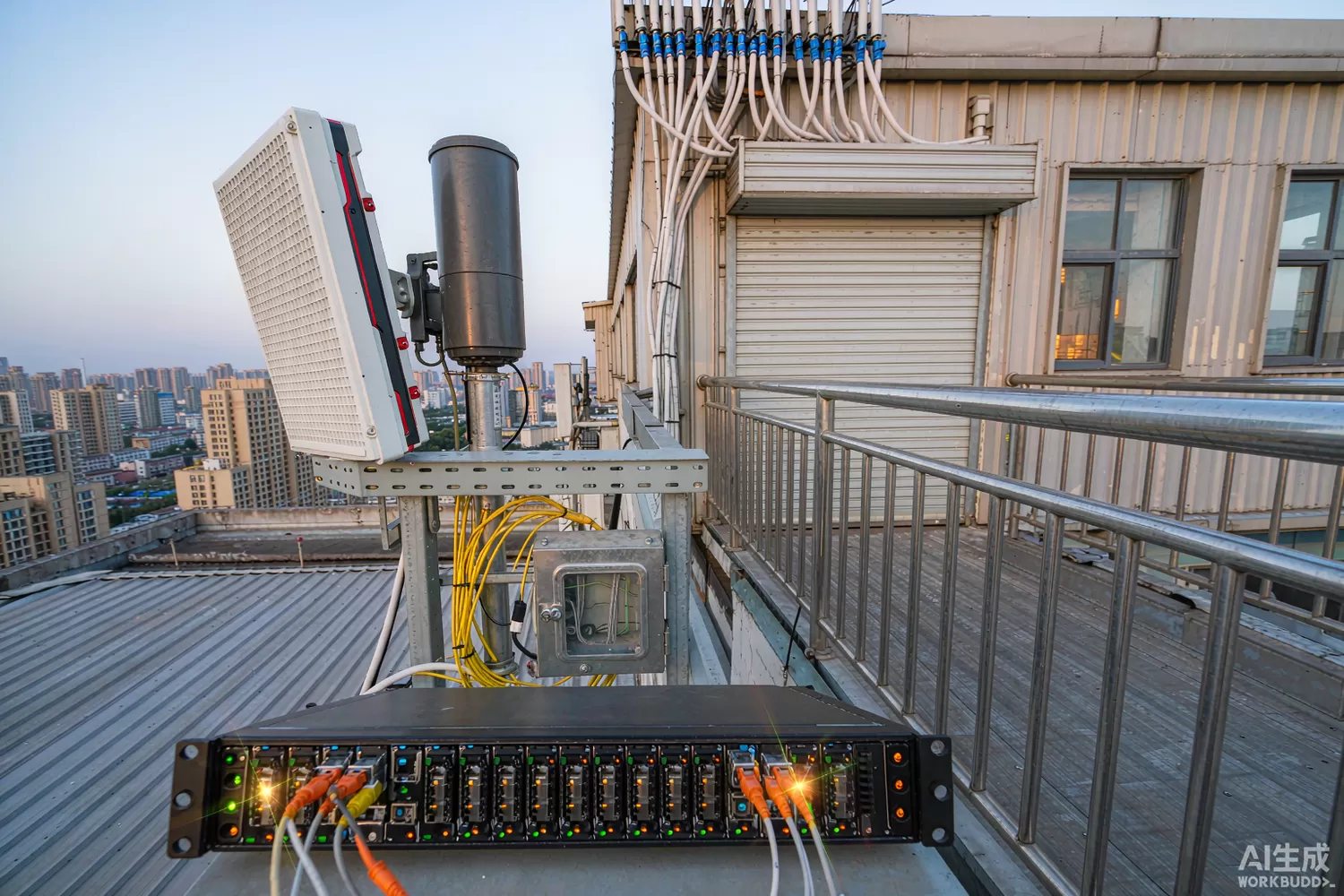
Run RF down a long coaxial cable and physics bills you per metre: loss grows with frequency and distance, the cable becomes an antenna for interference, and beyond a few hundred metres the budget is gone. Run the same signal down a single-mode fibre and the loss is 0.2 dB per kilometre at any frequency the link supports, the fibre neither radiates nor receives, and a kilometre of span costs no more than ten metres of coax ever did. That asymmetry is why distributed antenna systems, GPS timing distribution, satellite ground stations and radar remoting all converged on the same architecture: an analogue optical link — laser diode driven by the RF signal at one end, photodiode recovering it at the other — with RF amplifiers and, increasingly, digitisation wrapped around it. This article covers the link as an engineering choice: application logic, the three numbers that decide whether the link works, the technology trends, and the domestic supply picture. For the RF amplifiers that frame the optical span, see our gain block article.

Application logic: what the link is asked to carry
Analogue optical links split by the signal they carry, and the split determines every specification:
- Distributed antenna systems (DAS) and 5G remoting — carrying one or many cellular carriers from a central radio head to remote antenna units; multi-octave linearity and intermodulation management dominate, because the air interface never forgives distortion.
- GPS / timing distribution — carrying a 1.575 GHz GNSS signal plus calibration tone; here the differentiator is delay stability and delay symmetry, because a nanosecond of unaccounted fibre delay is 30 cm of position error.
- Satellite ground stations and radar remoting — carrying wideband IF or L-band over hundreds of metres to keep sensitive electronics out of the weather and away from the dish; noise figure and gain flatness across the band dominate.
- Test-range and EMC-facility distribution — carrying measurement signals through environments no coax survives; here the link is bought for isolation and bandwidth, and linearity is whatever the budget allows.
The architecture decision is intensity modulation with direct detection (IM/DD) — essentially, the RF amplitude modulates a laser's optical power and a photodiode demodulates it — versus externally modulated links (Mach-Zehnder or electro-absorption modulators) for the highest dynamic range. Direct-detection modules cover the volume market; external modulation appears where the SFDR budget exceeds what a directly modulated laser gives, at a price in both cost and complexity. Either way, the link is a chain of RF gain, an optoelectronic conversion, and RF gain again — and the system engineering lives in balancing those three gains.
The three numbers: gain, noise figure, SFDR
An analogue optical link is described by exactly the same specifications as an amplifier chain, with one twist — the optoelectronic conversion itself carries loss:
- Link gain — a directly modulated link typically runs −25 to −10 dB of net RF-to-RF gain; the RF amplifiers at both ends exist to pay this back. Gain flatness across the band, more than gain itself, is what the customer feels.
- Noise figure — dominated by laser relative-intensity noise (RIN) and photodiode shot noise; 25–35 dB NF figures for raw links are normal, which is why the link is never placed ahead of the first low-noise gain block — the LNA sits at the antenna, the link carries an already-amplified signal.
- Spurious-free dynamic range (SFDR) — set by laser nonlinearity in direct modulation; direct links achieve 100–110 dB·Hz²/3, externally modulated ones exceed 115. Multi-carrier DAS systems live or die on this number.
- Delay stability and symmetry — fibre delay is ~5 ns per metre; temperature moves it by tens of parts per million, which is invisible in DAS and fatal in timing distribution — hence calibration tones and active delay compensation in GNSS links.
- Bandwidth — photodiodes reach 40 GHz routinely; the laser and its driver set the practical ceiling in direct modulation (typically to 6–20 GHz).
Technology trends in analog photonics
Three movements are visible. First, digitisation at the remote end: where fibre bandwidth is available, digitising the signal at the antenna and shipping samples (the CPRI/eCPRI model of modern cellular, and increasingly the model for radar and EW receivers) removes the analogue linearity problem entirely; the analogue link survives where latency, cost or bandwidth make digitisation impractical — GPS timing, legacy DAS, test ranges. Second, linearisation: predistortion ICs and feed-forward techniques stretch direct-modulation SFDR toward external-modulation performance at a fraction of the cost, expanding the direct link's addressable market. Third, photonic integration: silicon photonics now integrates laser, modulator and photodiode on one chip-class platform, and 5G fronthaul pushed optical transceiver volumes to commodity pricing — pulling analogue link economics down with it. The engineering consequence: the analogue optical link is no longer exotic infrastructure; it is a component with a catalogue and a price curve.
Domestic alternatives: families and indicative cost
Domestic coverage is strong at the module tier and growing at the chip tier. Accelink (Accelink, stock code 002281) supplies analogue optical transmission modules used in domestic cable television and DAS networks; HG Genuine / HG Genuine (under HGTECH, 000988) volume-produces optical transceivers including analogue variants; and the CATV optical-node supply chain in Shenzhen and Wuhan exports worldwide. At the chip tier — laser drivers, TIAs, linear amplifiers — domestic coverage is thinner and designs commonly mix domestic optoelectronics with imported RF-ICs; the table states this honestly. Imported anchors are the Emcore (now part of the broadband-optics lineage), ViaLite and Foxcom link families that dominate the professional market, and the MACOM and Analog Devices RF-ICs inside them.
The RF stages around the optical span are ordinary catalogue design: a Mini-Circuits PHA-13LN+ LNA at the antenna, a Qorvo SGA5589Z or MACOM MAAL-011136 gain stage driving the laser, Mini-Circuits LFCN-95+ filtering against out-of-band pickup, and a COSINE COS6212Q24R line driver for the IF stages in lower-bandwidth designs.
Price figures below are indicative public-market reference ranges for moderate volumes, compiled from publicly observable listings. They fluctuate with the spot market, package option, grade (industrial, automotive, screened) and order quantity, and must not be read as a quotation. Ask us for a firm price on your exact part numbers and quantities.
| Function (imported anchor) | Example import part / class | Indicative import price (USD) | Domestic candidate | Indicative domestic price (USD) |
|---|---|---|---|---|
| Analogue optical link module, 0.5–3 GHz, DAS class | Emcore / ViaLite / Foxcom link modules | 600 – 2,500 | Accelink analogue module families; CATV node houses | 200 – 1,200 |
| GNSS timing optical link with delay calibration | ViaLite / Foxcom timing links | 1,500 – 4,000 | Domestic timing-link suppliers (project level) | 600 – 2,000 |
| Laser driver IC for direct modulation | MACOM / Analog Devices driver families | 3 – 12 | Domestic driver families (family level, documentation-dependent) | 1.5 – 6 |
| Transimpedance / post amplifier IC | MACOM / ADI TIA families | 2 – 10 | Domestic TIA families (family level) | 1.0 – 5 |
| DFB laser, 1310 nm, analogue grade | Imported analogue-grade DFBs | 15 – 60 | Accelink / domestic DFB vendors | 6 – 30 |
| RF gain stage framing the link | Mini-Circuits PHA-13LN+ / Qorvo SGA5589Z; site stock | 1.0 – 3.0 | Vanchip / Maxscend small-signal families | 0.3 – 1.2 |
| IF line driver (low-bandwidth designs) | TI THS-class line drivers | 1.5 – 4.0 | COS6212Q24R (COSINE) | 0.4 – 1.2 |
Read the table as a screening tool, not a quotation. The engineering summary: for DAS and CATV-class analogue spans, domestic modules are production-credible and price-competitive, because that supply chain has run at volume for two decades. For timing-critical GNSS distribution and the highest-SFDR links, imported systems still carry the reference designs, and domestic equivalents should be qualified against delay-stability data rather than brochure bandwidth. At the chip tier, expect a mixed bill of materials for the next few years — that is a normal stage of domestication, not a warning sign.
Validation flow before you commit
Characterise the link in its system context. Measure RF-to-RF gain flatness across band with the real fibre length and connector count; connector reflections ripple the response in ways bench data misses. Measure noise figure with the actual input level the LNA hands over. Sweep two tones across the band and record SFDR at the operating point — not the datasheet's peak. For timing links, measure delay over a 24-hour thermal cycle and check the compensation loop actually holds the nanosecond. Then install a pilot span and leave it: the failures that matter in analogue optical links are thermal (laser wavelength and bias drift) and mechanical (connector contamination), and both appear in the first month of field life, never on the bench.
Frequently asked questions
Why not just digitise at the antenna and avoid the analogue link?
Where bandwidth and latency allow, digitisation is the modern answer — that is how 5G fronthaul works. The analogue link survives where its simplicity wins: GPS timing, legacy DAS, wideband test distribution, and anywhere cost per channel or power budget beats sample-stream economics.
Why is the optical link's noise figure so high, and why does it not matter?
A directly modulated link runs 25–35 dB NF because laser RIN and shot noise dominate. It matters little because the link is never first in the chain: the LNA at the antenna sets sensitivity, and the link carries an already-amplified signal.
What decides SFDR in a directly modulated link?
Laser nonlinearity at the operating bias. Predistortion linearisation buys 5–10 dB of SFDR at modest cost; external modulation buys more at much higher cost.
Are domestic analogue optical modules trustworthy for DAS builds?
The domestic CATV/DAS optical supply chain has run at volume for two decades and is production-credible. For timing-critical spans, qualify against delay-stability data over thermal cycles rather than bandwidth claims.
About us & trademarks: JTDZ Tech (Shenzhen Jingteng Electronics Technology Co., Ltd.) is an independent distributor of electronic components. We are not an authorised distributor or representative of the imported manufacturers named in this article. Manufacturer, brand and part names are used for identification purposes only; all trademarks remain the property of their respective owners. Cross-reference information in this article is based on publicly available sources, is subject to change, and is not a substitute for your own engineering validation. Always verify specifications against the manufacturer's datasheet before design-in or purchase.
