
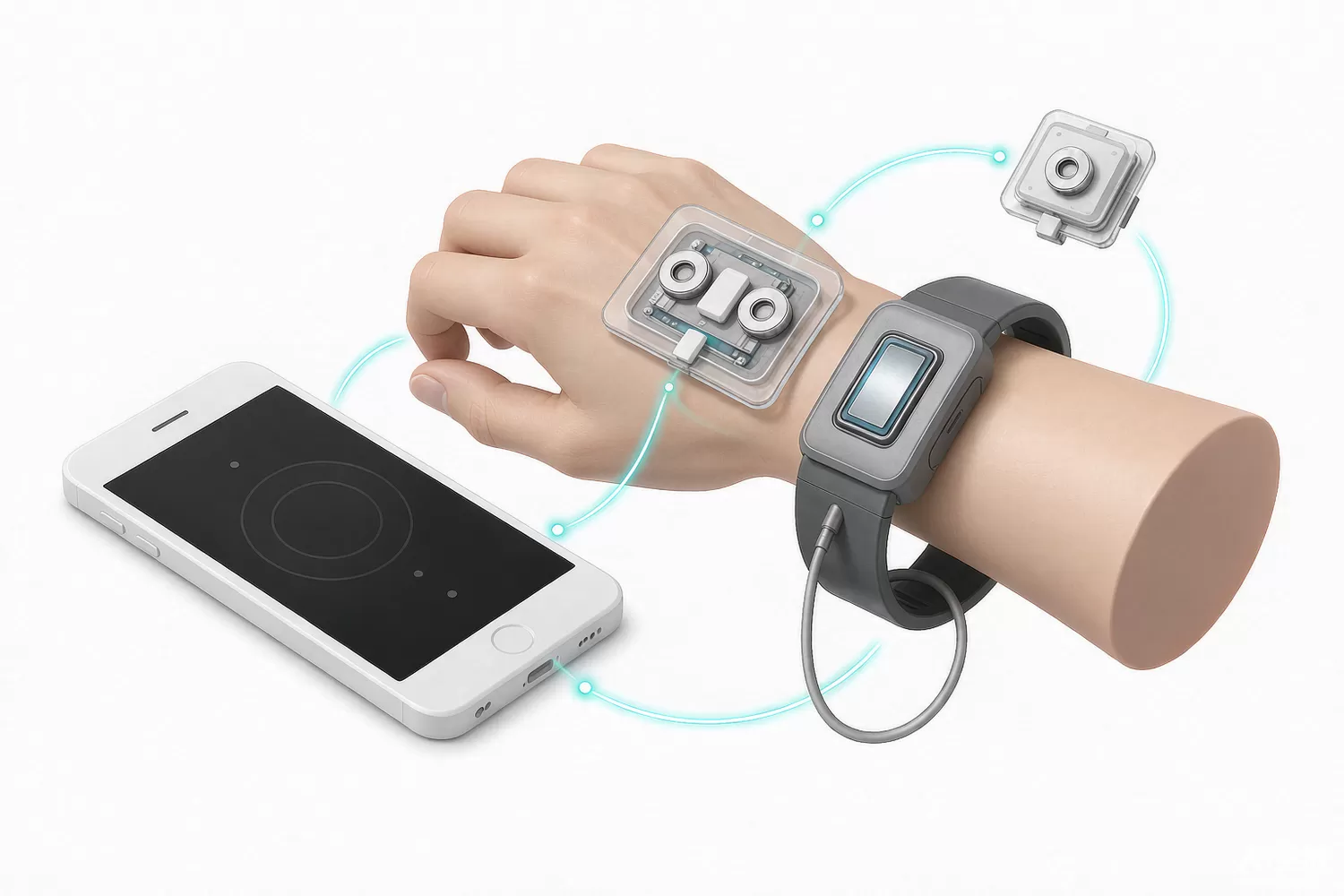
Low-power Bluetooth is the default radio of modern consumer electronics: wearables, remote controls, smart locks, medical patches, beacons, toothbrushes. Because the category is so broad, the chip market is unusually layered. At one end, imported SoCs from Nordic Semiconductor, Silicon Labs and Texas Instruments dominate engineering-led products where the SDK matters as much as the price. At the other end, a group of Chinese vendors — Goodix, Nations Technology, Telink and others — has taken a large share of high-volume consumer sockets. This article explains the application logic, what has changed in the technology, and how a domestic substitution decision should be structured.

Application logic: what shapes a BLE design
A BLE SoC contains the radio, the link-layer and profile stack, and an application processor. The design questions are dominated by the radio's receive sensitivity (which sets range), the transmit power and output matching, and above all the duty cycle — a beacon that advertises every 100 ms and a medical patch that connects once a day have completely different power architectures. Around the chip sit the antenna (PCB meander, chip antenna, or a matched external type), the crystal (32 MHz for the radio, 32.768 kHz for the sleep timer), and the DC-DC or LDO rails. Sleep leakage, wake-up latency and the flash-retention behaviour of the application code decide whether the product hits its battery target.
Protocol choices matter just as much. Connection-oriented designs must plan for the connection interval and MTU, while connectionless beacon and broadcast designs optimise advertising interval and payload. Mesh and higher-throughput features change the memory budget, and products that must coexist with Wi-Fi or cellular radios need filtering and antenna isolation planned from the start. Products that also do audio should look at our separate Bluetooth audio SoC analysis.
New technology in BLE
- Bluetooth 5.x cores with coded PHY: longer range at the cost of throughput, useful for industrial sensors and large buildings.
- Higher-throughput BLE modes: faster firmware-update and bulk-data paths that compete with classic data-transfer profiles.
- Angle-of-arrival and direction finding: antenna arrays for indoor positioning without a separate UWB or Wi-Fi based system.
- LE Audio and Auracast: new profiles that reshape headphone, hearing-aid and venue-broadcast products.
- Single-chip integration: DC-DC converters, USB or lithium chargers, touch controllers and sensor hubs integrated around the BLE core.
- RISC-V application cores: domestic vendors are adopting open instruction sets, which reduces licensing cost and improves long-term supply flexibility.
Domestic alternatives: what to analyse before switching
- Compare datasheet receiver sensitivity and, more importantly, measured range in your enclosure and orientation.
- Check the maximum transmit power and the harmonic and spurious performance against your regulatory limits.
- Audit the SDK: protocol-profile library coverage, debugging tools, sample code quality and documentation language.
- Confirm stack certification: BQB listing, and the product-level certification support the vendor provides for CE, FCC and similar regimes.
- Review the memory and peripheral mix against your application — flash size and the number of analogue channels are common pinch points.
- Ask for errata and silicon revision history; a young part with a long errata list is a schedule risk.
Indicative cost comparison: imported originals vs domestic candidates
Price figures below are indicative public-market reference ranges for moderate volumes, compiled from publicly observable listings. They fluctuate with the spot market, package option, reel size and order quantity, and must not be read as a quotation. Ask us for a firm price on your exact part numbers and quantities.
| Device class | Common imported reference | Indicative imported unit price | Commonly referenced domestic candidate | Indicative domestic unit price |
|---|---|---|---|---|
| BLE 5.x SoC, general purpose | Nordic nRF52832/nRF52840 class | USD 2.0–4.5 | Goodix GR551x / GR533x class; Nations N32WB031-class | USD 0.7–1.9 |
| BLE SoC with high-throughput or AoA support | Nordic nRF5340 class; Silicon Labs EFR32BG22 class | USD 3.5–7.0 | Domestic multi-core BLE SoCs with AoA support | USD 1.4–3.0 |
| BLE SoC with integrated charger and touch | Imported SoC plus external charger and touch IC | USD 2.5–5.0 plus externals | Domestic integrated BLE SoC (Telink TLSR9-class, Goodix GR-series) | USD 1.0–2.4 |
| Legacy Bluetooth Classic / dual-mode SoC | Qualcomm CSR BC417-class and successors | USD 2.5–6.0 | Domestic dual-mode or BLE-only alternatives (function-dependent) | USD 1.0–2.8 |
The arithmetic usually favours domestic silicon by 50–65 percent at moderate volume, and the gap is largest where integration replaces external parts. The counterweight is engineering cost: an unfamiliar SDK can add weeks of development, and a CE/FCC or BQB submission that has not been fully prepared costs real money. Compare total landed cost, including the RF certification retest, rather than chip price alone. If you need legacy Classic support or a specific profile set, check availability before committing — several domestic families are BLE-only.
Commonly referenced alternative models
| Imported original (reference) | Domestic candidate (public sources) | Why it is referenced |
|---|---|---|
| Nordic nRF52832 / nRF52840 — general-purpose BLE SoC | Goodix GR5515 / GR551x; Nations N32WB031; Telink TLSR8258 | Comparable BLE 5 core with integrated MCU and peripheral set; compare flash, RAM and sleep current. |
| Nordic nRF5340 — dual-core BLE with high throughput | Goodix GR533x-class; Telink TLSR9-class multi-core parts | Both target audio-adjacent and higher-throughput products; verify profile and SDK coverage. |
| Silicon Labs EFR32BG22 — low-power BLE with AoA | Domestic AoA-capable BLE SoCs (multi-antenna reference designs) | Direction-finding support at a lower unit price; antenna-array design support is the differentiator. |
| Qualcomm CSR BC417-class — legacy Bluetooth Classic | Domestic BLE SoCs for new designs; dual-mode availability varies | Most new products use BLE only, so the honest substitution is a product re-architecture, not a component swap. |
Our own catalogue includes the imported Bluetooth SoC families referenced above, for example Qualcomm BC417143B Bluetooth SoC, which many customers still buy for legacy maintenance builds. We can supply imported and domestic options side by side so you can make the trade-off on evidence.
Validation checklist
- Conducted and radiated measurements in the finished enclosure, at both temperature extremes.
- Average current in each operating mode with your real connection parameters.
- Interoperability testing against the phone and host platforms you actually support.
- OTA update path tested end to end, including recovery from an interrupted update.
- BQB and regional certification status confirmed before tooling release.
- Lifecycle statement and second-source strategy for the chosen family.
Related reading on our blog
Integrating a mature Bluetooth SoC · RF chips in IoT and wireless sensor nodes · SAW vs dielectric vs LC filters for 2.4 GHz IoT
Frequently asked questions
Is a domestic BLE SoC risky for a medical or industrial product?
Not inherently, but qualification evidence is the deciding factor. Ask for the operating temperature range, the certification documents you need (BQB, CE, FCC), errata history and a long-term supply commitment, and validate radio performance under your own enclosure and antenna. That is the same evidence we would ask of any vendor.
Do importers still have an advantage in BLE?
Yes in tooling and documentation depth: the Nordic and Silicon Labs ecosystems have very mature SDKs, protocol stacks, reference designs and community support. Domestic parts win mainly on price, integration level and supply responsiveness, so the choice is often a trade between unit cost and engineering hours.
What is the practical difference between BLE and Bluetooth Classic for new designs?
BLE is designed for short, low-duty-cycle transfers and beacons; Classic and dual-mode parts suit continuous audio and legacy peripheral profiles. The distinction is converging with LE Audio and higher-throughput BLE modes, but for most new sensor and accessory products BLE or dual-mode is the correct starting point.
Can you quote both imported and domestic BLE parts?
Yes. We can quote imported BLE SoCs such as Nordic and Silicon Labs families alongside domestic parts from Goodix, Nations and Telink, and we will tell you honestly which have stock and which are long-lead.
About us & trademarks: JTDZ Tech (Shenzhen Jingteng Electronics Technology Co., Ltd.) is an independent distributor of electronic components. We are not an authorised distributor or representative of any manufacturer named in this article. Manufacturer, brand and part names are used for identification purposes only; all trademarks remain the property of their respective owners. Cross-reference information in this article is based on publicly available sources, is subject to change, and is not a substitute for your own engineering validation. Always verify specifications against the manufacturer's datasheet before design-in or purchase.
