
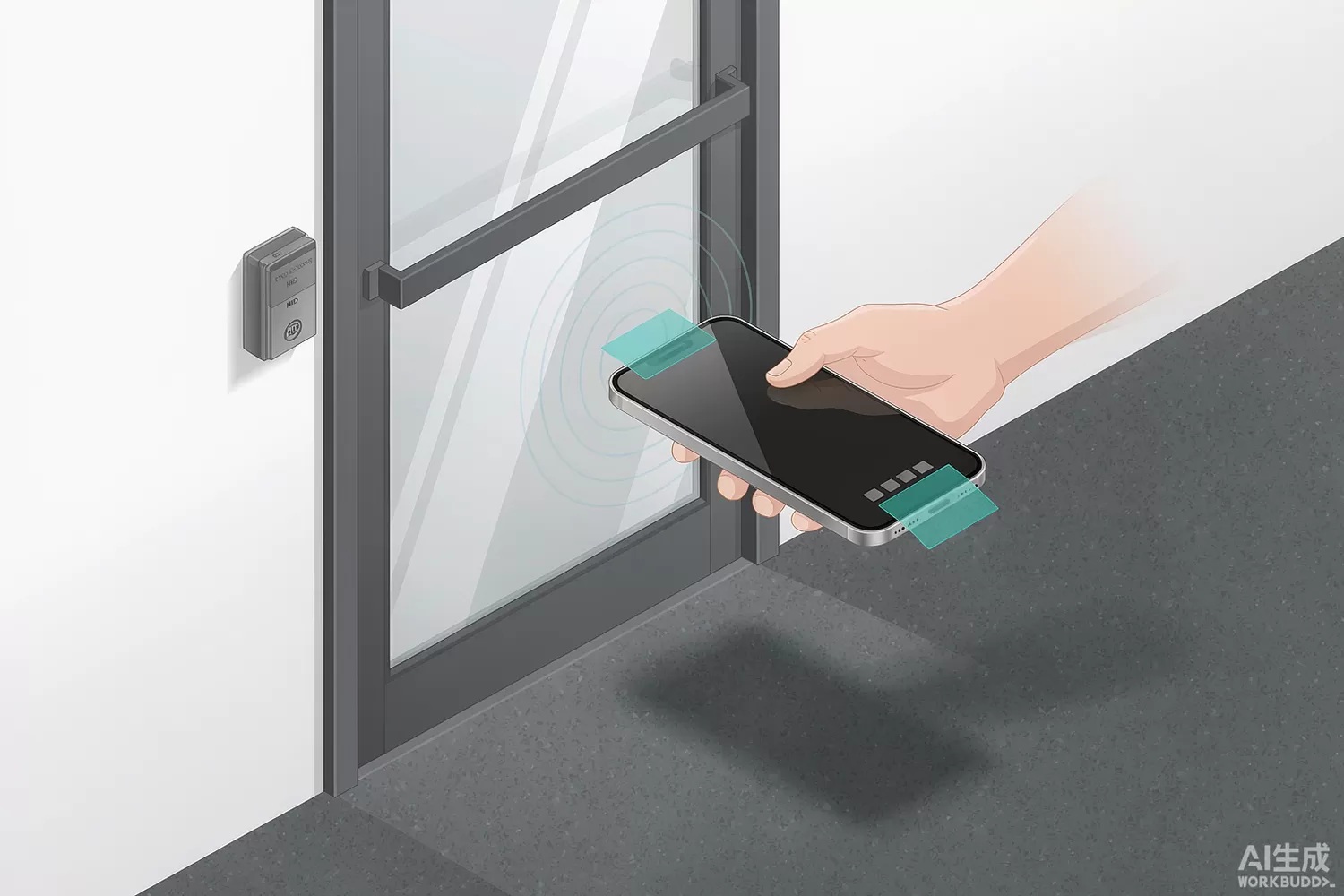
13.56 MHz contactless technology is one of the few RF categories that ordinary consumers use every day without thinking about it. The same physics — a reader generating an alternating magnetic field, and a passive tag harvesting power from that field to answer — underpins bank cards, transit tickets, building access, passports, industrial tool authentication and, increasingly, device pairing and charger identification. The chip market around it is mature, which makes it an unusually good place to examine how an imported incumbent and a domestic alternative actually compare.

Application logic: how a 13.56 MHz reader works
A reader IC drives an antenna coil through a matching network, typically with an EMC filter and a receive path that separates the tag's load-modulated answer from the carrier. The designer controls three things: the antenna geometry (which sets the read field and the read volume), the matching and filter network (which sets output power, harmonic emissions and receive sensitivity), and the protocol layer (ISO/IEC 14443 A/B for cards, ISO/IEC 15693 for vicinity tags, ISO/IEC 18092 for peer-to-peer, and proprietary schemes for some industrial tags).
The hard engineering constraints are less about the silicon and more about the field. A reader must deliver a minimum field strength at a specified distance — for example, the operating volume requirements in payment specifications — while keeping spurious emissions below the regulatory limits of the target market. Antenna detuning from metal, from the user's hand, or from a nearby second antenna can silently reduce read range, so reader products need measurement, not calculation, to close. Power budget and thermal design also matter in handhelds, and the host interface (SPI, I²C, UART or an internal host controller) determines how much firmware sits on top of the chip. Our RFID and RF energy-harvesting article covers the passive-power side of this problem in more detail.
New technology in 13.56 MHz readers
- Higher integration: today's reader ICs combine the transceiver, the protocol engine, a host interface and often a general-purpose MCU, removing a discrete host chip.
- Dynamic power control: automatic adjustment of driver strength and field strength to meet both read-range and emissions requirements with one hardware design.
- Multi-protocol stacks in silicon: support for several card standards in a single part reduces the firmware burden for multi-application readers.
- Smaller, thinner antennas with better metal tolerance, driven by phone-adjacent and accessory products.
- Card-emulation and peer-to-peer modes: reader ICs increasingly act as tags themselves, which enables phone-to-device pairing without a second chip.
- Energy harvesting: reader ICs can take power from an external field, which supports battery-less sensor tags and passive access tokens.
Domestic alternatives: what to analyse before switching
- Confirm protocol support and certification path: which standards the part implements in hardware, and which approvals the vendor can document.
- Compare the receive path carefully — minimum field strength, receiver sensitivity and the ability to decode weak load modulation at the maximum operating distance.
- Check the transmitter driver capability and the number of external matching components: fewer externals means a cheaper board, but often less tuning freedom.
- Review antenna reference designs and measurement support, since this is where most schedule risk sits.
- Assess security features if the reader handles payment or credentials: secure key storage, hardware cryptographic engines and tamper response.
- Validate the host interface and firmware ecosystem against your host processor and language preference.
Indicative cost comparison: imported originals vs domestic candidates
Price figures below are indicative public-market reference ranges for moderate volumes, compiled from publicly observable listings. They fluctuate with the spot market, package option, reel size and order quantity, and must not be read as a quotation. Ask us for a firm price on your exact part numbers and quantities.
| Device class | Common imported reference | Indicative imported unit price | Commonly referenced domestic candidate | Indicative domestic unit price |
|---|---|---|---|---|
| 13.56 MHz reader IC, SPI/UART front end | NXP PN532-class; ST ST25R3911B-class | USD 2.0–4.5 | Fudan Microelectronics FM17xx-class (e.g. FM17550); Nations NZ3801 | USD 0.6–1.6 |
| Reader IC with integrated host MCU | NXP PN7462-class | USD 4.0–9.0 | Domestic reader SoCs with integrated controller | USD 1.5–3.8 |
| Payment-grade reader front end with secure element | Imported payment-class front end plus secure element | USD 5.0–11.0 | Domestic payment-oriented front ends plus certified secure element | USD 2.5–6.0 |
| Reader module (antenna + IC + controller) | Imported certified module | USD 12–28 | Domestic module with reference antenna | USD 5–13 |
The unit-cost saving on a domestic reader front end is typically 55–70 percent, and because these parts are already ubiquitous in Chinese access-control and transport products, supply is broad. The place where the imported incumbent still earns its premium is payment and identity applications, where the approvals, secure-element interfaces and long documentation history are part of what you are buying. If your product is an access lock, a consumable-authentication reader or a configuration interface, the domestic route is usually straightforward; if it is a certified payment terminal, plan the approval work explicitly.
Commonly referenced alternative models
| Imported original (reference) | Domestic candidate (public sources) | Why it is referenced |
|---|---|---|
| NXP PN532 — widely used 13.56 MHz reader IC | Fudan Microelectronics FM17xx family (e.g. FM1702SL, FM17550) | Long-established domestic reader family for access control, transit and industrial readers; confirm interface and protocol coverage for your firmware. |
| NXP PN5180 / PN7462 — high-performance and integrated readers | Nations Technology NZ3801 / NZ3802-class reader ICs | Domestic NFC reader front ends with published protocol support; compare driver capability and receiver sensitivity. |
| ST ST25R3916 / ST25R3911B — automotive and industrial readers | Domestic reader ICs plus discrete matching networks | Substitution is feasible for non-payment readers; automotive-grade variants must be qualified separately. |
Model naming in this category spans many package and protocol variants, and domestic families are usually positioned as series rather than single part numbers. We list the family and the commonly used members, and will confirm the exact orderable code, protocol set and interface for your design when you send us a requirement.
Validation checklist
- Measured field strength and read distance across the intended operating volume, at temperature extremes.
- Spurious emissions and carrier harmonics against the regulatory limits of every target market.
- Antenna detuning tests with the final enclosure, metal parts and the user's hand in the field.
- Read/write reliability with the exact card and tag types your customers use, plus a sample of aged cards.
- Host interface throughput and firmware loading verified on your actual host processor.
- Security-function review if credentials or payments are involved, including key-injection and tamper behaviour.
Related reading on our blog
RFID and RF energy harvesting · RF switches and relays compared · Insertion-loss budget and link margin
Frequently asked questions
Why is NFC suddenly interesting again outside payments?
Because the installed base of phones with NFC is now effectively universal, so tapping is a zero-friction user interface. Access control, device pairing, consumable authentication, EV charger identification and industrial configuration all use the same 13.56 MHz reader technology that payment terminals use.
Do domestic NFC reader chips exist for payment-grade designs?
There is a real domestic supply base for 13.56 MHz reader front ends, and Chinese design houses have long supplied access control and transport-card readers. For payment-terminal work, EMVCo approvals and the certification dossier are the gating items, so confirm the approval evidence for the exact part and library before design-in.
What is the hardest part of an NFC reader design?
Almost always the antenna and the field strength. Reader antennas must deliver a defined field to the card at a defined distance while passing emissions limits, in a product whose enclosure is often metal-backed. Budget real time for antenna tuning and measurement.
Can you supply both imported and domestic NFC front ends?
Yes. We quote imported reader ICs and the domestically produced alternatives, plus the matching components around them. Send the target part number, interface type and volume and we will respond with a firm offer.
About us & trademarks: JTDZ Tech (Shenzhen Jingteng Electronics Technology Co., Ltd.) is an independent distributor of electronic components. We are not an authorised distributor or representative of any manufacturer named in this article. Manufacturer, brand and part names are used for identification purposes only; all trademarks remain the property of their respective owners. Cross-reference information in this article is based on publicly available sources, is subject to change, and is not a substitute for your own engineering validation. Always verify specifications against the manufacturer's datasheet before design-in or purchase.
