
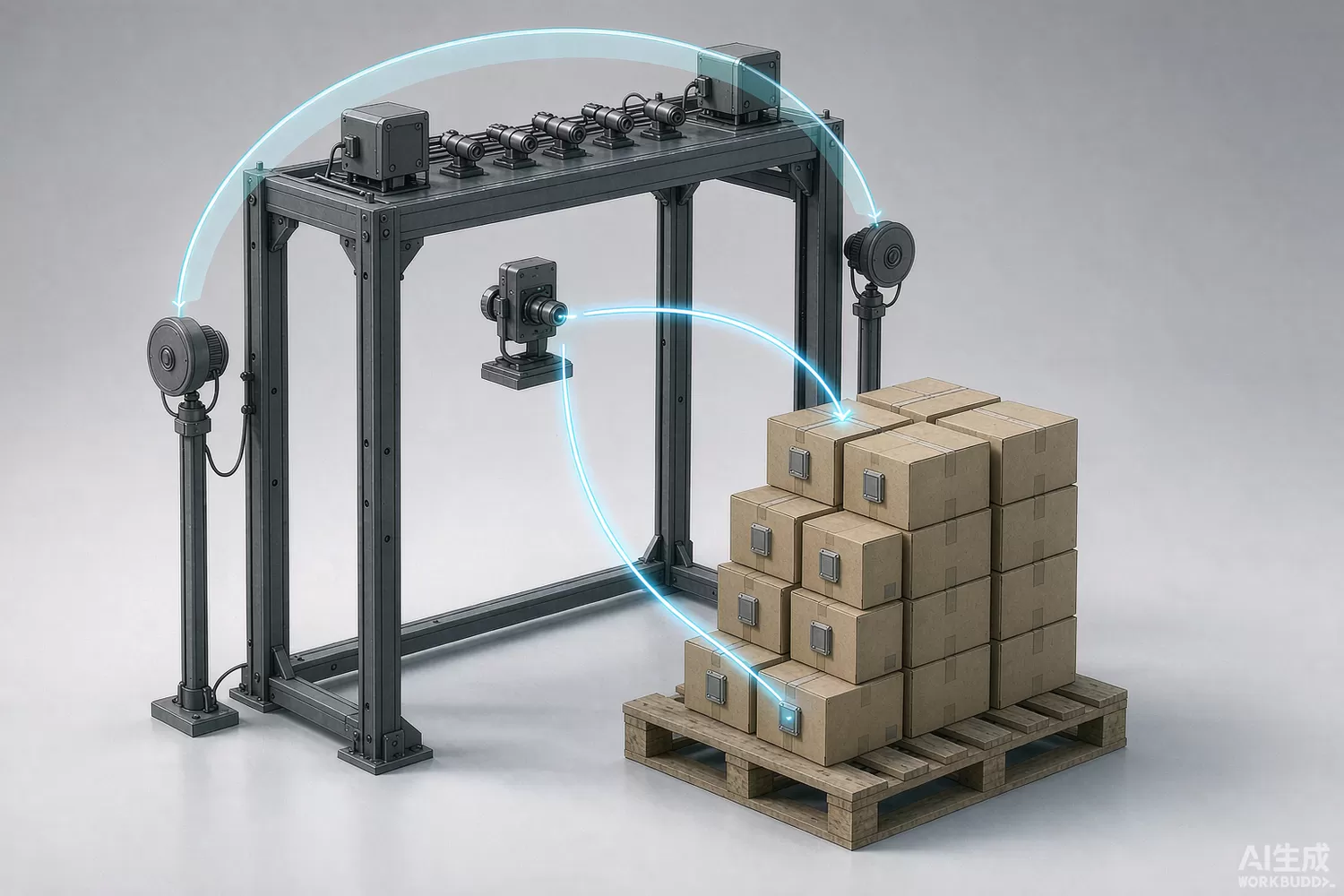
UHF RFID is the quiet workhorse of supply chains: tens of billions of passive inlays are produced every year for retail apparel, logistics, aviation baggage, industrial tools and vehicle identification. Functionally the technology is simple — a reader radiates power, a passive tag harvests it, and the tag answers by modulating its own reflection — but the engineering and the economics of the chip inside the inlay are surprisingly subtle. This is also a category where domestic silicon has taken a substantial share of the global market.

Application logic: how a passive UHF RFID link works
The tag chip performs two jobs at once. It rectifies the incoming carrier to power itself, and it modulates its input impedance to reflect a coded answer back to the reader — a scheme called backscatter. The chip's read sensitivity (the minimum RF power at which it wakes and decodes) is the single most important number for range, because the tag must operate at the far end of a round trip with a very small harvested power. Around that core, the designer must reconcile the tag antenna geometry with the material being tagged: a dipole in free air, a folded dipole for a carton, a small loop for a metal surface. Metal and liquids detune the antenna, which is why specialty tags exist.
On the reader side, the chain is a power amplifier, a circulator or directional coupler, a receive path with strong filtering to reject the reader's own carrier, and a protocol engine implementing the air interface and the inventory and access commands. Dense-reader environments require frequency hopping and listen-before-talk behaviour, since readers that talk over each other lose tags. Regulatory limits differ between regions — power, band edges, channel plans — so a globally sold reader needs configurable power and channel tables.
New technology in UHF RFID
- Higher-sensitivity chips: newer tag ICs wake at weaker fields, which extends range without increasing reader power.
- Larger user memory and sensor interfaces: chips now carry additional memory blocks and can accept inputs from external sensors for cold-chain and condition monitoring.
- Anti-counterfeit and authentication features: cryptographic or challenge-response schemes inside the tag chip address product authentication and grey-market control.
- Smaller die and thinner inlays: reduced silicon area per chip enables the ultra-low price points that retail programmes require.
- Reader-side integration: reader ICs integrate the protocol engine, filtering and more of the analogue chain, which simplifies portal and handheld designs.
- RAIN and retail standard alignment: chip vendors track the air-interface and data-model specifications that retail programmes mandate.
Domestic alternatives: what to analyse before switching
- Compare read and write sensitivity, and the sensitivity difference between reading and writing, since write range is always shorter.
- Check memory organisation: EPC length, user memory size, lock and kill behaviour, and whether the data model your programme requires is supported.
- Confirm the retention and endurance figures, and ask for reliability data rather than relying on the datasheet headline.
- Evaluate the chip in the actual inlay design from your converter — the chip and the antenna are a matched pair.
- Verify regional compliance handling and reader firmware compatibility with the reader platform you use.
- Assess anti-counterfeit feature support if the application needs authentication, and confirm application-level support from the vendor.
Indicative cost comparison: imported originals vs domestic candidates
Price figures below are indicative public-market reference ranges for moderate volumes, compiled from publicly observable listings. They fluctuate with the spot market, package option, reel size and order quantity, and must not be read as a quotation. Ask us for a firm price on your exact part numbers and quantities.
| Device class | Common imported reference | Indicative imported unit price | Commonly referenced domestic candidate | Indicative domestic unit price |
|---|---|---|---|---|
| Passive UHF tag chip (retail class) | Impinj Monza R6/R7-class; NXP UCODE 8/9-class; EM Microelectronic parts | USD 0.028–0.085 | Kilmallock KX2005X-class and comparable domestic tag ICs | USD 0.014–0.045 |
| Tag chip with extended user memory | Impinj M7xx-class; NXP UCODE DNA-class | USD 0.06–0.20 | Domestic extended-memory and sensor-ready tag ICs | USD 0.03–0.11 |
| UHF reader front-end IC | Impinj Indy R2000/R500-class; NXP reader platforms | USD 6–18 | Domestic reader front ends (series-level, vendor-dependent) | USD 3–9 |
| Portal or handheld reader (module level) | Imported reader module with certified firmware | USD 90–320 | Domestic reader module | USD 45–170 |
Per-chip figures look tiny, but tag ICs are bought in hundreds of millions and the difference of one cent per tag is enormous at programme scale: a domestic tag chip typically lands 40–55 percent below the imported reference, which on a 50-million-unit programme is a seven-figure sum. The tension is that retail and logistics programmes often specify an approved inlay list, so the chip must be qualified inside the inlay your converter sells — a commercial process, not only a technical one. For reader front ends, the saving is larger in absolute terms and the switching effort is mostly firmware and RF filtering work.
Commonly referenced alternative models
| Imported original (reference) | Domestic candidate (public sources) | Why it is referenced |
|---|---|---|
| Impinj Monza R6 / R7 — retail-grade passive tag chip | Kilmallock KX2005X-class UHF tag ICs | Domestic tag silicon with comparable sensitivity and memory organisation; verify inlay-level qualification with your converter. |
| NXP UCODE 8 / UCODE 9 — industry-standard tag families | Domestic UHF tag IC families with matched EPC memory layouts | Widely used in logistics and industrial tagging; check the data-model and locking behaviour your customer requires. |
| Impinj Indy R2000 / R500 — reader front-end ICs | Domestic UHF reader front-end platforms (series-level; part numbers vary by vendor) | Reader silicon cost reduction; verify dense-reader mode, channel plan configurability and firmware support. |
| EM Microelectronic / Atmel legacy tag ICs | Domestic tag ICs with equivalent memory maps | Legacy replacement for maintenance builds where the system software already expects a known memory layout. |
Because much of the domestic tag-chip market is sold directly into inlay converters rather than through distribution, public part-number documentation is thinner than for other categories. We therefore name families where that is all that public sources support, and confirm exact orderable codes, sensitivities and memory options against a vendor quotation before you commit a programme. That is also the point at which we can supply samples for inlay trials.
Validation checklist
- Read and write range measured on the real item, in the real orientation, inside the real reader environment.
- Multi-tag inventory performance and singulation in a dense population.
- Tag survival through the printing, converting and application processes used in your supply chain.
- Retention and endurance verification through your own qualification cycle.
- Compliance with the reader and air-interface standards your customer's programme requires.
- Inlay-supplier qualification and second-source plan at both chip and inlay level.
Related reading on our blog
RFID and RF energy harvesting · Low-noise amplifiers and receiver sensitivity · RF mixers and frequency conversion
Frequently asked questions
How is UHF RFID different from NFC for asset tracking?
UHF systems read at metres rather than centimetres and can identify hundreds of tags in the field at once, which is what makes them dominant in retail inventory, logistics, apparel and industrial asset tracking. NFC is a tap interaction for a single item.
What decides the read range of a passive UHF tag?
The tag chip's sensitivity and the antenna's gain and size, balanced against the reader's effective radiated power, the frequency band and the environment. Metal and water detune and absorb, so the tag choice is inseparable from what it is attached to.
Is a domestic UHF tag chip good enough for retail compliance?
Many domestic tag chips are used in retail and logistics programmes, and the functional requirements are the same as the imported parts. The decisive items are memory layout (EPC and user memory), read sensitivity, reliability of the write cycle, and whether the inlay supplier has already qualified that chip in their product.
Do you source UHF reader ICs and RF front-end parts too?
Yes. We quote reader front-end ICs, the power amplifiers, circulators, switches and filters that sit around them, and the passive matching components. If you are building a reader or a portal, send us the block diagram.
About us & trademarks: JTDZ Tech (Shenzhen Jingteng Electronics Technology Co., Ltd.) is an independent distributor of electronic components. We are not an authorised distributor or representative of any manufacturer named in this article. Manufacturer, brand and part names are used for identification purposes only; all trademarks remain the property of their respective owners. Cross-reference information in this article is based on publicly available sources, is subject to change, and is not a substitute for your own engineering validation. Always verify specifications against the manufacturer's datasheet before design-in or purchase.
