
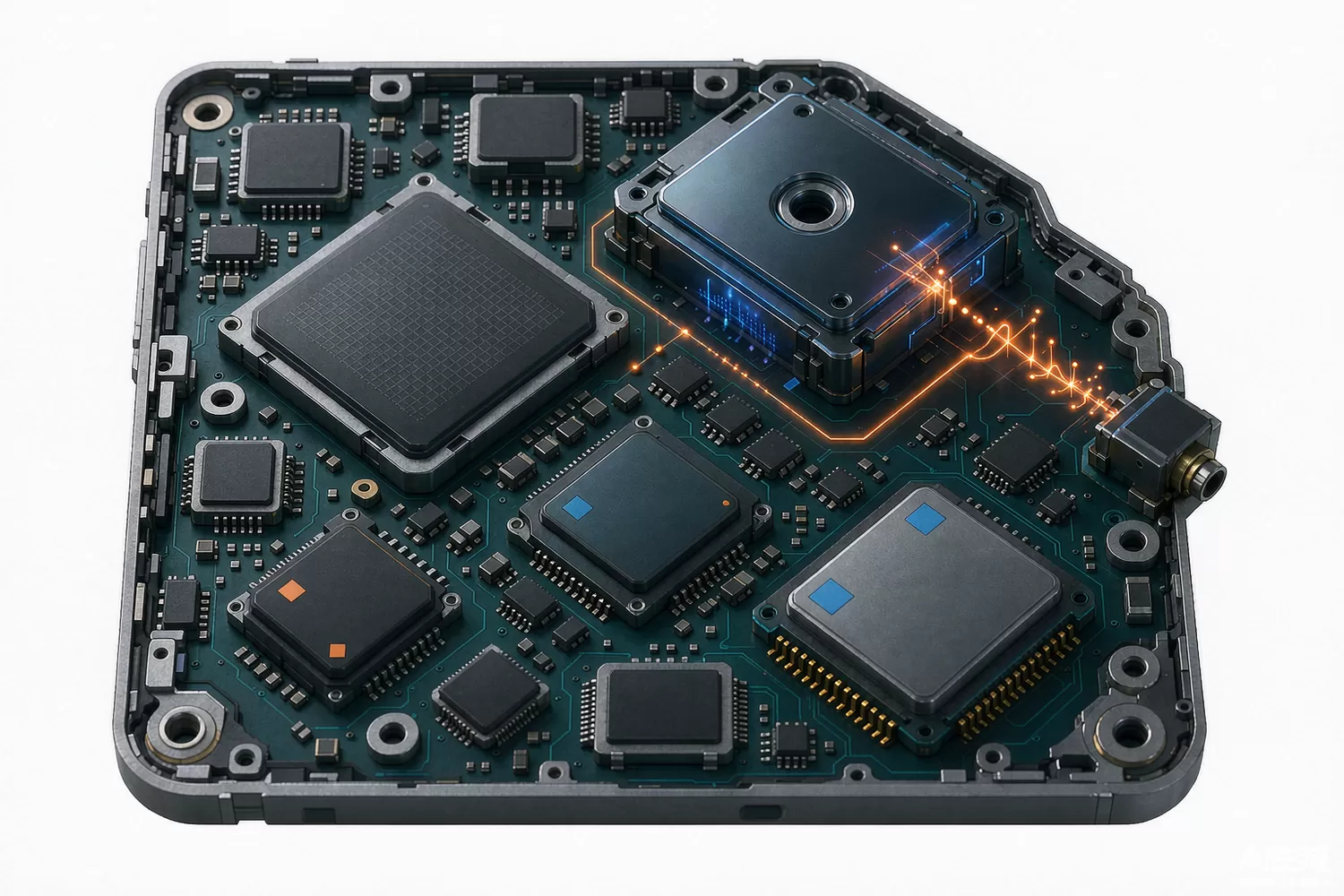
Radio-frequency power amplifiers are the components that make wireless communication physically possible, and the market they serve is stratified by power level and application. At one end, handset PAs and PAMiD modules operate at a few watts into a hostile thermal and space budget. At the other, small-cell and base-station amplifiers deliver tens of watts with the linearity that digital pre-distortion requires. In between sit Wi-Fi front ends, IoT transmitters and industrial radios. This article deals with the cellular PA and PAMiD layer, where the imported incumbents — Skyworks, Qorvo, Broadcom and Murata — have long set the benchmark and where Chinese vendors have moved from follower to volume supplier.

Application logic: what an RF power amplifier must do
A PA takes a small modulated signal and delivers it at power into a 50-ohm system without distorting the modulation. Four specifications drive the design. Output power at a defined error-vector-magnitude limit sets the usable headroom. Efficiency at the signal's average power, not at saturation, sets battery life and heat. Linearity — adjacent-channel leakage and harmonic levels — sets whether the product passes regulatory and operator requirements. Ruggedness under load mismatch sets field-failure rates, because antennas in the real world are not 50 ohms.
Inside a phone front end, the PA works with a power-management or envelope-tracking supply, a coupler for closed-loop power control, and a duplexer whose loss directly subtracts from transmit power and adds to receive noise figure. That is why PAMiD integration became popular: putting the amplifiers and duplexers in one module removes a series of 50-ohm interfaces, each of which would have cost insertion loss. Front-end architectures and switch choices are covered in our RF front-end building blocks article, and a concrete device-level design example sits in our RFPA5201 cellular PA design guide.
New technology in cellular PAs
- Envelope tracking and average power tracking: supplies that follow the signal envelope reclaim efficiency that fixed-supply designs throw away.
- GaAs HBT and CMOS-plus-GaAs hybrids: process mixes that trade bias complexity for efficiency at low cost.
- Reconfigurable PA architectures: tunable matching taps that let one amplifier chain cover multiple bands, reducing die count per phone.
- Module-level integration: PAMiD and L-PAMiD modules that fold duplexers, switches and couplers into one package.
- Better thermal paths: flip-chip and copper-pillar packaging that moves heat out of ever-thinner handsets.
- Advanced digital pre-distortion for infrastructure: algorithmic linearisation that lets devices run closer to saturation.
Domestic alternatives: what to analyse before switching
- Match the band plan exactly: supported bands, bandwidth per band and the aggregation combinations your product must handle.
- Compare efficiency at your real average output power, not at the datasheet's saturation point.
- Check the module pin-out and control interface — even for the same functional block, control signalling and MIPI or GPIO schemes differ.
- Review the duplexer and filter performance inside a module: receive-band noise and out-of-band rejection decide coexistence behaviour.
- Ask for thermal data in your package and stack-up, and for reliability data on the same product family.
- Confirm supply and lifecycle: several domestic families are positioned as cost-optimised, so confirm they will still be available across your product's life.
Indicative cost comparison: imported originals vs domestic candidates
Price figures below are indicative public-market reference ranges for moderate volumes, compiled from publicly observable listings. They fluctuate with the spot market, package option, reel size and order quantity, and must not be read as a quotation. Ask us for a firm price on your exact part numbers and quantities.
| Device class | Common imported reference | Indicative imported unit price | Commonly referenced domestic candidate | Indicative domestic unit price |
|---|---|---|---|---|
| 5G NR PA module (L-PAMiD, multi-band) | Skyworks SKY77xxx-class; Qorvo QM77xxx-class; Murata modules | USD 3.5–8.5 | Vanchip (Vanchip Technology) and Smarter Micro-class 5G PA modules | USD 1.6–4.0 |
| 4G/LTE PA module with duplexers | Broadcom AFEM-82xx-class; Qorvo multi-band modules | USD 2.0–5.0 | Domestic LTE PA modules from Vanchip, Smarter Micro, Lansus | USD 0.9–2.4 |
| Mid-power RF PA device (small cell, IoT, radio) | Qorvo and Skyworks discrete PA devices; RFMD heritage parts | USD 4–18 | Domestic GaAs PA devices (series-level; part numbers vary) | USD 1.8–8 |
| Discrete RF gain block / driver amplifier | Qorvo SGA/SZM-class gain blocks; Avago MGA-class | USD 1.5–6 | Domestic RF gain blocks and drivers | USD 0.7–2.8 |
The economics of handset PAs are dominated by volume and by module content. A domestically produced 5G PA module typically prices 50–60 percent below the imported equivalent, and because the module carries the duplexers and switches, the saving is multiplied across the front end. What still commands a premium on the imported side is deep integration for unusual band combinations, extensive reference designs for new platform bring-up, and documented field reliability across many phone generations. For mainstream band plans and volume consumer products, the domestic option is now a normal engineering choice rather than a compromise.
Commonly referenced alternative models
| Imported original (reference) | Domestic candidate (public sources) | Why it is referenced |
|---|---|---|
| Qorvo SZM-3166Z-class and Qorvo 5G PA modules | Vanchip 5G PA modules; Smarter Micro reconfigurable PA modules | Domestic PA vendors supply mainstream 5G band combinations at materially lower module cost; compare efficiency at average power and duplexer performance. |
| Skyworks SKY77xxx-class PA modules | Vanchip and Lansus LTE/5G PA families | Equivalent functional position in the transmit chain; band coverage and control interface must be re-verified. |
| Avago/Broadcom MGA-43xxx-class RF power amplifiers | Domestic mid-power RF PA devices and gain blocks | Viable for small cells, industrial radios and test setups; gain, P1dB and thermal derating are the comparison points. |
| RFMD/Qorvo RFPA5201-class cellular PA | Domestic 4G PA modules and discrete drivers | Long-lived reference part in many designs; the substitution is usually a board-level redesign rather than a part swap. |
We stock and quote the imported PA families used in existing designs — for example Qorvo SZM-3166Z RF power amplifier, Qorvo AH225-S8G RF power amplifier, Avago MGA-43828 RF power amplifier and RFMD/Qorvo RFPA5201 cellular PA — which is often exactly what a customer needs mid-life. Where a domestic module is the better long-term answer we will say so, and quote both so the decision can be made on numbers.
Validation checklist
- Output power and EVM across the whole operating band and temperature range, under real modulation.
- Efficiency at the actual average power profile of the application, including supply-tracking behaviour.
- Harmonic and spurious emissions against regulatory limits after the duplexer and antenna.
- Ruggedness under load mismatch, including antenna-present and antenna-absent conditions.
- Thermal performance in the finished product, not on an evaluation board.
- Reliability and lifecycle documentation matched to your product's warranty period.
Related reading on our blog
RFPA5201 cellular power amplifier design guide · Power amplifier compression and the cost of 1 dB · Smartphone RF front-end modules
Frequently asked questions
Why are phone power amplifiers still expensive when everything else got cheap?
Because efficiency at high peak-to-average power ratios is genuinely hard. A 5G signal spends most of its time well below peak power, so average efficiency — not saturation power — decides battery life and heat. Achieving that with linearity margins on GaAs and CMOS processes keeps the chip complex and the packaging specialised.
What does PAMiD mean in practice?
It stands for power amplifier module with integrated duplexers. The module bundles the amplifiers, the duplexers and often the switches and couplers for one or more bands, which shrinks the front end and pushes the matching problem into the module. The trade-off is that a module locks you to a band plan.
Are domestic PA vendors credible for 5G designs?
Yes for mainstream band combinations and volume consumer products — domestic vendors supply a large share of the global handset market. For specialised or highly integrated sockets, engineering support depth and design-history documentation are the differentiators to check.
What about base-station and small-cell power amplifiers?
That market is different: efficiency, thermal density and linearity under digital pre-distortion dominate, and GaN-on-SiC and LDMOS devices compete rather than handset PAs. We cover the device-level side of that separately in the RF power transistor discussion below.
About us & trademarks: JTDZ Tech (Shenzhen Jingteng Electronics Technology Co., Ltd.) is an independent distributor of electronic components. We are not an authorised distributor or representative of any manufacturer named in this article. Manufacturer, brand and part names are used for identification purposes only; all trademarks remain the property of their respective owners. Cross-reference information in this article is based on publicly available sources, is subject to change, and is not a substitute for your own engineering validation. Always verify specifications against the manufacturer's datasheet before design-in or purchase.
