
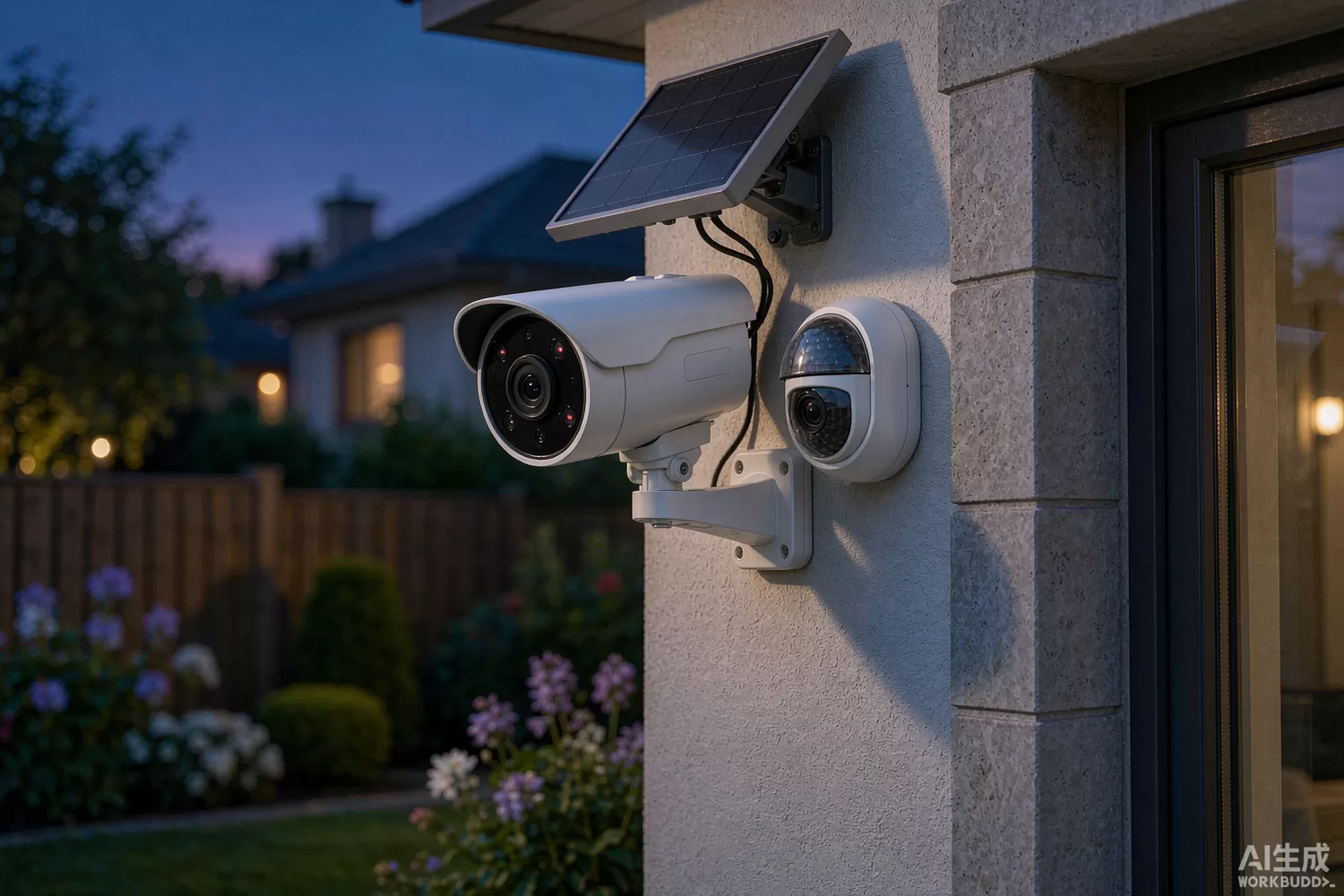
A mains-powered security camera is a video product. A battery-powered one is an energy product that happens to make video. The difference is not a bigger battery: it is a design discipline in which every millisecond of boot time, every decibel of receiver sensitivity and every microamp of standby current is traded against the promise printed on the box. Get the wake chain wrong and the camera misses the visitor; get the standby budget wrong and the customer recharges it every three weeks. This article walks the energy path of a battery camera from passive-infrared trigger to cloud clip, explains which radio and SoC parameters actually govern that path, and screens domestic camera SoCs against the imported parts used in premium models. For the Wi-Fi front-end side of the same product, see our Wi-Fi FEM article.

Application logic: the product is a duty cycle
Almost all of a battery camera’s life is spent asleep with the radio off. The product experience is defined by the short windows when it is awake:
- Sleep — the SoC is in its deepest state, the image sensor is powered down, and only a PIR detector, a real-time clock and a few microamps of leakage remain. Target figures are 15 to 40 microamps for the whole board, including the regulator’s quiescent draw.
- Trigger — the PIR asserts, a low-power domain wakes the application processor and restores the sensor. This stage is dominated by regulator startup and PLL lock, not by the CPU.
- Boot and authenticate — firmware is verified from flash, the sensor is configured and the encoder pipeline is set up. Secure boot costs time; skipping it costs credibility.
- Associate and handshake — the Wi-Fi station scans, authenticates, associates, runs DHCP and TLS, then opens the cloud session. In practice this is the longest and most variable stage, and the one buyers never see in a datasheet.
- Capture and stream — the clip is encoded and pushed. Peak current here is hundreds of milliamps; the art is keeping the burst short and the resolution honest.
- Return to sleep — flushing flash, closing sockets and powering down cleanly. A camera that leaks current after streaming fails the six-month promise even if every other stage is perfect.
The parameters that decide whether the battery promise holds
- Standby current, measured on the board — not the SoC datasheet number. Regulators, level shifters, pull-ups and the PIR module all contribute; a 3 microamp regulator with a 1 microamp load is still a 4 microamp floor.
- Wake-to-first-frame time — the interval from PIR assertion to the first encoded frame decides whether the clip includes the event or starts after it. Under 500 ms is a realistic target; under 300 ms is premium.
- Wi-Fi association time and sensitivity — a camera at the far end of a garden needs both. Fast scanning with a stored channel list and a receiver that holds −95 dBm or better matters more than peak throughput.
- Encoder efficiency — H.265 at a given quality costs roughly half the bitrate of H.264, which halves the radio-on time, which is where most of the energy goes. The encoder choice is an energy decision, not a video decision.
- ISP low-light behaviour — longer exposure with IR illumination reduces noise but lengthens the frame time; the ISP’s noise reduction and its ability to run at low frame rates without artefacts decide whether night clips are usable.
- PSRAM bandwidth and size — a 2K or 4MP pipeline needs a frame buffer, and PSRAM refresh current is part of the standby budget if it is not powered down properly.
What is changing: resolution, on-device detection and solar top-ups
Four shifts are visible. First, 2K and 4MP became the default for battery products, which raised encoder and PSRAM pressure without raising the battery budget. Second, detection moved on-device: person and vehicle classification now runs on a small neural accelerator before the radio wakes, so the camera can skip clips that a PIR alone would have recorded. That trades a few milliwatts of compute for a large saving in radio-on time, and it is the single biggest practical improvement in battery life in recent designs. Third, solar top-up changed the energy equation: a 2 to 3 W panel can cover a camera’s daily budget in many climates, which relaxes the standby requirement but adds a charging path and a battery-management problem. Fourth, dual-band and sub-GHz options appeared for long-range installations, but neither is an automatic energy win: higher bands add path loss, lower bands add antenna size.
Domestic alternatives: suppliers and indicative cost
The imported anchors are Ambarella’s CV2x/CV5x-class vision SoCs and Novatek’s NT98xxx camera SoCs, both well supported for low-power IP cameras. Domestic supply is strong and, for this product class, mature: SigmaStar’s SSC-series camera SoCs, Fullhan’s FH88xx family and Ingenic’s T31 are all used in volume security products, with reference designs that include the Wi-Fi companion and the PIR wake path. For a lower-resolution, deeply cost-sensitive product, Espressif’s ESP32-S3 can carry a 1080p pipeline with an external sensor. The practical caveat is not silicon but tooling: an imported SoC usually arrives with a complete low-power reference design and a tuned wake chain, while a domestic SoC may need the regulator sequencing and PSRAM power gating engineered from scratch. Budget that work honestly, because it is the difference between a six-month battery life and a six-week one.
A realistic camera BOM: an Espressif ESP32-S3-WROOM-1-N16R8 for the Wi-Fi and 1080p pipeline in cost-focused models, an Artery AT32F421C8T7 as the always-on housekeeping and PIR controller, a COS29752WU for the sensor analog rail, a GD25Q64CSIG for firmware and clip buffering, and a TS2502PN on the USB charging port. Our ESP32-S3 module guide covers the module-level trade-offs.
Price figures below are indicative public-market reference ranges for moderate volumes, compiled from publicly observable listings. They fluctuate with the spot market, package option, grade (industrial, automotive, screened) and order quantity, and must not be read as a quotation. Ask us for a firm price on your exact part numbers and quantities.
| Function (imported anchor) | Example import part / class | Indicative import price (USD) | Domestic candidate | Indicative domestic price (USD) |
|---|---|---|---|---|
| 4MP low-power camera SoC | Ambarella CV25 class | 8.0 – 15.0 | SigmaStar SSC series / Fullhan FH88xx (family level) | 2.50 – 5.00 |
| 2K camera SoC | Novatek NT9852x class | 5.0 – 9.0 | Ingenic T31 class | 2.00 – 4.00 |
| 1080p Wi-Fi SoC with integrated radio | Imported Wi-Fi camera SoC | 3.5 – 7.0 | ESP32-S3-WROOM-1-N16R8 (Espressif) | 2.50 – 4.50 |
| Always-on housekeeping MCU | STM32L-class Cortex-M0+ | 0.80 – 2.00 | AT32F421C8T7 (Artery) | 0.25 – 0.70 |
| Sensor analog rail LDO | Imported low-noise LDO | 0.25 – 0.70 | COS29752WU (Cosine) | 0.06 – 0.20 |
| Firmware NOR flash | 64 Mbit serial NOR | 0.45 – 1.00 | GD25Q64CSIG (GigaDevice) | 0.14 – 0.40 |
| USB charging-port ESD | Imported TVS array | 0.15 – 0.45 | TS2502PN (Titan Micro) | 0.03 – 0.12 |
Where the cost difference actually comes from
The camera SoC is the single largest component in a battery camera, often 25 to 40 percent of the electronics BOM, so a domestic part changes unit economics far more than a cheaper LDO ever will. That is why domestic SoCs dominate the mid-market and why the imported parts hold on in premium models where low-light performance and a mature low-power reference design carry the price. The cost that is easy to miss is the battery itself: a design that draws 60 microamps in standby instead of 30 needs roughly double the cell for the same runtime, or makes half the claims. On a 5,000 mAh pack that difference is larger than the saving from any single chip. Evaluate the whole energy budget, not the component price list, and remember that field returns from a camera that dies in three weeks cost more than the entire BOM.
Validation flow before you commit
Build an energy log before you build a product: instrument the board and record current over 24 hours of realistic traffic, including a night with IR on and a day with twelve events. Compute the daily microamp-hour budget and compare it with the cell capacity and a 20 percent ageing margin. Then measure wake-to-first-frame with a stopwatch and a logic analyser, because this number is what customers experience. Test Wi-Fi at the worst realistic location, not next to the router, and confirm re-association after a router reboot. Finally, run a thermal test in sunlight, since a black housing in summer is a worse enemy of battery life than any firmware bug.
Frequently asked questions
How many megapixels can a battery camera afford?
Two to four megapixels is the practical range for a six-month battery life with a 5,000 to 10,000 mAh pack. Beyond that, encoder and PSRAM energy grows faster than the perceived image benefit.
Is on-device AI worth it in a battery camera?
Usually yes. Local person or vehicle classification prevents pointless wake-ups and uploads, and the radio-on time saved is far larger than the compute cost.
Why does Wake-on-LAN style triggering not work here?
Because the radio must be off to save energy. The trigger has to come from an always-on sensor and an always-on low-power domain, not from the network.
Can a domestic SoC match an imported one on night image quality?
Often in good light and with a decent sensor; the gap appears in extreme low light and in the tuning effort required. Ask for sample clips from your own scene before committing.
About us & trademarks: JTDZ Tech (Shenzhen Jingteng Electronics Technology Co., Ltd.) is an independent distributor of electronic components. We are not an authorised distributor or representative of the imported manufacturers named in this article. Manufacturer, brand and part names are used for identification purposes only; all trademarks remain the property of their respective owners. Cross-reference information in this article is based on publicly available sources, is subject to change, and is not a substitute for your own engineering validation. Always verify specifications against the manufacturer's datasheet before design-in or purchase.
