
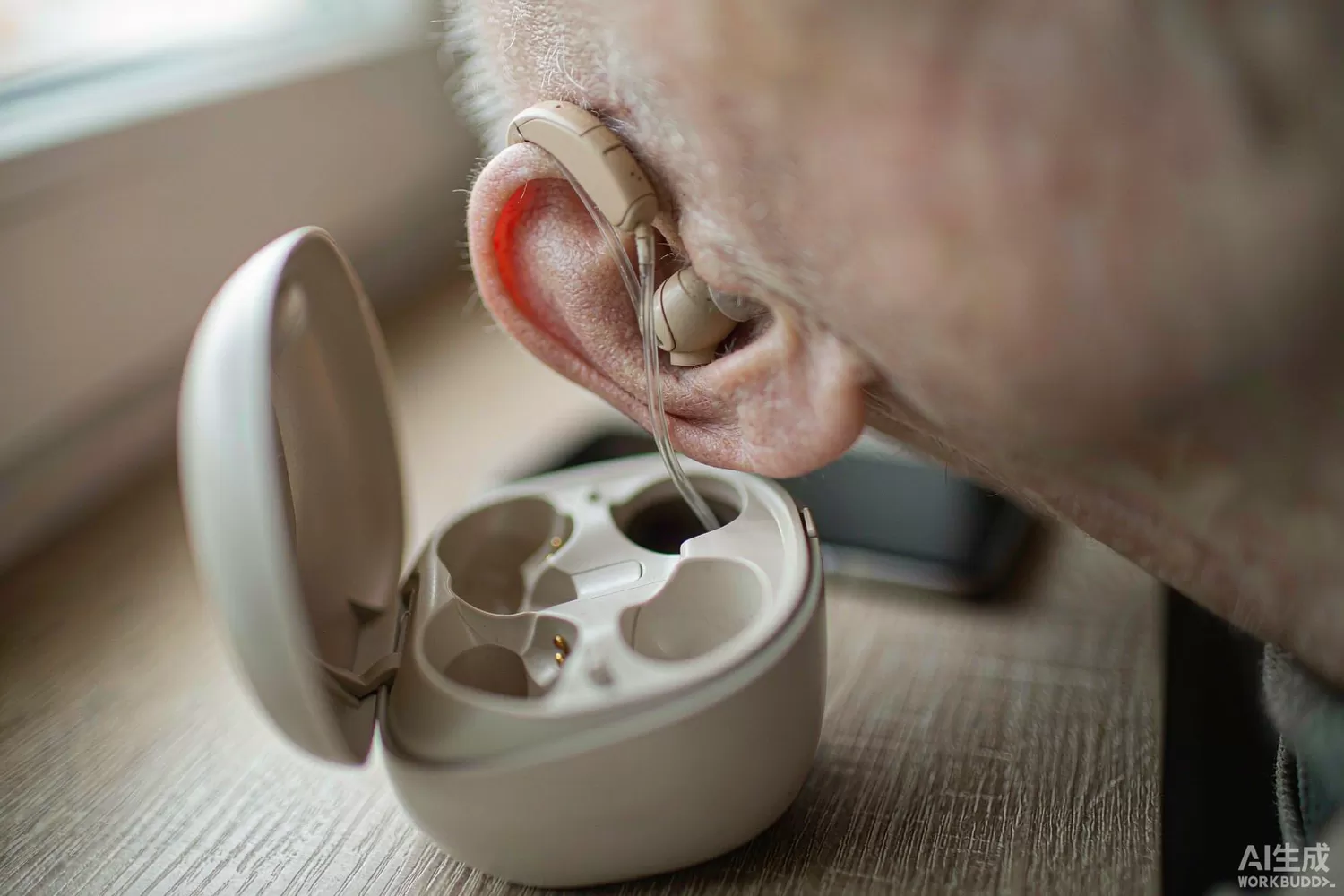
A modern hearing instrument contains two radios, two antennas, a digital signal processor that runs a feedback canceller, and a battery that must last a full day — all inside a shell smaller than the last joint of a finger. The radios are not interchangeable. One carries audio between the two ears at a latency short enough that the brain does not notice, the other carries a phone call or a television stream. Getting the split wrong produces a product that either sounds hollow or dies at four in the afternoon. This article explains how the two links are architected, what the newest LE Audio and Auracast workflows ask of the silicon, and where domestic parts can realistically enter a design that imported specialists have owned for two decades. For the generic Bluetooth side, see our low-power Bluetooth SoC article.

Application logic: two radios with two different jobs
- Ear-to-ear link — the two instruments exchange audio, control and gain state so that the pair behaves as one binaural system. This link must be short-range, robust through a head, and above all fast: a few milliseconds of differential latency is audible as a phase artefact.
- Near-field magnetic induction at about 10.6 MHz — the traditional answer. A coil in each instrument couples through the head by magnetic field, which does not care about the tissue absorption that plagues 2.4 GHz around a human head, and which stays inside the wearer rather than radiating into the room.
- Phone link at 2.4 GHz — Bluetooth, now increasingly LE Audio with the LC3 codec, carries calls, media and the fitting session. Power is the constraint: a radio that draws several milliamps cannot run from a zinc-air cell for a day.
- Audio routing policy — streaming to both ears simultaneously, relaying from one ear to the other, or mixing an assistive listening stream with the local microphone. Each policy has a different energy cost, and the product specification is really a statement about which policy runs most of the time.
- Fitting and control — a programming interface, volume and program changes from a phone, and increasingly over-the-air firmware updates. All of these need a link that can be opened without draining the battery and without interfering with the audio stream.
- Charging and the battery — rechargeable instruments spend the night in a case that also acts as a radio bridge; that dock is where the heavy data transfer happens, which is why rechargeable designs can afford richer features than zinc-air ones.
- Latency budget — the ear-to-ear path plus the local processing must stay below roughly five milliseconds, or the wearer hears their own voice with a delay and the fitting is rejected.
The parameters that decide whether the wearer keeps wearing it
- Link latency, not throughput — an ear-to-ear link carrying a 24 kilobit per second audio channel at 2 milliseconds is a harder engineering problem than one carrying 200 kilobits at 20 milliseconds. Frame length and codec delay, not the radio datasheet, set the number.
- Average current of the radio subsystem — measured in microamps across a day, including the listening windows, the wake-up radio and the coil driver. The coil driver is often the surprise: a magnetic link that is efficient in data terms can still dominate the energy budget.
- Magnetic antenna efficiency in a tiny shell — the coil has to fit around the battery and the receiver; its quality factor collapses next to metal. The link budget must be measured in the real shell, in a real ear, on a real head.
- Coexistence with the wearer — a head absorbs 2.4 GHz energy, so the phone link suffers body loss that a wrist-worn device never sees. Antenna placement and a modest external antenna in the case or the charger help more than raw transmit power.
- Audio quality under packet loss — LC3 and its concealment behave gracefully, but a link that retransmits aggressively burns energy. Configuring the codec for the loss rate you actually see is worth more than a stronger radio.
- Fitting range and security — pairing must be authenticated, fitting data must be protected, and the whole thing must work when the wearer is 90 years old and holds the phone at arm’s length.
- Mechanical and thermal — the shell is sealed, the battery is small, and there is no fan. Every milliwatt of dissipation becomes a temperature the wearer notices.
What is changing: LE Audio, Auracast and the docking bridge
The biggest shift is LE Audio. The LC3 codec delivers better quality at a lower bit rate than the legacy codecs, and its frame structure suits the short intervals a hearing instrument can afford. More importantly, Auracast broadcast turns the instrument into a receiver for an arbitrary transmitter — a television in an airport, a lecture hall loop, a cinema — which changes the product from a phone accessory into a public-infrastructure receiver. That has a direct radio consequence: the instrument must be able to discover and join a broadcast stream without a phone, which means the 2.4 GHz radio has to run a scanning mode that the older designs never budgeted for.
The second shift is the charger as a data bridge. Rechargeable instruments already sit in a case for eight hours; putting a radio in the case lets the pair do bulk transfers, firmware updates and diagnostics without touching the wearer's energy budget. The third is sensor fusion: motion sensors, in-ear detection and even photoplethysmography are appearing in premium instruments, and each one adds an interface that must be powered down completely when idle. The fourth, quieter shift is regulatory: over-the-counter instruments have widened the market and pushed cost targets down, which is precisely where domestic silicon becomes interesting.
Domestic alternatives: suppliers and indicative cost
Be honest about the segmentation. The hearing-instrument DSP with an integrated magnetic ear-to-ear link is a specialised market with a handful of imported suppliers and no broad domestic equivalent; a design team should not assume one exists. What domestic supply does cover well is everything around it: the 2.4 GHz Bluetooth SoC (Tailing Micro's TLSR series is widely used in audio and wearable products), the power path including chargers and low-quiescent regulators, the protection devices, and the flash and sensor interface. For a product that streams from a phone and uses a separate DSP for the audio core, a domestic Bluetooth SoC plus a domestic power chain is a realistic architecture today.
A practical bill of materials for the phone-facing side: a nRF52840 as the imported reference platform for comparison builds, with Tailing Micro class parts as the domestic candidate; a HX2001 for the always-on housekeeping rail; a COS29152WU as the low-dropout stage behind the charger where a 300 millivolt dropout still matters at end of discharge; a TS2502PN on the charging contacts, which the wearer touches every night; and an AT32F421C8T7 as a small housekeeping controller on the charger side. The supply-rail trade-offs are covered in our low-noise LDO article.
Price figures below are indicative public-market reference ranges for moderate volumes, compiled from publicly observable listings. They fluctuate with the spot market, package option, grade (industrial, automotive, screened) and order quantity, and must not be read as a quotation. Ask us for a firm price on your exact part numbers and quantities.
| Function (imported anchor) | Example import part / class | Indicative import price (USD) | Domestic candidate | Indicative domestic price (USD) |
|---|---|---|---|---|
| Hearing-instrument DSP with magnetic link | Imported hearing DSP class | 8.0 – 20.0 | No volume domestic equivalent identified | — |
| Bluetooth 5 LE SoC | Nordic nRF52 class | 2.0 – 4.0 | Tailing Micro TLSR series (family level) | 0.80 – 1.80 |
| Low-dropout regulator, 300 mV class | Micrel MIC29152 class | 0.50 – 1.20 | COS29152WU (Cosine) | 0.10 – 0.28 |
| Ultra-low quiescent LDO | Imported 1 uA-class LDO | 0.15 – 0.40 | HX2001 (Hexin) | 0.03 – 0.12 |
| Charging-contact ESD array | Imported TVS array | 0.15 – 0.45 | TS2502PN (Titan Micro) | 0.03 – 0.12 |
| Charger-side housekeeping MCU | STM32F0-class | 0.80 – 1.80 | AT32F421C8T7 (Artery) | 0.25 – 0.60 |
| Serial NOR flash for fitting data | 16 to 32 Mbit serial NOR | 0.35 – 0.80 | GD25Q32CSIG (GigaDevice) | 0.10 – 0.30 |
| Battery fuel gauge | Imported coulomb-counter class | 0.60 – 1.60 | Domestic gauge families (family level) | 0.20 – 0.55 |
Where the cost difference actually comes from
The cost structure of a hearing instrument is unusual: the DSP and its fitting software are the product, and the radio is a peripheral. A domestic bill of materials that halves the Bluetooth and power sections therefore moves the instrument price by a few percent, not by a third. What it does change is the entry price of an over-the-counter or assistive-listening product, where the DSP is simpler, the fitting is app-driven, and the whole business case depends on hitting a retail number. That is where domestic silicon wins first.
For premium instruments the calculus is different. The imported DSP's low-latency magnetic link, its audiological tooling and its long-term supply commitment are the reason it is chosen; no bill-of-materials saving compensates for a fitting that a dispenser cannot complete. The sensible strategy is a domestic platform for the charger, the accessories and the OTC tier, and a retained imported core in the premium tier until a domestic path is genuinely proven.
Validation flow before you commit
Measure the 2.4 GHz link with the instrument in a real ear on a real head, not on a bench: body loss is the single largest discrepancy between simulation and product. Measure the magnetic link with the coil inside the final shell, at the smallest battery size you intend to ship, and log the bit error rate against coil alignment, because the wearer will not hold their head still. Then run a full-day energy log with the real audio policy, including idle, streaming, a phone call and a fitting session, and compare the integrated charge against the cell capacity with a margin for ageing. Finally, test the audio path end to end for latency with a click stimulus and a two-channel recorder; if the ear-to-ear delay exceeds the budget, no codec setting will hide it.
Frequently asked questions
Why keep a magnetic ear-to-ear link when Bluetooth is available?
Because at 2.4 GHz the head absorbs energy and the link budget through a skull is poor, while a magnetic field at about 10.6 MHz couples through the head with far less loss and far less latency.
Can a generic Bluetooth SoC handle hearing-instrument audio?
It can handle the phone-facing link, but the ear-to-ear path, the audio core and the fitting stack are normally a specialised part; a generic SoC plus a separate DSP is the usual architecture.
What latency is acceptable between the two ears?
Roughly five milliseconds end to end including processing; beyond that the wearer hears their own voice with an audible delay and often rejects the fitting.
Does Auracast change the hardware?
It changes the usage more than the silicon: the instrument must be able to discover and join a broadcast stream without a phone, which adds a scanning mode and a new energy line to the budget.
About us & trademarks: JTDZ Tech (Shenzhen Jingteng Electronics Technology Co., Ltd.) is an independent distributor of electronic components. We are not an authorised distributor or representative of the imported manufacturers named in this article. Manufacturer, brand and part names are used for identification purposes only; all trademarks remain the property of their respective owners. Cross-reference information in this article is based on publicly available sources, is subject to change, and is not a substitute for your own engineering validation. Always verify specifications against the manufacturer's datasheet before design-in or purchase.
