
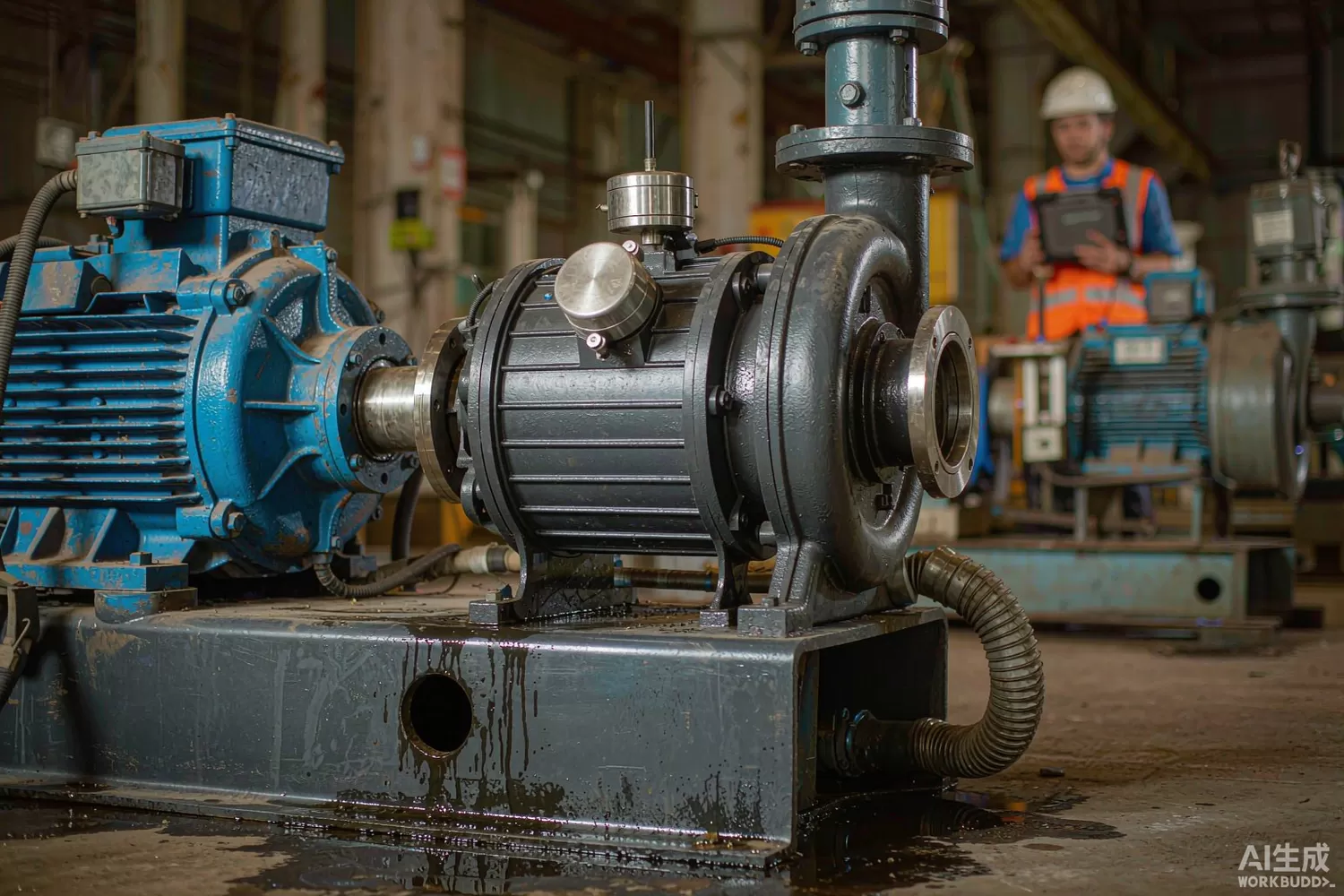
A pump that will fail in six weeks does not announce itself. It starts with a bearing defect that shows up as a small peak at a non-synchronous frequency, buried under a much larger shaft-rate component, detectable only if the measurement chain has enough dynamic range and enough bandwidth to see it. Predictive maintenance lives or dies on that margin. This article follows the signal from the accelerometer to the gateway in a battery-powered vibration node: the analog front end, the anti-alias filter, the feature extraction that makes a five-year battery possible, the radio scheduling, and the domestic parts that can carry most of the design. For the always-on rail that dominates the sleep current, see our standby current guide.

Application logic: the node is a measurement instrument with a radio attached
- What the sensor must capture — shaft imbalance at the running speed, bearing defect frequencies that typically sit between three and ten times running speed, gear mesh harmonics, and the high-frequency burst that a lubricated-but-degrading bearing produces. Covering all of it means a bandwidth from below 1 Hz to at least 10 kHz.
- Why bandwidth is not free — sampling at 25.6 kHz for 10 kHz of usable bandwidth costs power in the converter, in the digital filter and in the radio. The design decision is how much of the spectrum goes into the node and how much into the gateway.
- Two sensor technologies — a MEMS accelerometer with a digital output is small, cheap and low power but has a limited noise floor and a limited upper frequency; a piezoelectric IEPE sensor with a charge amplifier reaches higher frequencies and lower noise at the cost of an analog front end and more power.
- Feature extraction on the node — RMS, peak, crest factor, kurtosis, and the energy in a few defined bands. These are the numbers a trend engine actually uses, and they compress a second of waveform into a few dozen bytes.
- Triggering — measuring continuously is wasteful. Most nodes wake on a timer, take a short burst, compute features, compare against a threshold and only then send a waveform for diagnosis.
- Radio scheduling — a node that transmits once an hour can last five years on a lithium cell; one that streams waveforms cannot. The radio protocol therefore sets the battery life, and the analog design sets whether the data is worth transmitting.
- Time synchronisation — features from three axes and several machines only make sense if their timestamps are comparable, so the node needs a clock good enough to keep a few milliseconds of alignment across weeks.
- Installation reality — a magnet mount that detaches, a cable that work-hardens, and a sensor bolted to a painted surface with no flatness are the three most common causes of a node that reports nonsense.
The parameters that decide whether the feature is trustworthy
- Noise density — expressed in micrograms per root hertz, this sets the smallest defect you can trend. It matters most in the high-frequency band where bearing faults live and where a cheap sensor has almost no margin.
- Dynamic range and clipping — a node mounted on a resonant bracket sees far larger accelerations than the datasheet example. Clipping is not obvious in the feature values, which is why the node should report an overload flag alongside every measurement.
- Anti-alias filter order — a second-order filter at 12 kHz leaves enough energy folded back to fake a bearing peak. Digital filters inside the converter help, but the analog stage still has to do its part.
- Reference and supply rejection — a switching regulator on the same board injects its ripple into the measurement. Post-regulation with a quiet linear stage, or a converter with good supply rejection, is cheaper than a redesign.
- Temperature and drift — a machine surface at 80 degrees Celsius shifts the sensor bias and the charge-amplifier offset. Whatever you do not compensate becomes a false trend.
- Sleep current — the honest budget includes the sensor, the converter, the reference, the regulator quiescent draw and the radio’s listening window. A node specified at 5 microamps of sleep current is only achievable if every one of those is chosen for it.
- Radio robustness — a steel plant is a hostile place for 2.4 GHz. Sub-GHz links with a mesh or a star-of-stars topology usually win on range, while BLE wins on commissioning convenience.
What is changing: on-node machine learning, wideband captures and energy harvesting
Three shifts are visible. First, features moved into the node: a Cortex-M4 with a single-precision floating-point unit can run a 4096-point transform and a small classifier in a few milliseconds, which means the gateway receives a diagnosis rather than a waveform and the uplink shrinks by three orders of magnitude. Second, wideband capture became affordable: a 50 kHz-bandwidth MEMS sensor and a 24-bit converter now let a node look at the ultrasonic region where early bearing damage is visible, and that has moved the analog design problem from amplification to anti-aliasing. Third, energy harvesting is real but narrow: a vibration harvester on a machine running at constant speed can power a node, but the same node on an intermittent machine cannot, so most deployments still use a primary cell and treat harvesting as a range extender rather than a replacement.
A fourth shift is organisational. Maintenance platforms increasingly expect a node to present a self-test result and a calibration date, because a fleet of two thousand sensors cannot be visited individually. Designing that self-test into the front end — an injected reference signal, a measured noise floor — costs almost nothing at design time and saves the whole programme later.
Domestic alternatives: suppliers and indicative cost
The domestic picture is strong at the microcontroller and power level and improving at the sensor level. Artery's AT32L021 series offers a low-power Cortex-M4 with enough arithmetic for on-node transforms; domestic MEMS accelerometer families from suppliers such as MiraMEMS and QST cover the general industrial band, though for the highest-frequency, lowest-noise measurements the imported specialist sensors still hold an advantage that has to be verified against your own defect signatures rather than assumed. Radio options split between imported sub-GHz transceivers and domestic families such as the HOPERF CMT series, which are widely used in metering and industrial telemetry.
A realistic node: an Artery AT32L021C8T7 as the measurement and feature engine, a COS721SR low-noise amplifier for the charge-amplifier stage on IEPE variants, a COS8551TRC zero-drift stage for the sensor bias and reference buffering, an HX2001 post-regulator to keep switching ripple out of the measurement, a GD25Q32CSIG for local history so a gateway outage does not lose trend data, and a TS2502PN on the sensor connector and the antenna port. The charge-amplifier and transimpedance topology is covered in our transimpedance front-end article.
Price figures below are indicative public-market reference ranges for moderate volumes, compiled from publicly observable listings. They fluctuate with the spot market, package option, grade (industrial, automotive, screened) and order quantity, and must not be read as a quotation. Ask us for a firm price on your exact part numbers and quantities.
| Function (imported anchor) | Example import part / class | Indicative import price (USD) | Domestic candidate | Indicative domestic price (USD) |
|---|---|---|---|---|
| Low-power Cortex-M4 MCU with FPU | STM32L4-class | 2.5 – 5.0 | AT32L021C8T7 (Artery) | 0.70 – 1.60 |
| MEMS accelerometer, industrial grade | ADI ADXL35x class | 6.0 – 14.0 | MiraMEMS / QST industrial families (family level) | 1.50 – 4.50 |
| Low-noise signal amplifier | TI OPAx class | 0.80 – 2.00 | COS721SR (Cosine) | 0.10 – 0.30 |
| Zero-drift instrumentation stage | ADI AD8551 class | 0.90 – 2.20 | COS8551TRC (Cosine) | 0.15 – 0.40 |
| Ultra-low quiescent LDO | Imported 1 uA-class LDO | 0.15 – 0.40 | HX2001 (Hexin) | 0.03 – 0.12 |
| Sub-GHz transceiver | TI CC1125 class | 2.5 – 4.5 | HOPERF CMT series (family level) | 0.45 – 1.00 |
| Configuration and log flash | 32 Mbit serial NOR | 0.35 – 0.80 | GD25Q32CSIG (GigaDevice) | 0.10 – 0.30 |
| Connector and antenna ESD | Imported TVS array | 0.15 – 0.45 | TS2502PN (Titan Micro) | 0.03 – 0.12 |
Where the cost difference actually comes from
For a vibration node the bill of materials is bigger than in most RF products because the sensor, the converter and the battery are all in it, so a domestic redesign genuinely moves the unit cost — often by a third. That is the good news. The complication is that the specification that matters, the smallest defect you can trend, is set by the noise floor of the sensor and the first amplifier, and those are exactly the two parts where the domestic catalogue is thinnest. A cheaper sensor that loses six decibels of noise margin does not save money; it silently shortens the warning window from six weeks to six days.
The split that works in practice is to decide the target defect size first, then let that number pick the sensor, and only afterwards cost-reduce everything downstream. On nodes where the target is a large imbalance or a loose foundation bolt, a fully domestic chain is perfectly adequate. On nodes aimed at early bearing damage, keep the imported sensor and reduce cost in the microcontroller, the power stage, the memory and the protection.
Validation flow before you commit
Mount the node on a shaker and sweep a known acceleration from 1 Hz to 10 kHz, then compare the measured spectrum with the reference accelerometer on the same fixture; this is the only honest way to find the filter and resonance problems that a datasheet hides. Repeat at minus 20 and at 70 degrees Celsius and record the bias shift. Then run a battery-life test with the real duty cycle for at least a week and extrapolate from measured charge, not from sleep-current arithmetic. Finally, install a pair of nodes — one imported reference, one domestic build — on the same machine for a month and compare the trend of the band energies; if the two lines diverge, the cheaper chain is losing the signal you built the product for.
Frequently asked questions
Is a MEMS accelerometer good enough for bearing diagnostics?
For imbalance, misalignment and gear problems, yes. For the earliest bearing damage, which appears as low-level high-frequency bursts, the noise floor of a general-purpose MEMS part is usually the limiting factor and a specialised sensor is worth its price.
How often should a node transmit?
As often as the failure mode requires and no more. A one-hour interval suits most rotating machinery; a ten-minute interval is common on critical assets; continuous streaming is almost always the wrong answer for a battery node.
Should the node compute a spectrum or send raw data?
Compute on the node and send raw data only on request. A spectrum costs a few hundred bytes and answers most questions; a waveform costs tens of kilobytes and is only needed when a human has to diagnose something new.
Can a domestic MCU really run the transform?
Yes, at the sizes that matter here. A 2048 or 4096 point transform on a Cortex-M4 with a floating-point unit takes a few milliseconds, which is negligible against a measurement interval of minutes.
About us & trademarks: JTDZ Tech (Shenzhen Jingteng Electronics Technology Co., Ltd.) is an independent distributor of electronic components. We are not an authorised distributor or representative of the imported manufacturers named in this article. Manufacturer, brand and part names are used for identification purposes only; all trademarks remain the property of their respective owners. Cross-reference information in this article is based on publicly available sources, is subject to change, and is not a substitute for your own engineering validation. Always verify specifications against the manufacturer's datasheet before design-in or purchase.
