
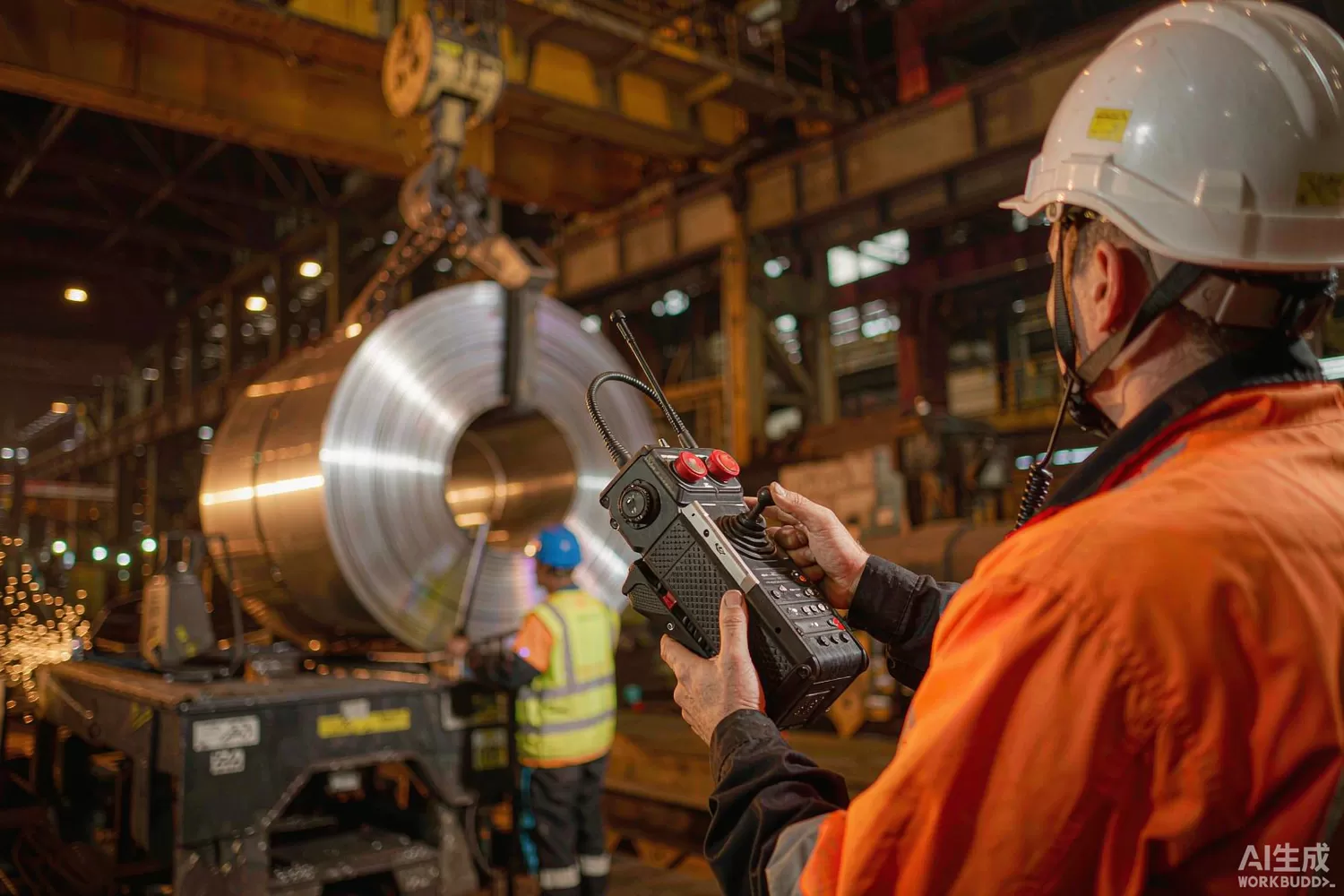
Walk along any steel plant, port or precast yard and you will find a worker holding a belt-pack transmitter, steering a 20-tonne hook with a thumb. That link is not a convenience feature. If it drops a command, stalls a stop, or accepts a command from a neighbouring transmitter, the consequence is measured in injuries rather than in returned units. The electronics inside look modest — a microcontroller, a sub-GHz transceiver, a battery — yet the design rules behind them are closer to industrial safety engineering than to consumer wireless. This article walks the signal chain of an industrial radio remote control, explains what the newest safety standards and proportional controls are pushing onto the radio, and screens domestic transceiver candidates against the imported parts that dominate today’s belt packs. For the raw chip-selection view, our sub-1 GHz transceiver guide covers the catalogue side.

Application logic: the control loop is the product
A remote control system is a closed loop with a hard real-time floor:
- Command encoding — joystick and switch states are sampled, checked for plausibility and packed into a frame with a rolling sequence number and a transmitter identity. The encoding is proprietary but the requirement is universal: a frame must never be mistakable for a frame from another transmitter.
- Radio transport — the frame leaves over a narrowband sub-GHz carrier, typically 433 MHz or 868/915 MHz, hopping across a channel list. Narrowband is chosen for sensitivity and for coexistence with the dense 2.4 GHz traffic already present in factories.
- Receiver and watchdog — the receiver validates identity and freshness, then drives two independent output channels. If a valid frame does not arrive within the watchdog window, typically 100 to 250 ms, both channels drop to the safe state.
- Output stage — relay or solid-state outputs feed the machine’s safety circuit. The radio does not switch power directly; it tells a safety controller what the operator asked for, and the controller decides.
- Feedback path — modern systems send load, limit, battery and fault data back to a display on the belt pack. That turns a one-way link into a bidirectional one and doubles the radio’s duty cycle.
- Power — two AA cells or a rechargeable pack must last a shift or a week. Average current, not peak current, is the specification that decides whether the product is usable.
The parameters that decide a link you can certify
- End-to-end latency — from stick movement to output change, 100 ms is a practical ceiling for precise positioning work; above that the operator starts overshooting and the machine feels vague.
- Watchdog behaviour — the timeout must be short enough to stop a runaway and long enough to survive a burst of interference. The receiver’s timing source therefore has to be independent of the radio link.
- Hopping agility — synthesizer settling time decides how fast the link can leave a jammed channel. A transceiver with a slow PLL cannot implement a fast hop list, no matter what the firmware does.
- Sensitivity and blocking — a receiver that hears −118 dBm in the datasheet but desenses next to a welding inverter is the wrong receiver. Blocking and selectivity figures at close-in offsets matter more than the headline number.
- Antenna inside a metal housing — the belt pack is a plastic shell full of hand and body; the receiver sits in a steel cabinet. Both ends need matching that survives being detuned, which usually means measuring efficiency in the real enclosure.
- Dual-channel independence — safety architects expect two processors or at least two independent paths. The radio only has to deliver a trustworthy frame; the redundancy lives downstream, and mixing the two up is a classic certification failure.
What is changing: proportional control, dual band and safety-rated silicon
Three shifts are visible in current designs. First, proportional control: hall-effect joysticks with dual redundant outputs replaced mechanical switches, so the frame now carries 8 to 12 bits per axis and the radio must deliver them at a steady rate rather than on change. Second, dual-band links: a 2.4 GHz channel alongside the sub-GHz carrier gives video or high-rate feedback, but it also introduces coexistence problems inside the same enclosure, and it does not replace the sub-GHz path for safety commands. Third, safety-rated building blocks: watchdogs, plausibility checks and certified relay drivers are moving into dedicated silicon, and the radio transceiver is increasingly expected to report link quality and error counters that a safety controller can consume. A newer trend worth watching is remote diagnostics: belt packs that log link quality and battery ageing let a fleet operator replace a degrading unit before it strands a shift.
Domestic alternatives: suppliers and indicative cost
The imported anchors are narrowband transceivers such as TI’s CC1125, Analog Devices’ ADF7023 and Semtech’s SX1231 class, with complete belt-pack systems dominated by European makers. Domestic supply is strongest at the transceiver and MCU level. HOPERF (Shenzhen) publishes a sub-1 GHz transceiver family, the CMT2300A being the best-known member, covering roughly 140 to 1020 MHz with a narrowband-oriented feature set and a low standby current. Shanghai Panchip’s PAN3028 family targets sub-GHz links with an integrated PA and is widely used in industrial telemetry. For the control MCU, Artery’s AT32F425 gives Cortex-M4 performance with the timers and dual ADC paths proportional joysticks need. What domestic supply does not yet offer off the shelf is a certified safety protocol stack: the encoder, watchdog and dual-channel architecture are yours to qualify, and any claim about a domestic part must be tested on your own link, not inferred from a datasheet.
A realistic transmitter BOM: an Artery AT32F425C8T7 as the control and encoding MCU, a HX2001 low-quiescent LDO for the always-on rail, a GD25Q32CSIG for configuration and log storage, and a TS2502PN array on the exposed keypad and charging contacts. Battery monitoring can use a LM393SR comparator pair instead of an ADC channel. Our standby current article covers the always-on rail budget in detail.
Price figures below are indicative public-market reference ranges for moderate volumes, compiled from publicly observable listings. They fluctuate with the spot market, package option, grade (industrial, automotive, screened) and order quantity, and must not be read as a quotation. Ask us for a firm price on your exact part numbers and quantities.
| Function (imported anchor) | Example import part / class | Indicative import price (USD) | Domestic candidate | Indicative domestic price (USD) |
|---|---|---|---|---|
| Narrowband sub-GHz transceiver | TI CC1125 class | 2.5 – 4.5 | HOPERF CMT2300A class | 0.45 – 1.00 |
| Sub-GHz transceiver with integrated PA | ADI ADF7023 class | 2.8 – 5.0 | Panchip PAN3028 family (family level) | 0.70 – 1.40 |
| Sub-GHz SoC (radio + MCU) | Imported sub-GHz SoC | 3.0 – 6.0 | HOPERF CMT series SoC families (family level) | 1.00 – 2.20 |
| Control and encoding MCU | STM32-class Cortex-M4 | 1.5 – 3.5 | AT32F425C8T7 (Artery) | 0.50 – 1.20 |
| Ultra-low quiescent LDO | Imported 1 uA-class LDO | 0.15 – 0.40 | HX2001 (Hexin) | 0.03 – 0.12 |
| Configuration NOR flash | 32 Mbit serial NOR | 0.35 – 0.80 | GD25Q32CSIG (GigaDevice) | 0.10 – 0.30 |
| Keypad / charging-contact ESD | Imported TVS array | 0.15 – 0.45 | TS2502PN (Titan Micro) | 0.03 – 0.12 |
| Battery threshold comparator | Imported dual comparator | 0.12 – 0.35 | LM393SR (Cosine) | 0.03 – 0.10 |
Where the cost difference actually comes from
The tempting reading of the table is that a domestic radio cuts the bill of materials by half. The honest reading is narrower: the transceiver is perhaps 8 to 15 percent of a belt-pack BOM, so halving it moves the unit cost by under a tenth. What moves the cost is the certification and validation effort around it. A functional-safety assessment, an EMC re-test and a field trial on real machines dominate the programme. That is why the domestic part earns its place fastest in cost-sensitive, high-volume categories — hoists, small telehandlers, agricultural implements — where the safety architecture is already proven and only the radio changes. In high-reliability categories, the imported transceiver’s documented long-term behaviour and second-source history is worth more than its price difference, and the pragmatic strategy is to keep two qualified radios in parallel rather than to chase the cheapest one.
Validation flow before you commit
Start with the link budget in the real enclosure, not on a dev board: measure radiated power and sensitivity with the transmitter in a gloved hand and the receiver in its steel cabinet. Then stress the watchdog: inject packet loss and confirm the outputs reach the safe state within the specified time, every time. Run a coexistence test with a welding inverter, a VFD and a Wi-Fi access point within a metre, and log the error counters rather than eyeballing the machine. Finally, run a two-week shift trial with real operators and record stop-command latency and re-link behaviour after power cycling, because those two numbers decide whether the product is trusted on the floor.
Frequently asked questions
Can a domestic sub-GHz transceiver replace the imported one without requalification?
No. The radio is part of a safety-related control path; any change of transceiver requires the same link, watchdog and EMC evidence as a new design, even if the electrical interface is identical.
Is 2.4 GHz acceptable for the safety commands?
Rarely on its own. Its shorter wavelength and crowded spectrum make it more sensitive to body shadowing and interference; most designs keep sub-GHz for commands and use 2.4 GHz for video or high-rate feedback.
How long should the watchdog be?
Short enough to stop the machine before the operator loses control, long enough to survive a burst of interference. The value comes from the machine’s stopping distance, not from the radio datasheet.
Do domestic parts support frequency hopping?
The transceivers support channel switching and fast PLL settling, but the hop engine and its timing are implemented in your firmware. Verify settling time and channel-switch latency on your own board.
About us & trademarks: JTDZ Tech (Shenzhen Jingteng Electronics Technology Co., Ltd.) is an independent distributor of electronic components. We are not an authorised distributor or representative of the imported manufacturers named in this article. Manufacturer, brand and part names are used for identification purposes only; all trademarks remain the property of their respective owners. Cross-reference information in this article is based on publicly available sources, is subject to change, and is not a substitute for your own engineering validation. Always verify specifications against the manufacturer's datasheet before design-in or purchase.
